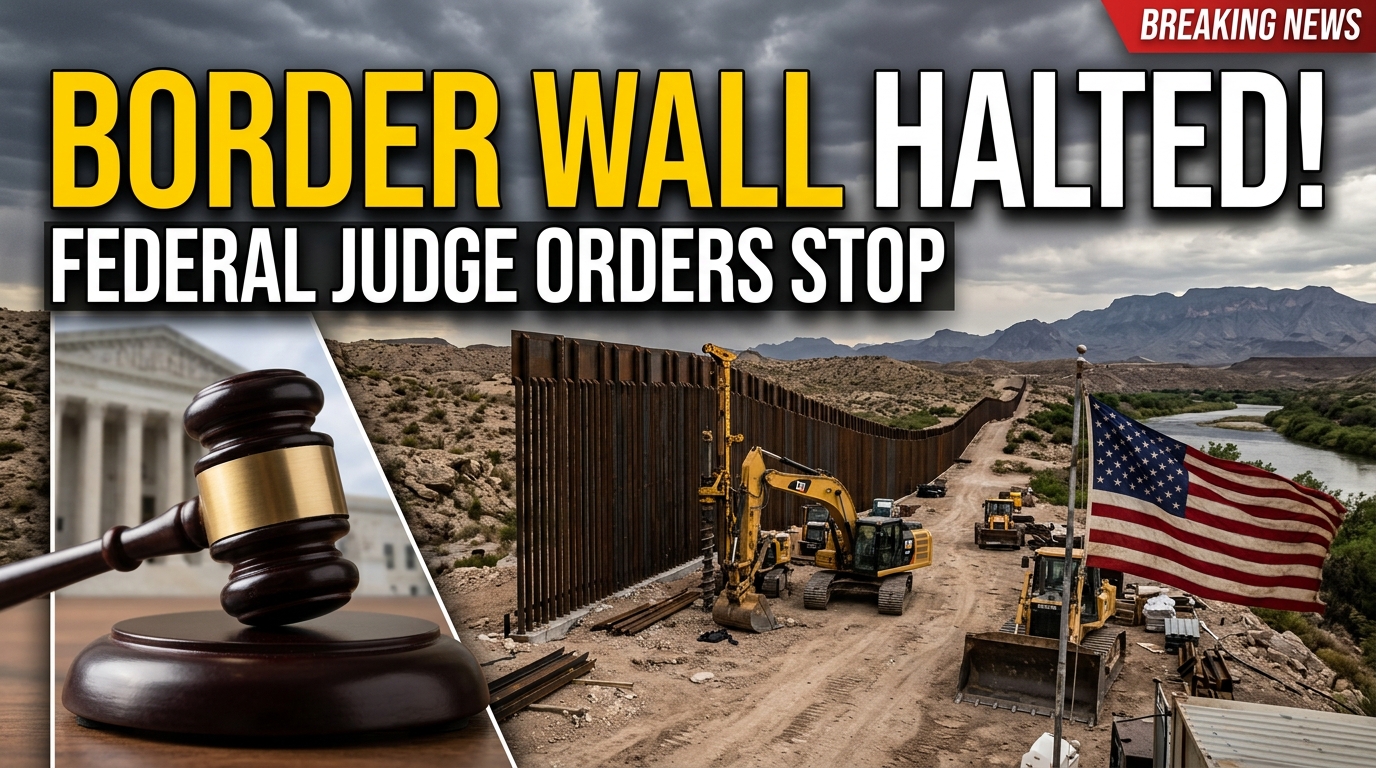
Federal Judge Halts Big Bend Border Wall Construction: Full Legal Breakdown
A sudden and significant legal roadblock has just altered the trajectory of the United States’ southernmost infrastructure project. A federal judge in Texas has issued a temporary injunction effectively halting all ongoing construction of the border wall in the Big Bend region. This judicial intervention deals a considerable blow to the Trump administration’s stringent immigration and border security agenda, pausing a cornerstone project that has sparked intense national debate.
Also read:
G7 Emergency Oil Reserves: 100 Million Barrels Released
The ruling does more than just park bulldozers and silence construction crews; it reignites a complex battle over executive authority, environmental preservation, and private land rights in one of America’s most rugged and ecologically sensitive landscapes. Here is a comprehensive look into the ruling, the affected region, and what this means for the future of U.S. border policy.
The Big Bend Border Wall Project: An Overview
To understand the magnitude of this injunction, one must first look at the geography of the Big Bend region. Located in West Texas, Big Bend National Park and its surrounding areas form a massive, sweeping curve along the Rio Grande. For decades, the natural topography of the land—characterized by steep limestone canyons, vast deserts, and unpredictable river currents—served as a natural deterrent to undocumented crossings.
When the Trump administration accelerated its plans to construct a continuous physical barrier along the U.S.-Mexico border, Big Bend presented a unique logistical nightmare. Unlike the flat, urbanized borders of El Paso or San Diego, building a massive steel bollard wall through the Chihuahuan Desert requires billions of dollars in specialized engineering, explosive blasting through bedrock, and the construction of new roads just to get heavy machinery into the area.
Despite these extreme challenges, the administration prioritized closing the “gaps” in the Texas border infrastructure. Contracts were awarded, funding was reallocated from military budgets, and preliminary ground clearing had begun—until the gavel came down in federal court.
Understanding the Federal Injunction in Texas
A temporary injunction is not a final ruling, but it is a powerful legal mechanism used to maintain the “status quo” while a broader lawsuit is fully litigated in court. In this instance, plaintiffs—which often include a coalition of environmental organizations, local landowners, and civil rights groups—argued that proceeding with construction would cause irreparable harm before the court could properly evaluate the legality of the project.
The Legal Arguments
The federal judge’s decision to halt construction hinges on several key arguments brought forward by the plaintiffs:
Funding Mechanisms: A primary point of contention in border wall litigation has been the executive branch’s use of emergency declarations to divert funds originally appropriated by Congress for the Department of Defense. The courts are currently scrutinizing whether this circumvents the constitutional “power of the purse” held exclusively by the legislative branch.
Environmental Waivers: To expedite construction, the Department of Homeland Security (DHS) frequently utilized the REAL ID Act to waive dozens of bedrock environmental laws, including the Clean Water Act, the Endangered Species Act, and the National Environmental Policy Act (NEPA). The lawsuit challenges the sheer scope of these waivers.
Eminent Domain and Land Rights: Unlike border states further west, the vast majority of border land in Texas is privately owned. The federal government’s aggressive push to seize generational ranches and family-owned properties via eminent domain has faced fierce pushback from Texas landowners.
By granting the injunction, the judge acknowledged that if construction were allowed to continue, the damage to the land, wildlife, and property rights could not be undone, even if the plaintiffs eventually won the overarching lawsuit.
Impact on the Trump Administration’s Agenda
This ruling acts as a massive speed bump for a flagship policy of the Trump administration. The promise to build a comprehensive border wall was the defining theme of Donald Trump’s initial presidential campaign and has remained a highly visible metric of his administration’s success among his political base.
Disrupted Timelines
Infrastructure projects of this scale operate on strict, multi-year timelines. A temporary injunction forces contractors to demobilize their crews, halt supply chain deliveries, and leave machinery idle. Even if the administration successfully appeals the injunction in a few months, the delay pushes the completion date significantly further down the calendar, likely past crucial political deadlines and election cycles.
The Legal Precedent
This ruling adds to a growing patchwork of judicial decisions across different districts regarding border security projects. While the administration has seen some victories at the Supreme Court level allowing certain segments of the wall to proceed, local injunctions like the one in Big Bend force the Department of Justice (DOJ) to continuously fight protracted, costly legal battles on multiple fronts.
Environmental and Local Community Reactions
The immediate reaction to the judge’s order has been sharply divided, reflecting the deeply polarized nature of border politics in Texas.
For environmentalists, the injunction is a massive, albeit temporary, victory. Big Bend is one of the most biologically diverse desert regions in the world. A continuous, impenetrable steel wall would sever vital migratory corridors for dozens of species, including the endangered Mexican black bear, the ocelot, and the desert bighorn sheep. Furthermore, constructing a wall in a floodplain like the Rio Grande valley risks acting as a dam during heavy rains, potentially causing catastrophic flooding and soil erosion on both sides of the river.
Local residents and landowners have also breathed a sigh of relief. Many generational ranchers in West Texas have fiercely opposed the wall, not necessarily out of political ideology, but because a physical barrier would cut them off from their only water source (the river) or result in their ancestral lands being seized by the federal government.
Conversely, proponents of the wall, including local border patrol unions and some county officials, view the injunction as a dangerous vulnerability. They argue that as other sections of the border are secured, human trafficking and cartel smuggling operations are naturally funneled into the remote, less-protected stretches of Big Bend, putting local law enforcement and isolated residents at immense risk.
Legal Battles Ahead: What Happens Next?
The halt is temporary, and the legal war is far from over. The immediate next step is highly predictable: The Department of Justice will almost certainly file an emergency appeal with the Fifth Circuit Court of Appeals, seeking to overturn the lower court’s injunction.
The Fifth Circuit is widely considered one of the most conservative appellate courts in the country, meaning the administration has a viable path to getting the injunction lifted. If the appellate court sides with the plaintiffs, however, the DOJ’s only remaining recourse would be to elevate the case to the United States Supreme Court.
Until the higher courts weigh in, the heavy machinery in Big Bend will remain silent. The ultimate fate of this stretch of the border wall will be decided not by engineers or politicians, but by the slow, deliberate grind of the American judicial system.
Conclusion
The federal injunction halting border wall construction in Big Bend is a quintessential example of the checks and balances inherent in the U.S. government. It highlights the fierce tension between sweeping executive action aimed at national security and the meticulous judicial review designed to protect constitutional procedures, environmental integrity, and private property rights. As the Trump administration fights to preserve its signature policy, the outcome of this specific Texas legal battle will likely set a lasting precedent for how future large-scale federal projects are funded and executed on American soil.
Frequently Asked Questions (FAQs)
1. What exactly does a “temporary injunction” mean in this context? A temporary injunction is a court order that forces a party to stop a specific action—in this case, building the border wall—until a full trial or legal review can be completed. It does not mean the wall is permanently canceled, only that construction is paused while the courts figure out if the project is legally sound.
2. Why is building a wall in Big Bend so controversial compared to other areas? Big Bend is characterized by extreme, rugged terrain and serves as a highly protected national park area. It is ecologically vital, and a physical wall threatens to destroy wildlife corridors and disrupt the natural flow of the Rio Grande. Additionally, the sheer engineering cost of building in this remote bedrock is astronomically high.
3. Will the Trump administration appeal the judge’s decision? Yes. It is standard legal procedure for the Department of Justice to immediately appeal federal injunctions that halt executive branch initiatives. The appeal will likely go to the Fifth Circuit Court of Appeals.
4. How does this impact private landowners in Texas? Unlike federal lands out West, most border land in Texas is privately owned. The injunction temporarily halts the government’s ability to seize this land through eminent domain or alter the landscape of privately owned ranches that sit along the river.
5. How long will the construction be paused? The pause will last until a higher court (like the appellate court or the Supreme Court) overturns the injunction, or until the original lawsuit reaches a final verdict. This could take anywhere from a few weeks to several years.
Trusted References & Source Links
(Note: Stay updated on ongoing border wall litigation through these authoritative legal and news organizations)
The Associated Press (AP News): Comprehensive coverage of U.S. border policy and federal court rulings. apnews.com
Reuters: In-depth reporting on the Department of Justice appeals and executive branch legal battles. reuters.com
The Texas Tribune: Detailed local coverage on how border wall construction impacts Texas landowners, Big Bend ecology, and state politics. texastribune.org
American Civil Liberties Union (ACLU): Legal analysis and tracking of ongoing lawsuits regarding border wall funding and environmental waivers. aclu.org