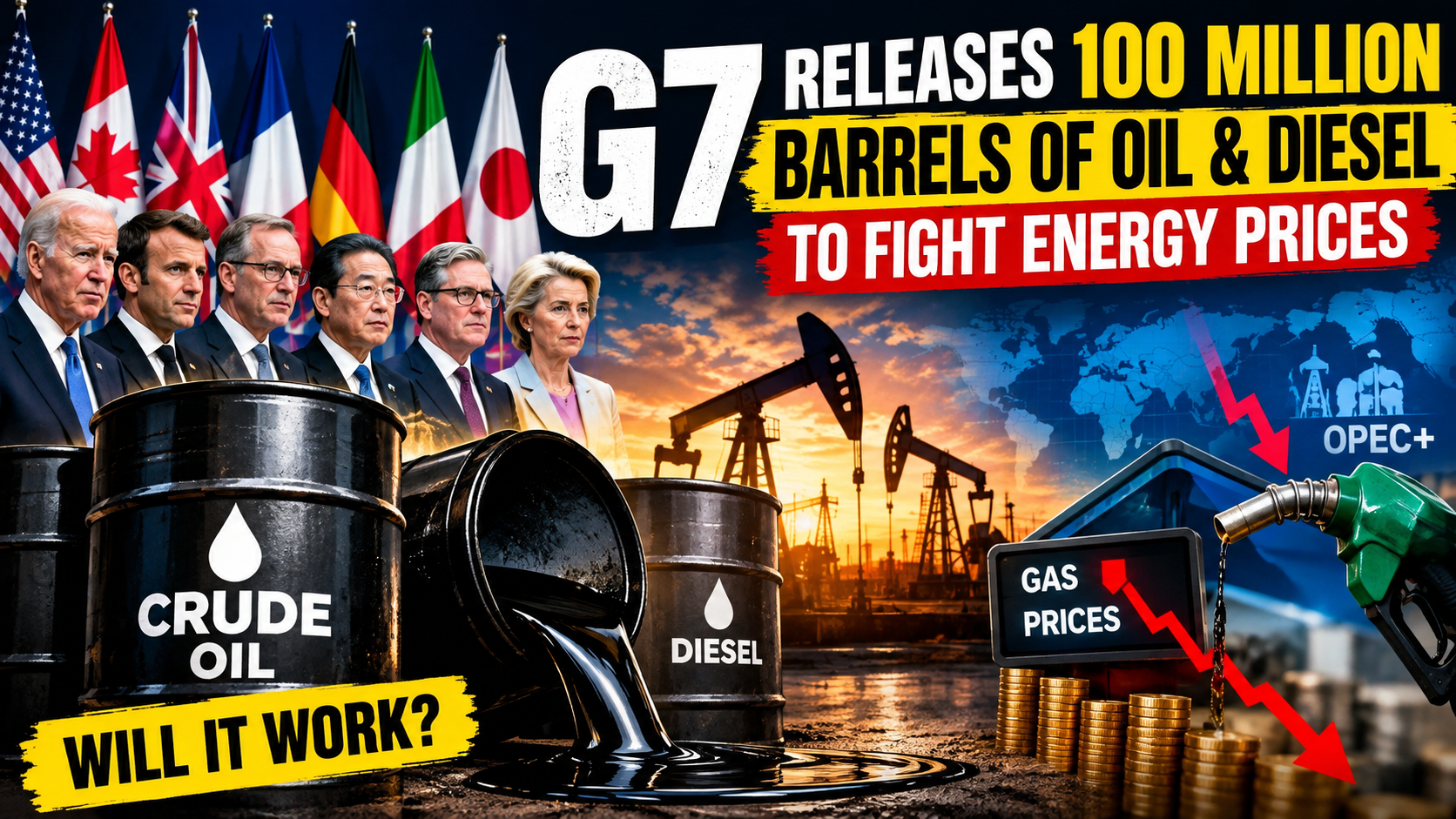
G7 Taps Emergency Oil Reserves: 100 Million Barrels Released to Fight Surging Energy Prices
Have you looked at your energy bills or the price at the pump lately? It’s not pretty. The world is dealing with a massive energy crunch, and the Group of Seven (G7) finally decided they couldn’t just sit on the sidelines anymore.
In a massive, coordinated effort, leaders from the world’s wealthiest democracies just pulled a major lever. They have officially authorized the release of 100 million barrels of crude oil and diesel fuel directly from their emergency stockpiles. They are rolling this out over the next four months.
But why now? And more importantly, is this actually going to make a dent in the inflation that’s eating away at everyone’s wallets? Let’s break down exactly what this historical move means for the global economy, the energy market, and your daily life.
The Breaking Point for Global Energy
To understand why the G7 is taking such drastic action, you have to look at what’s happening globally. The energy market has been an absolute rollercoaster lately. Geopolitical tensions, especially the ongoing conflicts and instability in the Middle East, have spooked investors and traders alike. Every time a major headline drops about a supply route being threatened, the risk premium on a barrel of oil shoots up.
It’s a classic supply and demand nightmare. The world relies heavily on consistent energy imports to keep things running. When supply looks shaky, prices go crazy. The G7—driven in large part by heavy lobbying from the United States—realized that if they didn’t step in, the soaring cost of fuel was going to trigger a severe economic slowdown. They had to flush the market with real, physical supply to stop the panic.
The Math Behind 100 Million Barrels
So, what does 100 million barrels actually look like? It sounds like a staggering amount of oil. And it is. But you also have to remember that the entire planet consumes over 100 million barrels of oil every single day.
If they dumped it all on the market tomorrow, it would be a drop in the bucket. That’s exactly why they aren’t doing that. The G7’s strategy is to release this stockpile steadily over a four-month period.
If you do the math, that averages out to about 833,000 extra barrels hitting the market daily for 120 days. That steady trickle is incredibly important. It’s enough to relieve the acute bottlenecks at refineries and shipping hubs without completely crashing the long-term market. The United States is pulling heavily from its Strategic Petroleum Reserve (SPR)—those massive underground salt caverns in Texas and Louisiana—while countries like Japan and European allies are unlocking their own domestic safety nets.
The Diesel Factor: Why It Matters So Much
Here is the part of this announcement that isn’t getting enough attention, but it is easily the most important: they are releasing refined diesel alongside crude oil.
Usually, emergency releases focus heavily on unrefined crude. You pump it out, sell it to refineries, and hope it eventually turns into cheaper gas. But right now, the world doesn’t just have an oil problem. We have a refining problem. There is a massive global shortage of middle distillates, which is industry jargon for things like diesel and jet fuel.
Think about it. Your car might run on gasoline, but the entire global economy runs on diesel. The trucks that deliver Amazon packages to your door run on diesel. The massive cargo ships bringing electronics from Asia run on diesel. The tractors harvesting wheat run on diesel.
When diesel prices spike, the cost of literally everything else goes up. A farmer pays more to harvest crops, the trucker pays more to haul them, and the grocery store passes all those extra costs directly onto you. By injecting refined diesel straight into the market, the G7 is trying to put an immediate band-aid on supply chain inflation. European countries, which rely heavily on diesel for manufacturing and transportation, basically demanded this inclusion to survive the winter without their industries grinding to a halt.
A High-Stakes Game of Poker with OPEC+
You can’t talk about oil without talking about OPEC+. The cartel, led heavily by Saudi Arabia and Russia, has spent the last year tightly controlling their production quotas. Their goal? Keep supply just tight enough so that prices stay high, boosting their own economies.
The G7’s decision to tap their reserves is essentially a giant middle finger to that strategy. It’s a direct market intervention. The G7 is trying to artificially lower the price ceiling, taking control away from the producers and giving it back to the consumers.
The big question now is how OPEC+ will react. Will they just sit back and watch Western nations drain their emergency piggy banks? Probably not. There is a very real risk that OPEC+ could decide to cut their daily production even further just to offset the G7’s extra barrels. If that happens, we are looking at a full-blown economic standoff.
Is This a Long-Term Fix?
Let’s be brutally honest: no. Tapping emergency reserves is a temporary fix. It buys time.
Strategic reserves exist for actual emergencies—think major hurricanes taking out Gulf Coast refineries, or a sudden war cutting off shipping lanes entirely. They aren’t meant to be used as a permanent tool to fight inflation. Eventually, the 100 million barrels will run out. And when they do, those G7 nations are going to have to buy oil off the open market to refill those reserves, which could ironically drive prices right back up later on.
But for right now? It’s exactly what the market needed to hear. The immediate reaction on Wall Street was a sharp drop in both Brent Crude and West Texas Intermediate (WTI) benchmark prices. It’s providing breathing room. The hope is that over the next four months, geopolitical tensions will cool down, and standard supply chains will catch up, meaning we won’t need to rely on emergency oil by the time the release schedule ends.
Conclusion
The decision by the G7 to release 100 million barrels of emergency oil and diesel isn’t just an economic policy; it’s a desperate play to keep the global economy from suffocating under the weight of energy inflation. By throwing 833,000 extra barrels into the mix every day for the next four months, they are buying precious time. It’s going to help truck drivers, farmers, and everyday consumers in the short term by cooling off out-of-control diesel and crude prices. But the clock is officially ticking. The world’s wealthiest nations just played one of their biggest cards, and now we just have to wait and see if the market actually stabilizes before the reserves run dry.
Frequently Asked Questions (FAQs)
What exactly is an emergency oil reserve? Emergency reserves are massive stockpiles of crude oil and refined fuel owned by national governments. They are meant to be a safety net. The US version is called the Strategic Petroleum Reserve (SPR), which stores millions of barrels of oil in deep underground salt caverns in Texas and Louisiana to be used during severe supply disruptions.
Will this announcement make gas prices go down right away? Yes and no. You won’t see a massive drop overnight at your local gas station, but the market reacts to the news instantly. Crude oil prices usually drop on the global market as soon as a reserve release is announced. It usually takes a few weeks for those wholesale savings to trickle down to the actual retail gas pumps.
Why is releasing diesel such a big deal? Because diesel controls the price of goods. If diesel is expensive, freight companies have to charge more to deliver food, clothing, and building materials. Releasing refined diesel directly into the market helps cut those shipping costs immediately, which is one of the fastest ways to fight everyday consumer inflation.
Can they just keep doing this if prices stay high? Not forever. By international agreement, G7 nations have to maintain a certain level of emergency supply (usually enough to cover 90 days of net imports). They can’t drain them to zero. Eventually, they have to stop selling and actually start buying oil to replace what they took out.
How does this affect OPEC? It puts pressure on them. OPEC wants to control the price of oil by limiting how much they pump out of the ground. When the G7 dumps 100 million barrels of their own saved oil into the market, it undermines OPEC’s control. It’s basically a tug-of-war between the people producing the oil and the people consuming it.
Official News Links & Trusted References
Yeni Şafak (2026): G7 to release 100M barrels from emergency oil reserves. Available at: https://en.yenisafak.com/economy/g7-to-release-100m-barrels-from-emergency-oil-reserves-3724065
Hürriyet Daily News (2026): G7 to release 100 million barrels from oil reserves. Available at: https://www.hurriyetdailynews.com/g7-to-release-100-million-barrels-from-oil-reserves-227643
Arab News (2026): G7 countries agree to release diesel and oil stocks after US pressure. Available at: https://www.arabnews.com/world/g7-countries-agree-to-release-diesel-and-oil-stocks-after-us-pressure-3004297
Helsinki Times (2026): G7 to release 100 million barrels of oil and diesel from emergency reserves. Available at: https://www.helsinkitimes.fi/world-int/29338-g7-to-release-100-million-barrels-of-oil-and-diesel-from-emergency-reserves.html