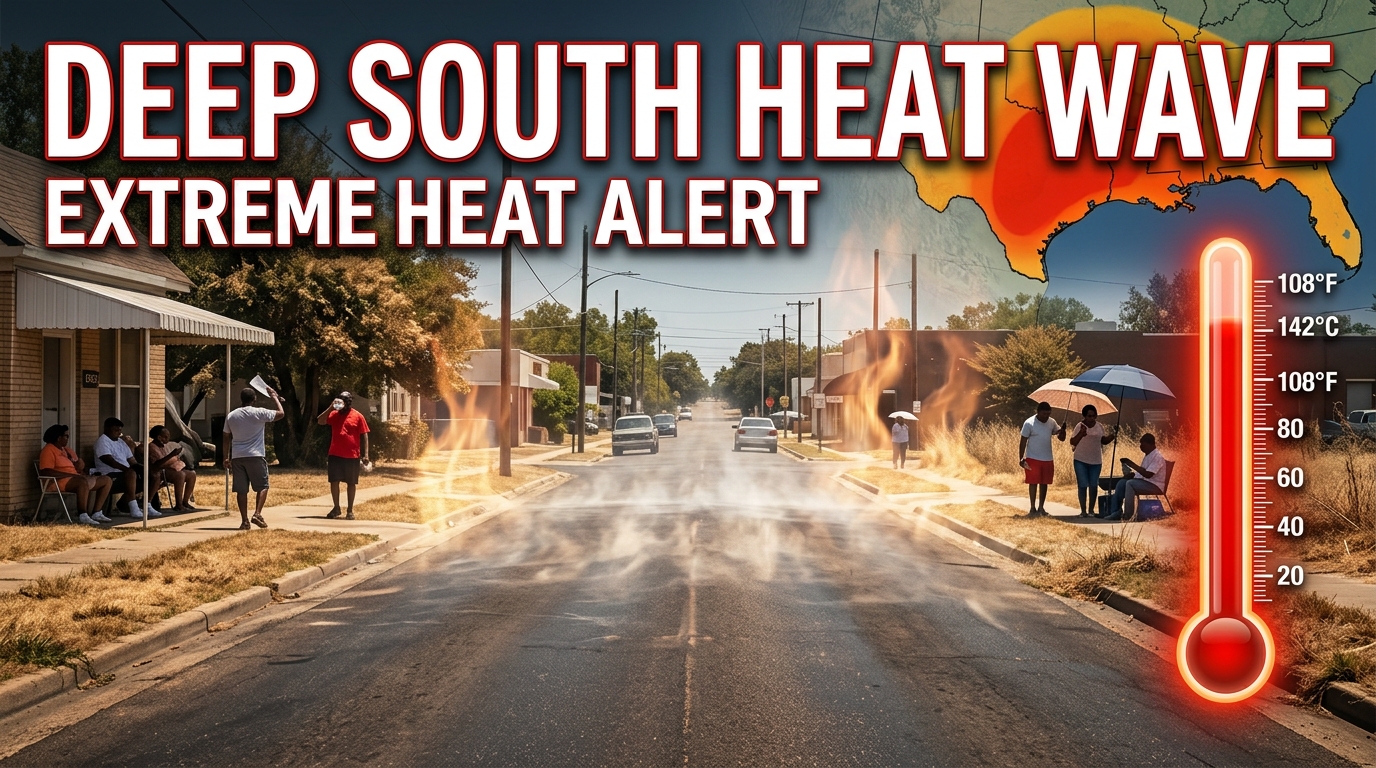
Deep South Heat Wave: Atmospheric Causes, Public Health Risks, and Long-Term Climate Solutions
The Deep South of the United States—a region historically accustomed to muggy summers—is facing an unprecedented escalation in extreme thermal events. Heat waves across states like Texas, Louisiana, Mississippi, Alabama, Georgia, Florida, and South Carolina are no longer mere midsummer inconveniences; they have evolved into prolonged, multi-week meteorological emergencies. Driven by high atmospheric pressure systems, warm ocean currents from the Gulf of Mexico, and a changing global climate, these extreme heat events push infrastructure, human physiology, and regional economies to their absolute limits.
Also read:
Global AI Market Growth & Size Forecast (2026–2035)
Understanding the mechanics of a Deep South heat wave requires examining a complex interplay of atmospheric science, geography, public health, and climate adaptation. As heat-related mortality continues to top the list of weather-related fatalities in North America, analyzing these events becomes essential for community survival and long-term resilience.
1. The Atmospheric Anatomy of a Deep South Heat Wave
Extreme thermal events in the Southeastern United States are rarely accidental or isolated. They are governed by specific atmospheric configurations that trap heat over vast geographical areas for extended periods.
The “Heat Dome” Mechanism
At the center of most severe Deep South heat waves lies a phenomenon known as a heat dome. A heat dome forms when a strong, static high-pressure ridge—often referred to as an upper-level anticyclone—parks itself over a region in the middle-to-upper atmosphere.
Sinking Air (Subsidence): High-pressure systems force air downward toward the Earth’s surface.
Compression Heating: As the descending air compresses under increasing atmospheric pressure, its temperature rises significantly (a process known as adiabatic heating).
Cloud Suppression: The sinking air prevents warm air from rising, effectively smothering the cloud formation that would normally offer shade or rainfall.
Solar Radiation Loop: With clear, cloudless skies, intense summer solar radiation strikes the ground unimpeded, continually heating the surface and the air directly above it.
This self-reinforcing cycle acts like a atmospheric pressure cooker lid, locking intense heat over the southern landmass while deflecting rain-bearing storm systems around its perimeter.
       [ UPPER-LEVEL HIGH PRESSURE RIDGE ]
                     |
                     V  (Sinking, Compressing Air)
           +--------------------+
           |   TRAPPED HEAT     |  <-- Suppressed Clouds &
           |   & MOISTURE       |      Continuous Solar Heating
           +--------------------+
    ~~~~~~~~~~~~~~~~~~~~~~~~~~~~~~~~~~~~~~~~
                 EARTH'S SURFACE
The Gulf Moisture Amplification
While heat waves in the American Southwest (such as Arizona or Nevada) are characterized by dry, desert heat, Deep South heat waves are defined by extreme, stifling humidity. The proximity of the Gulf of Mexico acts as a massive thermal reservoir and moisture generator.
Southerly wind patterns on the western edge of high-pressure systems transport warm, moisture-laden maritime air inland across the coastal plains. When high air temperatures combine with dew points exceeding 75°F (24°C) to 80°F (27°C), the resulting Heat Index—the human-perceived temperature—can easily climb into the 115°F to 125°F (46°C to 52°C) range.
2. Public Health Cascades: The Silent Danger
Heat waves kill more people annually in the United States than hurricanes, tornadoes, floods, and lightning combined. In the Deep South, where the humidity prevents natural cooling, heat stress becomes an immediate medical threat.
Physiology of Heat Illness and the Wet-Bulb Threshold
The human body cools itself primarily through sweat evaporation. However, when atmospheric humidity is extremely high, ambient air becomes saturated, reducing or completely halting the rate of evaporation from the skin.
Heat Exhaustion: Characterized by heavy sweating, rapid pulse, dizziness, fatigue, nausea, and muscle cramps. It indicates that the body’s thermoregulatory system is under severe strain.
Heat Stroke: A critical medical emergency occurring when core body temperature rises above 104°F (40°C). Symptoms include hot/red/dry skin or profuse sweating, confusion, loss of consciousness, and organ failure. Without immediate medical intervention, heat stroke is frequently fatal.
Medical experts increasingly monitor the Wet-Bulb Globe Temperature (WBGT), which measures heat stress in direct sunlight by accounting for temperature, humidity, wind speed, sun angle, and cloud cover. A WBGT reading exceeding 90°F (32°C) presents an extreme risk to working populations, athletes, and anyone outdoors, as physical exertion can rapidly lead to heat illness regardless of hydration levels.
Vulnerable Populations and Health Disparities
Extreme heat does not affect all populations equally. Deep South heat waves expose underlying social and economic vulnerabilities:
Outdoor Workers: Agricultural laborers, construction crews, utility workers, and roofers face direct, prolonged exposure.
Low-Income Communities: Families living in poorly insulated housing without central air conditioning or unable to afford high electric bills during extreme heat events face severe indoor heat exposure.
The Elderly and Medically Compromised: Older adults have a decreased ability to regulate body temperature and may take medications that impair fluid balance.
Urban Heat Island Inhabitants: Urban areas with low tree canopy coverage and dense concrete, asphalt, and brick experience temperatures up to 10°F to 15°F higher than neighboring rural regions.
3. Infrastructure and Economic Strain
The effects of a persistent Deep South heat wave extend beyond health, placing unprecedented stress on public infrastructure, energy grids, and regional economies.
Electrical Grids and Power Demand
During a heat wave, air conditioning units operate continuously across millions of homes, commercial buildings, and industrial facilities. This creates record-breaking peak demand on regional power grids, such as the Electric Reliability Council of Texas (ERCOT) or the Midcontinent Independent System Operator (MISO).
Transformer Overheating: High nighttime temperatures prevent electrical transformers from cooling down overnight, leading to equipment failure and localized brownouts or blackouts.
Rolling Blackouts: Grid operators may be forced to implement controlled outages to prevent complete grid collapse when power demand exceeds generation capacity.
Transportation and Built Environment
Extreme ambient heat physically alters construction materials:
Road Buckling: Asphalt softens and concrete pavement slabs expand and buckle under sustained high temperatures, creating hazards for highway traffic.
Rail Sun Kinks: Steel railway tracks expand under extreme heat, causing them to warp or bend sideways (“sun kinks”), forcing trains to operate at reduced speeds to prevent derailments.
Agricultural Stress and Water Systems
Agriculture across the Deep South—including cotton, poultry, timber, livestock, and crop production—suffers heavy losses during extreme heat events.
| Sector | Primary Impact | Secondary Consequence |
| Livestock & Poultry | Thermal stress, reduced feeding rates | Higher mortality, lower meat/dairy yields |
| Row Crops (Corn, Soy) | Pollination disruption, rapid soil drying | Reduced crop yield, early crop death |
| Water Supply | Increased evaporation rates in reservoirs | Water use restrictions, municipal strain |
| Aquaculture (Catfish/Shrimp) | Decreased dissolved oxygen in ponds | Fish kills, increased disease susceptibility |
4. Nighttime Temps: The Missing Cooling Window
One of the most dangerous, often overlooked features of Deep South heat waves is elevated nighttime low temperatures. Historically, atmospheric radiation allowed ground temperatures to drop after sunset, providing the human body and built infrastructure a crucial cooling recovery window.
Due to elevated atmospheric humidity and greenhouse gas concentrations, heat remains trapped near the surface throughout the night. When nighttime low temperatures fail to drop below 80°F (27°C), the body remains under continuous heat stress. Epidemiological studies demonstrate that the highest spikes in heat-related emergency room visits and mortality occur during multi-day heat waves featuring unusually high nighttime lows.
5. Climate Change Connection: The New Baseline
Atmospheric scientists and climate researchers emphasize that while heat waves are naturally occurring weather events, anthropogenic climate change acts as a force multiplier.
+-----------------------------------------------------------------------+
|                       GLOBAL CLIMATE CHANGE                           |
|  - Higher Baseline Temperatures                                       |
|  - Increased Ocean Warming (Gulf of Mexico)                           |
|  - Meandering, Sluggish Jet Stream Patterns                           |
+-----------------------------------------------------------------------+
                                   |
                                   V
+-----------------------------------------------------------------------+
|                    DEEP SOUTH HEAT WAVE AMPLIFICATION                 |
|  - Increased Frequency: More heat waves per decade                    |
|  - Greater Intensity: Higher peak temperatures & Heat Indices        |
|  - Longer Duration: Systems remain stagnant for longer periods       |
+-----------------------------------------------------------------------+
Data from the National Oceanic and Atmospheric Administration (NOAA) indicates that the frequency of heat waves in major Southern metro areas—such as Houston, Atlanta, New Orleans, and Miami—has tripled since the 1960s. Furthermore, warming ocean waters in the Gulf of Mexico pump higher volumes of water vapor into the air, ensuring that heat waves in the region become progressively more humid over time.
6. Adaptation, Emergency Management, and Mitigation Strategies
Coping with intensified heat waves requires a dual approach: immediate emergency response and long-term urban adaptation.
Immediate Safety Guidelines
During extreme heat advisories and excess heat warnings:
Maintain High Hydration: Drink water continuously, avoiding excessive caffeine or alcohol which accelerate dehydration.
Limit Outdoor Activity: Avoid strenuous outdoor activities between 10:00 AM and 6:00 PM when solar intensity and heat index values peak.
Utilize Cooling Centers: Cities across the South increasingly open air-conditioned public centers in libraries, recreation hubs, and community facilities for vulnerable residents.
Check on Neighbors: Perform routine wellness checks on elderly, isolated, or outdoor-working neighbors and family members.
Urban and Structural Adaptation
To lessen the impact of future heat waves, southern municipalities are implementing structural changes:
Urban Tree Canopies: Planting native shade trees in dense urban centers to mitigate the Urban Heat Island effect and reduce surface temperatures by up to 20°F (11°C).
Cool Roofs and Pavements: Installing reflective roofing materials and high-albedo cool pavements that reflect rather than absorb solar radiation.
Parametric Heat Emergency Planning: Establishing official heat officer roles, designated heat danger tiers, and automated alert systems to safeguard outdoor workforce populations.
Frequently Asked Questions (FAQs)
Q1: Why are heat waves in the Deep South more dangerous than heat waves in dry desert climates?
Deep South heat waves carry exceptionally high humidity levels driven by moist air from the Gulf of Mexico. High humidity prevents sweat from evaporating off human skin, which is the body’s primary natural cooling mechanism. This creates dangerously high “feels-like” temperatures (Heat Index) and significantly accelerates the onset of heat-related illnesses like heat exhaustion and heat stroke.
Q2: What is the difference between a Heat Advisory and an Excessive Heat Warning?
A Heat Advisory is issued by the National Weather Service when the Heat Index is expected to reach 100°F to 105°F (38°C to 41°C) for at least two consecutive hours. An Excessive Heat Warning is issued when the Heat Index is forecast to exceed 105°F to 110°F (41°C to 43°C) or higher, posing a severe and life-threatening risk to anyone without adequate cooling.
Q3: What is a “Heat Dome” and how long can it last?
A heat dome is a large, static system of high atmospheric pressure that traps warm air beneath it, repels clouds, and prevents rain storms. Because high-pressure ridges can become stationary or “blocked” by surrounding atmospheric wave patterns, heat domes can hover over a region anywhere from several days to several weeks.
Q4: Why are rising nighttime temperatures during a heat wave so dangerous?
When nighttime temperatures remain elevated (often above 80°F / 27°C), the body cannot recover from daytime thermal strain. This continuous exposure dramatically increases physiological stress, particularly for vulnerable populations without access to air conditioning, leading to higher rates of hospitalization and mortality.
Q5: What should I do if someone shows signs of heat stroke?
Heat stroke is a severe medical emergency. Immediately call 911. While waiting for emergency responders, move the person to a cool, shaded area, remove excess clothing, and cool them rapidly using ice packs on the neck, armpits, and groin, or spray them with cold water while fanning them. Do not force them to drink fluids if they are confused or unconscious.
Conclusion
Deep South heat waves represent one of the most immediate and severe climate challenges facing the United States today. Driven by atmospheric heat domes and fueled by humid air from the Gulf of Mexico, these events test the boundaries of human endurance, energy grid stability, and regional agriculture. As global temperatures continue to rise, addressing the threat of extreme heat requires a combined commitment to public health education, equitable cooling access, infrastructure upgrades, and long-term climate resilience initiatives across Southern communities.
Official Resources & Trusted Scientific Links
National Oceanic and Atmospheric Administration (NOAA): NOAA Heat Safety and Warnings Information
Centers for Disease Control and Prevention (CDC): CDC Extreme Heat and Public Health Guidance
U.S. Environmental Protection Agency (EPA): EPA Climate Indicators: Heat Waves
National Aeronautics and Space Administration (NASA): NASA Global Climate Change and Extreme Weather Data