US Treasury Yields & Market Outlook 2026: Navigating the 5% Era and Fed Rate Hikes
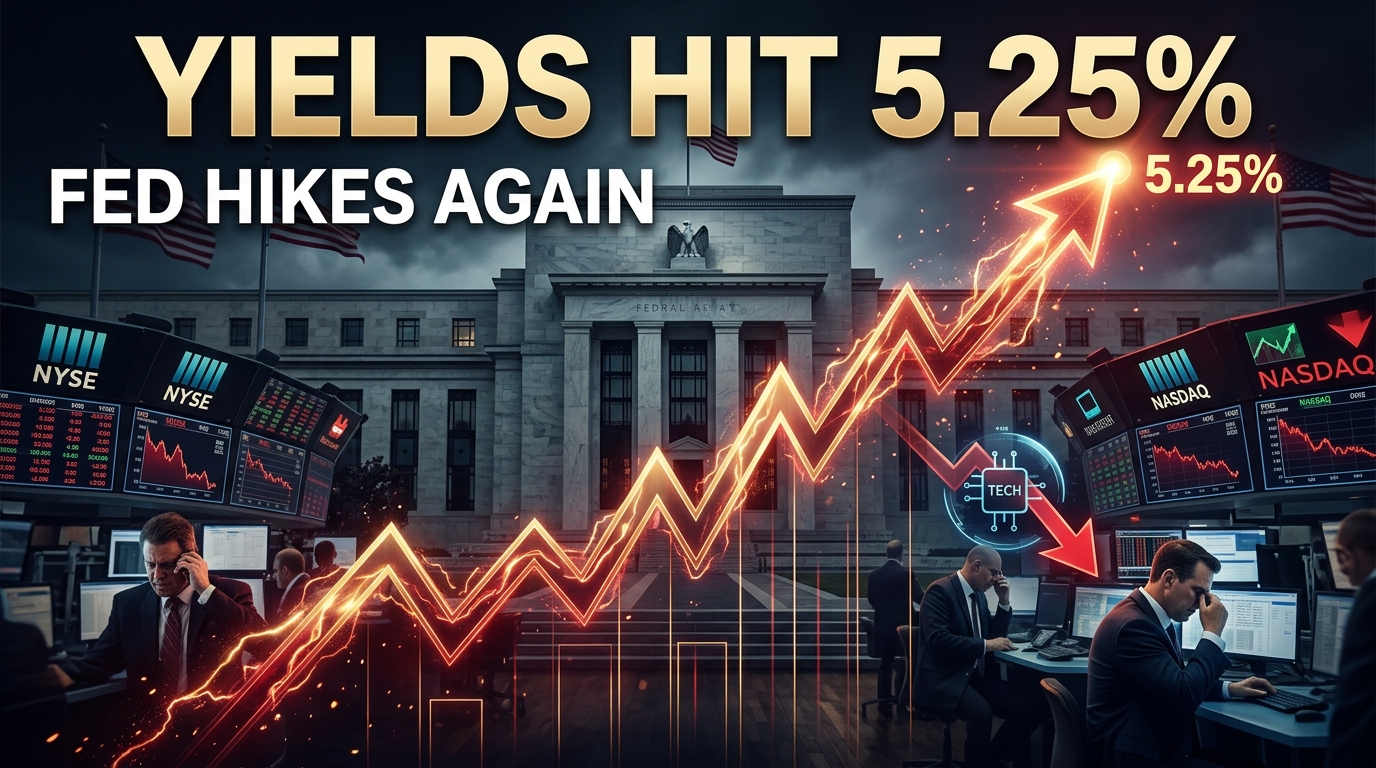
US Treasury yields have reclaimed their position as the focal point of global financial markets in late 2026, demanding a strategic recalibration from institutional allocators and retail investors alike. With the benchmark 10-year Treasury note pushing past the psychological 5.25% threshold in late September, the fixed-income landscape is fundamentally re-pricing risk, macroeconomic growth, and federal policy expectations. This elevated rate environment—characterized by long-term yields hitting near-20-year highs—forces a profound reassessment of equity valuations, corporate funding costs, and portfolio duration management as we head into the final quarter of the year.
Also read:
RAF Fairford Terror Arrests: 5 Men Released on Bail
The 2026 Federal Reserve Shift: A Surprising Rate Hike
Entering 2026, consensus expectations heavily favored a sustained easing cycle and aggressive rate cuts. However, resilient economic expansion and structurally sticky inflation forced the central bank to execute a hawkish pivot. In September 2026, the Federal Reserve under Chairman Kevin Warsh raised the federal funds target rate by 25 basis points to a range of 3.75% to 4.00%.
The central bank’s decision prioritized price stability over monetary easing, acknowledging that while core PCE and CPI inflation hover near 2.9% and 3.1% respectively, these metrics remain uncomfortably above the Fed’s long-term 2% mandate. The September Federal Open Market Committee (FOMC) meeting and its accompanying Dot Plot revealed a wider, more cautious distribution of future rate paths. Policymakers now expect the federal funds rate to decline at a much slower pace than previously anticipated, aiming for a longer-run neutral rate of approximately 3.25%. This explicit acknowledgment that inflation requires tighter monetary policy has decisively shattered the market’s “lower for longer” interest rate assumptions.
Yield Curve Dynamics: The 10-Year Breaches 5.25%
The most pronounced market development of late 2026 is the rapid steepening and un-inversion of the Treasury yield curve. For much of the post-pandemic recovery era, markets operated under a severely inverted yield curve, traditionally viewed as a reliable recessionary harbinger. However, by late September 2026, the 10-year Treasury yield surged to 5.24%, while the 2-year note settled near 4.85%.
This positive spread indicates a normalized, aggressively steepening curve. Unlike standard steepening driven by near-term rate cuts (bull steepening), this environment is characterized by “bear steepening,” where long-term rates rise faster than short-term rates. Prediction markets and institutional derivatives currently assign a 64% probability that the 10-year Treasury will close 2026 comfortably above 5.25%, with heavy conviction clustered around the 5.0% to 5.5% range rather than reverting to extreme lows.
Key Drivers Behind Soaring Long-Term Yields
Several distinct macroeconomic and structural tailwinds are driving this aggressive re-pricing at the long end of the curve:
Fiscal Deficits and Treasury Issuance: Structural U.S. fiscal deficits continue to require massive debt issuance, flooding the primary dealer network with supply. To counter localized illiquidity and stabilize the market architecture, the U.S. Treasury Department expanded its bond buyback program for longer-maturity Treasuries in August 2026. Despite these liquidity injections, the sheer volume of issuance demands higher yields to attract buyers.
Resilient Macroeconomic Data: U.S. GDP growth is tracking at a robust 2.0% for the calendar year. Corporate earnings remain resilient, and consumer spending has not fractured under the weight of previous tightening cycles. Because the economy is comfortably absorbing 4.00% short-term rates, the bond market has aggressively priced out the necessity for emergency recessionary rate cuts.
Geopolitical and Capital Competition: Sovereign debt markets are facing intense global competition for capital. Shifting geopolitical alliances, deglobalization trends, and shifting foreign exchange reserves require the U.S. Treasury to offer a higher term premium to attract and retain foreign institutional buyers.
Equity Market Outlook: The Value Rotation
Higher discount rates typically pressure long-duration assets, notably growth-oriented technology stocks whose valuations rely heavily on earnings projected far into the future. However, the broader equity market outlook remains constructively bullish, heavily contingent on corporate earnings execution.
Analysts project potential double-digit corporate earnings growth in the year ahead, providing a fundamental floor for equities despite the 5.25% risk-free rate. Furthermore, the anticipated extension of the 2017 Tax Cuts and Jobs Act guarantees a favorable corporate tax environment, effectively shielding net margins from legislative drag.
Because of these dynamics, the market is undergoing a structural rotation toward large-cap value stocks. Value equities—characterized by strong current cash flows, robust balance sheets, and immediate dividend payouts—are inherently less sensitive to long-term interest rates. With comparative valuations representing near-historic discounts against growth stocks, large-cap value is uniquely positioned to experience a multi-year cycle of outperformance.
Strategic Fixed Income Positioning
Fixed-income allocations demand a highly tactical approach heading into 2027. With short-term rates anchored by a cautious Federal Reserve and long-term rates experiencing elevated volatility, traditional “buy and hold” passive bond strategies carry substantial duration risk.
Floating-Rate Instruments: Investors are heavily favoring floating-rate exposures to mitigate duration risk while capturing high yields. Instruments like the WisdomTree Floating Rate Treasury Fund (USFR) have seen massive inflows—over $3 billion year-to-date in 2026. These funds utilize a zero-duration mechanism that adjusts payouts based on prevailing short-term rates, currently offering dividend yields near 3.8% while keeping the principal value anchored tightly to net asset value (NAV).
Short-to-Intermediate Quality Bonds: For investors looking to lock in yields before potential economic moderation in 2027, the 1-to-10 year maturity range offers an optimal risk-reward profile. High-quality investment-grade corporate bonds at the intermediate segment of the curve provide excellent income generation with limited price risk, especially given that credit spreads remain at historically tight levels.
Active Sector Management: Navigating the current yield curve requires dynamic allocation. Strategies utilizing targeted Treasury ETFs (such as GOVM or FLOT) allow investors to build precise bond ladders that capture the 4.85% yields on the short end while cautiously averaging into the 5.25% yields on the long end.
Navigating the Forward Path
The financial landscape of late 2026 emphatically rejects the return to the zero-interest-rate policies of the previous decade. Investors and corporations must adapt to an environment where the cost of capital is structurally higher, the Federal Reserve prioritizes inflation control through targeted rate hikes rather than rapid cuts, and the 10-year Treasury note comfortably yields above 5%. Portfolios that balance the principal stability of floating-rate fixed income with high-quality, cash-flowing value equities are best positioned to weather the steepening yield curve and generate durable real returns in the macroeconomic environment ahead.
Frequently Asked Questions (FAQs)
Why did the Federal Reserve raise interest rates in September 2026?
Despite market expectations entering the year for rate cuts, the Federal Reserve increased the federal funds rate by 0.25% (to a target range of 3.75%–4.00%) due to persistently elevated inflation. Core CPI and PCE metrics remained near 3.0%, above the Fed’s 2.0% target. The economy’s continued solid expansion allowed the Fed to prioritize price stability without immediately risking a severe labor market contraction.
What does a 5.25% 10-year Treasury yield mean for the stock market?
A higher 10-year yield increases the “risk-free” rate of return, meaning stocks must offer better earnings to justify their inherent risk. This mathematically lowers the valuation multiples of growth stocks (like tech) because their future cash flows are discounted at a higher rate. Conversely, it benefits large-cap value stocks that generate strong, immediate cash flows and trade at lower valuation multiples.
How should I adjust my bond portfolio with rates this high?
Investors should consider a barbell approach: utilizing floating-rate Treasury funds (like USFR or FLOT) to capture high short-term yields without duration risk, while simultaneously locking in 2-year to 10-year maturity ranges in high-quality investment-grade corporate bonds to maximize long-term income.
Will the yield curve invert again in the near future?
While possible if a sudden recession forces the Fed to rapidly slash short-term rates, the current trajectory is a “steepening” curve. Long-term rates (like the 10-year) are rising above short-term rates (like the 2-year) due to massive Treasury issuance, global capital competition, and term premiums reflecting a growing, inflation-prone economy.
References & Official Market Sources
U.S. 10-year clears 5.25%, but where will it finish in 2026? – Seeking Alpha
Fed Outlook 2026: Rate forecasts and fixed income strategies – iShares
Navigating Rate Uncertainty: Why USFR Shines After the Fed’s September Meeting – ETF Database
Treasury Yields Snapshot: September 2026 – Advisor Perspectives