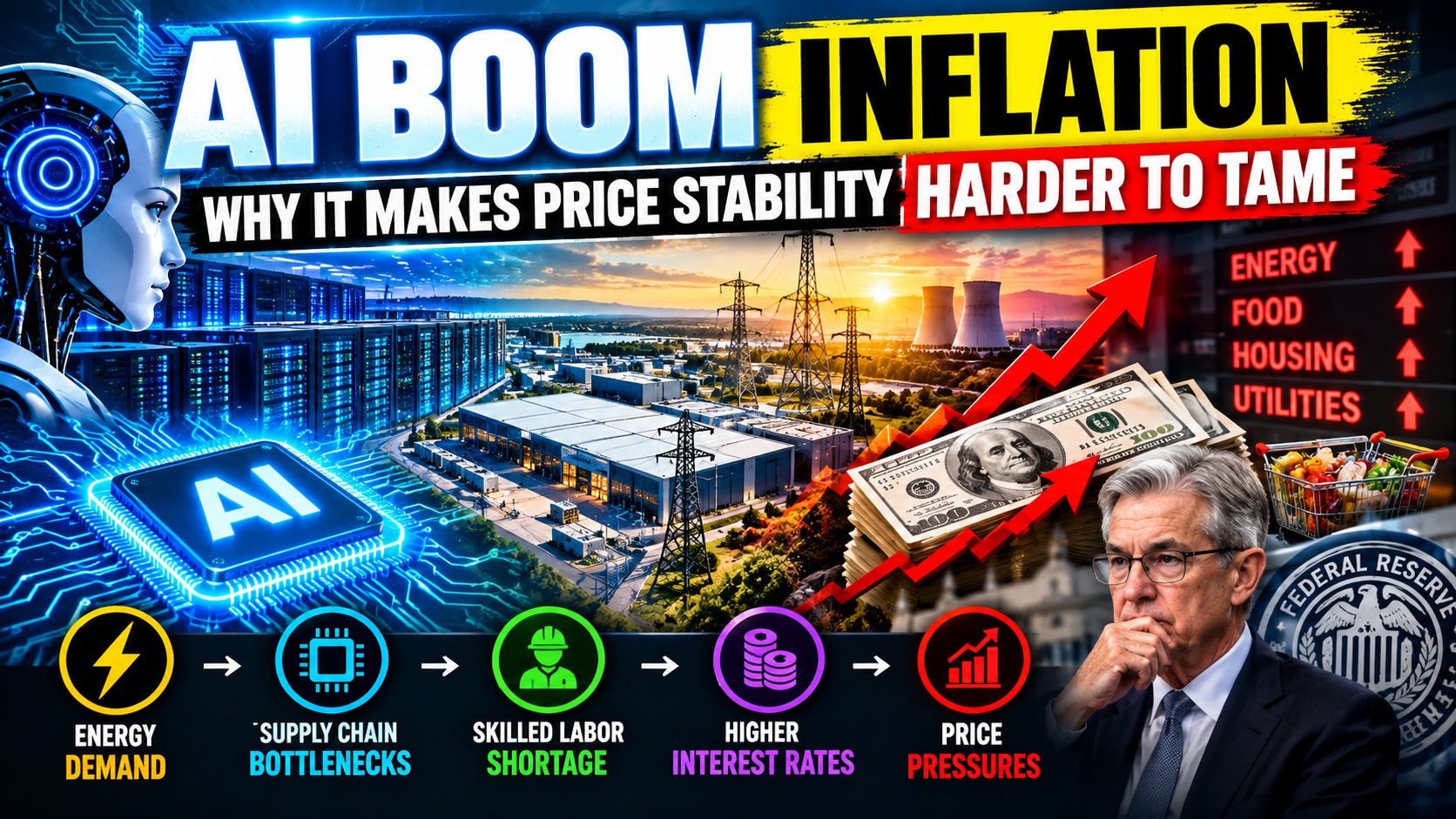
AI Boom Inflation: Why It Makes Price Stability Harder to Tame
The AI boom inflation wave presents a structural paradox for the global economic landscape. While artificial intelligence promises long-term productivity gains that should theoretically depress costs across goods and services, its immediate macroeconomic footprint is heavily inflationary.
Rather than functioning purely as a light-touch software innovation, generative AI requires an unprecedented physical footprint: hyperscale data centers, advanced semiconductor fabrication, subsea fiber infrastructure, and massive power grid upgrades. This capital expansion generates localized supply shortages, inflates energy costs, bids up specialized labor, and complicates central bank policy.
Also Read:
SpaceX Starship Orbital Flight Impact: Complete Strategic Analysis
                [ AI Infrastructure Boom ]
                            │
    ┌───────────────────────┼───────────────────────┐
    ▼                       ▼                       ▼
[ Energy Demand ]   [ Supply Bottlenecks ]  [ Specialized Labor ]
 • Power grids       • HBM & GPUs            • Electricians
 • Natural gas       • Transformers          • HVAC Techs
    │                       │                       │
    └───────────────────────┼───────────────────────┘
                            ▼
             [ Broad-Based Price Pressures ]
                            │
                            ▼
     [ Higher Neutral Rate (r*) & AI Boom Inflation ]
1. Aggregate Demand vs. Productivity Lag
At its core, the AI boom inflation dynamic stems from a temporal imbalance where aggregate demand outpaces aggregate supply ($AD > AS$). Aggregate demand is governed by the standard macroeconomic identity:
Where:
$C$ = Household Consumption
$I$ = Gross Private Investment
$G$ = Government Spending
$NX$ = Net Exports
While household consumption ($C$) shows signs of cooling under elevated benchmark interest rates, private investment ($I$) driven by tech conglomerates has surged. Hyperscalers are deploying hundreds of billions of dollars annually into capital expenditure.
Crucially, this investment shock hits the economy immediately, whereas the broad total factor productivity ($A$) gains in the aggregate production function—$Y = A \cdot f(K, L)$—take years to materialize across non-tech industries.
| Economic Factor | Short-Term Real-World Impact (0–3 Years) | Long-Term Theoretical Impact (5–10+ Years) |
| Capital Spending | Massive demand for raw materials & hardware | High capital stock enables automated output |
| Power Consumption | Upward pressure on commercial utility rates | Spurs investment in renewable & nuclear energy |
| Labor Markets | Severe wage inflation for skilled trade labor | Automation of routine white-collar tasks |
| Monetary Policy | Higher neutral interest rate ($r^*$) required | Disinflationary structural tailwinds |
2. Power Grid Demands and Energy Inflation
The most acute driver of AI boom inflation is electrical power generation and grid transmission. High-density AI training clusters consume exponentially more electricity per square foot than traditional cloud hosting facilities.
Utility Rate Hikes: To accommodate gigawatt-scale data center builds, utility companies must expand transmission infrastructure, erect high-voltage substations, and secure firm baseload power. The capital costs of these grid upgrades are routinely passed along to residential and commercial ratepayers via utility regulatory frameworks.
Fossil Fuel & Commodity Demand: The immediate demand for uninterrupted power has extended the operational life of natural gas plants and elevated demand for industrial copper, aluminum, and electrical steel. This commodity surge drives up baseline production costs across surrounding manufacturing sectors.
3. Specialized Supply Chains and Labor Market Spillovers
The physical constraints of constructing AI data centers spill over into the broader economy, amplifying AI boom inflation pressures across non-tech sectors.
Skilled Construction Labor
Building modern AI facilities requires high-voltage electricians, industrial pipefitters, and specialized HVAC technicians. Because the supply of skilled trade labor is inelastic due to training timelines and demographic shifts, tech megaprojects bid up wages. Commercial real estate developers, public infrastructure projects, and housing builders must match these elevated wages, escalating overall construction costs.
Hardware Component Crowding-Out
Demand for High Bandwidth Memory (HBM), enterprise solid-state storage, specialized power management integrated circuits (PMICs), and cooling systems has prioritized semiconductor capacity toward AI infrastructure. Industrial, automotive, and consumer electronics producers face higher input prices for standard components as silicon foundries allocate capacity to high-margin AI chips.
4. Monetary Policy Dilemmas: The Shifting Neutral Rate ($r^*$)
Central banks rely on the real neutral rate of interest—denoted as $r^*$—to determine whether monetary policy is restrictive or accommodative. The macroeconomic reality of AI boom inflation complicates central bank decision-making in two key ways:
Signal Distortion
Heavy investment in data centers and digital infrastructure generates robust top-line GDP growth. Central bankers face the challenge of determining whether strong growth reflects an overheating economy requiring elevated rates or an expanding productive capacity that accommodates non-inflationary growth.
Upward Drift of $r^*$
If structural demand for capital remains persistently high to fund AI buildouts, the real neutral rate of interest rises. Attempting to lower benchmark interest rates prematurely risks accelerating demand in an already capacity-constrained industrial environment, reigniting price inflation.
Structural Outlook
While generative AI offers promising efficiency gains over the long term, its short-to-medium-term physical buildout creates measurable cost pressures. Until power grid infrastructure catches up with energy demand and supply chains adapt to hardware consumption, AI boom inflation will remain a persistent hurdle for central banks aiming for stable inflation targets.
Frequently Asked Questions (FAQs)
How does AI boom inflation directly impact everyday consumer prices?
AI boom inflation impacts consumers through higher household electricity bills as power utility companies pass on grid-expansion costs. It also drives up hardware component prices and bids up skilled labor wages, raising construction and product costs across non-tech industries.
Isn’t AI supposed to be disinflationary by reducing business costs?
Over the long term, AI can reduce prices by automating routine tasks and improving productivity. However, during the initial infrastructure buildout, capital expenditure and material consumption outpace productivity gains, resulting in short-term inflationary pressures.
Why are central banks monitoring AI data center construction?
Central banks monitor data center growth because concentrated capital spending can overheat local economies, bidding up raw material prices and specialized labor across non-tech sectors.
Will higher interest rates slow down AI infrastructure spending?
Because major tech firms possess strong cash reserves and view AI development as essential to competitive survival, capital expenditure has remained resilient despite elevated interest rates.
Disclaimer
This article is provided strictly for educational, informational, and analytical purposes and does not constitute financial, investment, or macroeconomic policy advice. Global economic conditions, monetary projections, and market dynamics are subject to change based on evolving economic data.