
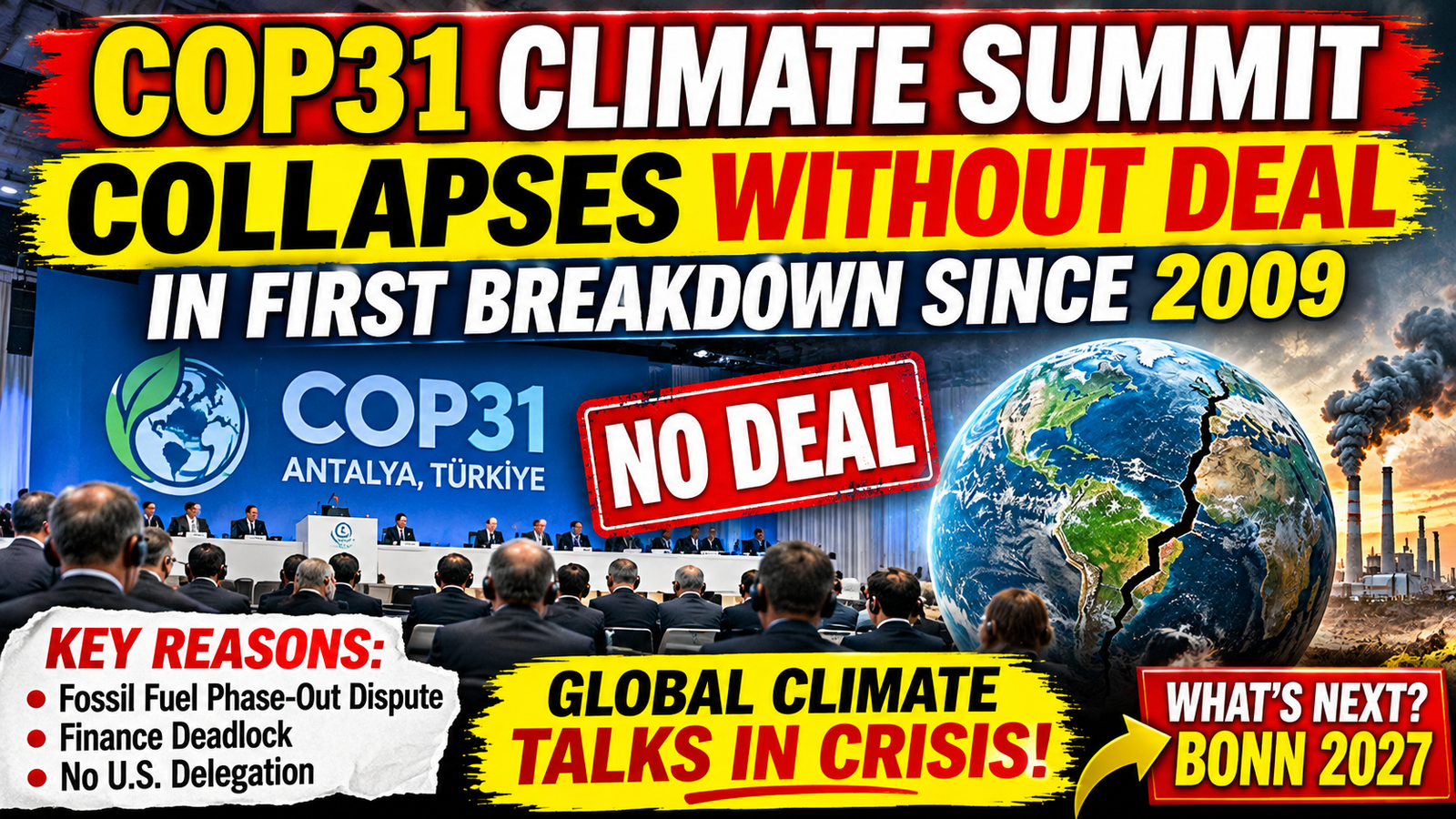
COP31 Climate Summit Collapses Without Deal in First Breakdown Since 2009
Global climate diplomacy suffered a historic setback in Antalya, Türkiye, as COP31 climate summit collapses without deal in first breakdown since 2009 following roughly 50 hours of overtime negotiations that stretched into Sunday, November 22, 2026. Co-led by Türkiye’s Environment Minister Murat Kurum as summit president and Australia’s Climate Change and Energy Minister Chris Bowen overseeing negotiations, the longest overrun in United Nations climate conference history ended without an overarching cover decision.
The deadlock in Antalya marked the first time since the 2009 Copenhagen talks that delegates left a U.N. climate summit without adopting a headline pact. At the heart of the collapse was a fierce standoff over whether the final agreement should explicitly call for transitioning away from fossil fuels—a core pillar of the 2023 Dubai agreement—alongside disputes over adaptation finance, the Mitigation Work Programme, and the absence of an official U.S. delegation.
Also Read:
Brandon Aiyuk Clears Waivers and Becomes Free Agent After 49ers Release
                  [ COP31 ANTALYA NEGOTIATION BREAKDOWN MATRIX ]
                                          │
             ┌────────────────────────────┴────────────────────────────┐
             ▼                                                         ▼
  [ CORE POINTS OF DEADLOCK ]                             [ MARATHON OVERTIME & OUTCOME ]
   • Fossil Fuel Phase-Out Language Removed                • Scheduled Nov 9–20; Ran ~50 Hrs Overtime
   • Clashes Over Finance & Mitigation Work                • Adjourned Without Cover Deal Nov 22, 2026
   • Consensus Rule Blocks Adoption on Objection            • First Summit Breakdown Since Copenhagen 2009
             │                                                         │
             └────────────────────────────┬────────────────────────────┘
                                          ▼
                    [ SHIFT TO COALITIONS, COURTS & BONN 2027 TALKS ]
1. How Negotiations Unraveled in Antalya
What began as a summit intended to advance implementation and raise ambition quickly ran aground on deep divisions between major fossil-fuel-producing nations and countries pushing for explicit commitments to move away from oil, gas, and coal.
  Early Draft Language            Revision & Omission of Terms     Plenary Rejection & Standoff
+----------------------------+  +------------------------------+  +------------------------------+
| Nov 16 Draft Urges Rapid   |->| Later Drafts Drop Explicit   |->| EU, UK, Panama & Others      |
| Transition Away From       |  | Mention of Fossil Fuels      |  | Reject Weakened Text; No     |
| Fossil Fuels               |  | Amid Oil-Producer Pushback   |  | Consensus Reached in Plenary |
+----------------------------+  +------------------------------+  +------------------------------+
|                 **Status: Cover Pact Unadopted; Select Side Decisions Passed**               |
+----------------------------------------------------------------------------------------------+
Key Flashpoints During the Summit
Disappearing Fossil Fuel Language: An initial draft released on November 16 called for an “immediate transition away from fossil fuels in energy systems,” but subsequent revisions stripped out explicit mentions of fossil fuels after pushback from oil-producing countries including Russia and Saudi Arabia. Speaking for the European Union, Irish Environment Minister Darragh O’Brien called it unconscionable to adopt a climate text without referencing fossil fuels, while Panama’s Environment Minister Juan Carlos Navarro argued that consensus rules allowed fossil-fuel interests to block meaningful action.
Mitigation Work Programme Deadlock: Delegates also rejected a draft decision on the Mitigation Work Programme—the forum designed to accelerate emissions cuts and investment—after failing to agree on how long to extend it and how closely to link it to the U.N.’s global progress assessment, pushing further work to Bonn in 2027.
Narrow Areas of Agreement: Despite the overarching failure, negotiators adopted separate decisions on the Adaptation Fund, the Global Goal on Adaptation, and a “just transition” framework for affected workers and communities, while leaving operational funding and institutional mechanics to be worked out in 2027.
2. Quantitative & Structural Snapshot: COP31 in Context
The breakdown in Antalya underscored both the procedural limits of U.N. consensus diplomacy and the widening gap between climate science and political will:
| Metric / Summit Dimension | COP31 Record / Status | Key Context & Comparison |
| Summit Dates & Overtime | Nov 9–20 scheduled; ran ~50 hours overtime to Nov 22, 2026 | Longest overtime overrun in U.N. climate summit history |
| Headline Pact Outcome | No overarching cover deal adopted | First major summit breakdown without a deal since Copenhagen (2009) |
| Presidency & Host | Co-led by Türkiye (Murat Kurum) and Australia (Chris Bowen) in Antalya | Followed Dubai (2023), Baku (2024), and Belém (2025) |
| U.S. Participation & Subsidies | No official U.S. delegation; global fossil fuel subsidies projected at $1.1T in 2026 | Subnational actors attended; UNDP projects $1.1T in explicit subsidies |
3. Reform Calls, Plurilateral Coalitions, and What Comes Next
The failure in Antalya has sparked intense debate over whether consensus-based U.N. summits remain fit for purpose as global warming approaches and tests the 1.5°C threshold.
                              [ POST-COP31 TRAJECTORY ]
                                            │
             ┌──────────────────────────────┴──────────────────────────────┐
             ▼                                                             ▼
  [ GOVERNANCE & REFORM DEBATE ]                             [ PLURILATERAL & SUBNATIONAL ACTION ]
   • Calls to Reexamine Consensus Voting                      • Beyond Oil & Gas / Santa Marta Coalitions
   • U.N. Climate Chief Backs Review Process                  • 30-Nation Fossil Fuel Treaty Momentum
   • Next Formal Talks Shift Toward Bonn 2027                 • Courts, Markets & Subnational Policies
             │                                                             │
             └──────────────────────────────┴──────────────────────────────┘
                                            ▼
                        [ EXISTING TREATY OBLIGATIONS REMAIN ]
Strategic Takeaways
Consensus Rule Under Scrutiny: Former U.S. Vice President Al Gore, Panama’s environment minister, and other critics argued that requiring unanimous consensus allows a small group of countries to water down or block ambitious language, while U.N. climate chief Simon Stiell backed an advisory review process on potential reforms even as some warned changing voting rules itself requires consensus.
Momentum Shifting to Coalitions and Courts: Even without a global COP31 cover pact, coalitions such as the Beyond Oil and Gas Alliance, the Santa Marta group, and a 30-country push toward a Fossil Fuel Non-Proliferation Treaty continue to pursue voluntary and regional measures alongside domestic regulations, markets, and litigation.
Prior Commitments Still Stand: Energy and legal experts note that failing to adopt a new cover text in Antalya does not erase existing obligations under the 2015 Paris Agreement or the 2023 Dubai decision to transition away from fossil fuels, though it leaves a political void heading into 2027 negotiations.
Technical Conclusion
The outcome in which COP31 climate summit collapses without deal in first breakdown since 2009 highlights how entrenched fossil-fuel interests, geopolitical fractures, and consensus rules can stall multilateral breakthroughs even after marathon negotiations. While existing climate treaties remain in force and smaller coalitions continue moving forward, Antalya’s impasse puts renewed pressure on governments and institutions ahead of the next round of talks in 2027.
Frequently Asked Questions (FAQs)
Why did the COP31 climate summit collapse without a deal?
Negotiations in Antalya broke down after countries could not reach consensus on whether to include explicit language calling for a transition away from fossil fuels, alongside disputes over climate finance and the Mitigation Work Programme.
When was the last time a U.N. climate summit ended without an agreement?
The last comparable breakdown occurred at the 2009 Copenhagen climate summit, making COP31 the first failure to reach an overarching pact since then.
What decisions were adopted at COP31 despite the deadlock?
While delegates did not adopt a cover decision or a draft decision on the Mitigation Work Programme, they reached agreements on the Adaptation Fund, the Global Goal on Adaptation, and a “just transition” decision with operational details deferred to 2027.
Does the COP31 collapse cancel the Paris Agreement or earlier climate pledges?
No. Legal and energy analysts emphasize that countries remain bound by commitments under the Paris Agreement and prior COP decisions, even when a given summit fails to produce a new cover deal.
Disclaimer
This article is provided strictly for educational, informational, and environmental policy news analysis purposes. Negotiation accounts, diplomatic statements, and institutional assessments reflect verified public reporting at the time of publication and are subject to ongoing developments.