
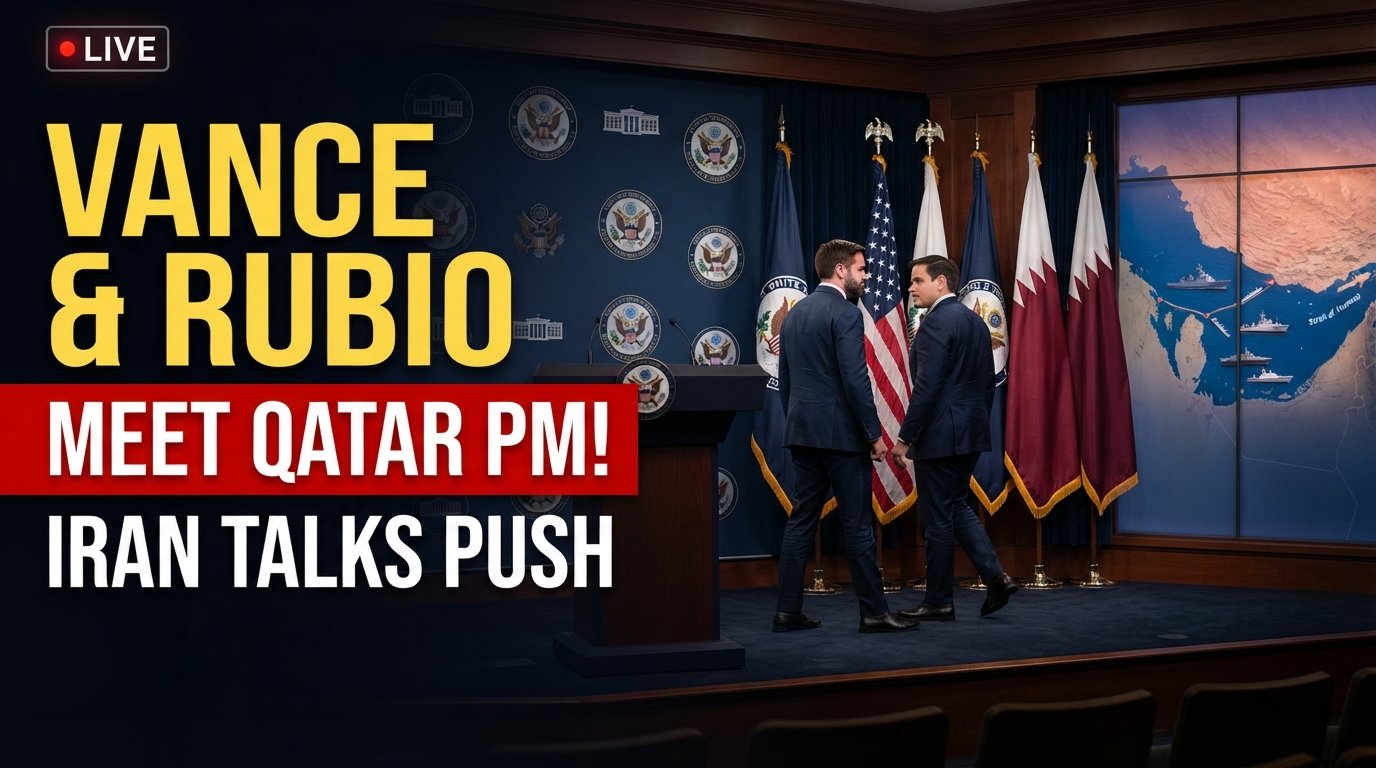
Vance and Rubio Meet Qatar PM as Efforts to Revive Stalled Iran Talks Continue
High-level diplomacy intensified in Washington this week as Vance and Rubio meet Qatar PM as efforts to revive stalled Iran talks continue against a backdrop of maritime friction and sharp disagreements over terms. Vice President JD Vance and Secretary of State Marco Rubio held talks with Qatari Prime Minister and Foreign Minister Sheikh Mohammed bin Abdulrahman Al Thani—joined by Qatari envoy Ali Al-Thawadi—as Doha presses to keep a diplomatic track alive between Washington and Tehran.
The Washington meetings build on a flurry of shuttle diplomacy that included talks in Berlin with U.S. envoys Steve Witkoff and Jared Kushner and a trip by a Qatari delegation to Tehran. While President Donald Trump has stated that the conflict is militarily largely over and voiced skepticism toward certain Iranian demands, Qatari officials are working to bridge gaps over nuclear assurances, the U.S. naval blockade, and security in the Strait of Hormuz.
Also Read:
81.5 Million Americans to Travel for Thanksgiving as Bomb Cyclone Threatens Busiest Corridor
                 [ U.S.–QATAR DIPLOMATIC & IRAN MEDIATION MATRIX ]
                                          │
             ┌────────────────────────────┴────────────────────────────┐
             ▼                                                         ▼
  [ WASHINGTON ENGAGEMENTS ]                              [ SHUTTLE & REGIONAL TRACKS ]
   • VP Vance & Sec. Rubio Meet Qatari PM                  • Berlin Talks With U.S. Envoys
   • Qatari Envoy Ali Al-Thawadi Joins Talks               • Qatari Delegation Visits Tehran
   • Focus on Reviving Stalled Negotiations                • Broader Regional Files Covered
             │                                                         │
             └────────────────────────────┬────────────────────────────┘
                                          ▼
                   [ CORE STICKING POINTS: HORMUZ, BLOCKADE & NUCLEAR TERMS ]
1. Diplomatic Push: Washington Talks and Shuttle Mediation
Qatari mediators have sought to find a workable formula that prevents renewed escalation while addressing core demands from both Washington and Tehran.
  Berlin & Tehran Outreach          Washington High-Level Talks      Competing Bargaining Positions
+----------------------------+  +------------------------------+  +------------------------------+
| Qatari PM Meets U.S.       |->| Vance & Rubio Host Qatari PM |->| Tehran Proposes Hormuz       |
| Envoys in Berlin; Qatari   |  | & Envoy to Advance Talks &   |  | Reopening Tied to Blockade & |
| Team Travels to Tehran     |  | Regional De-escalation       |  | Asset Relief; U.S. Pushes Back |
+----------------------------+  +------------------------------+  +------------------------------+
|               **Status: Active Mediation; Major Gaps Remain Unresolved**                      |
+----------------------------------------------------------------------------------------------+
Key Developments in the Mediation Effort
High-Level Meetings in Washington: Following earlier White House engagement with Qatar’s prime minister, Rubio and Vance met with Sheikh Mohammed bin Abdulrahman Al Thani in Washington—alongside Qatari envoy Ali Al-Thawadi—to discuss reviving stalled negotiations with Iran and broader regional stability.
Multi-Stop Diplomatic Sequence: Sheikh Mohammed’s Washington visit followed meetings in Berlin with U.S. envoys Steve Witkoff and Jared Kushner, as well as discussions by a Qatari delegation in Tehran aimed at testing whether diplomatic space remains open.
Wider Regional Agenda: According to Qatar’s Foreign Ministry, U.S.–Qatari discussions also touched on regional flashpoints including Gaza, Syria, Lebanon, and Afghanistan, alongside strengthening conflict-resolution cooperation.
2. Core Sticking Points: Strait of Hormuz, Sanctions, and Nuclear Demands
Despite active mediation by Qatar—alongside regional partners such as Pakistan—fundamental differences continue to separate Washington and Tehran.
| Issue / Negotiation Pillar | Washington & Allied Stance | Tehran & Mediation Dynamics |
| Negotiation Posture | Trump has signaled no rush to accept terms that fall short of U.S. goals; Rubio has criticized some Iranian demands | Iran has signaled conditional flexibility on talks if key demands are addressed |
| Strait of Hormuz & Naval Blockade | U.S. naval blockade has constrained Iranian oil exports; regional partners face maritime security risks | Tehran floated reopening the Strait of Hormuz within two days in exchange for lifting the blockade and ending wider fighting |
| Nuclear & Asset Disputes | Focus on preventing Iran from acquiring nuclear weapons under a durable arrangement | Demands include lifting the naval blockade, releasing frozen assets, and halting hostilities across fronts |
| Broader Regional Security | Concerns over attacks affecting U.S. partners and bases in the Gulf | Qatar urges both sides to de-escalate, noting the region cannot absorb further escalation |
3. Domestic Washington Dynamics and Regional Stakes
The diplomatic push is unfolding alongside political debate in Washington and heightened sensitivity across Gulf shipping lanes.
                              [ STRATEGIC PRESSURE POINTS ]
                                            │
             ┌──────────────────────────────┴──────────────────────────────┐
             ▼                                                             ▼
  [ CAPITOL HILL & BUDGET CLOCK ]                               [ GULF & MARITIME FRICTION ]
   • Bipartisan Senate Ideas on War Limits                       • Strait of Hormuz Warnings
   • Weapons Replenishment vs. Offensive Ops                     • Naval Blockade & Oil Export Limits
   • Dec 11 Government Funding Deadline                          • Gulf Base & Partner Security Risks
             │                                                             │
             └──────────────────────────────┴──────────────────────────────┘
                                            ▼
                        [ HIGH STAKES FOR REGIONAL STABILITY ]
Strategic Takeaways
Congressional Scrutiny Ahead of Funding Deadlines: On Capitol Hill, lawmakers—including Republican Sen. Susan Collins—have explored bipartisan approaches to replenishing U.S. munitions stocks while limiting funding for further offensive operations against Iran ahead of the December 11 government funding deadline.
Maritime and Gulf Security Risks: Warnings around the Strait of Hormuz, the ongoing U.S. naval blockade affecting Iranian oil exports, and recent strikes targeting Gulf sites and bases underscore how fragile regional security remains even as mediators push for de-escalation.
Value of Open Diplomatic Channels: Analysts and regional observers note that keeping a mediation channel open—even through setbacks and tough public rhetoric—preserves a pathway to de-escalation if both sides decide the cost of prolonged confrontation outweighs compromise.
Technical Conclusion
The diplomatic push in which Vance and Rubio meet Qatar PM as efforts to revive stalled Iran talks continue shows that backchannel and ministerial outreach remains active even when public positions sound hardened. Whether Qatar’s mediation can translate into concrete progress on the Strait of Hormuz, nuclear boundaries, and sanctions relief will depend on whether Washington and Tehran can bridge wide-ranging core demands.
Frequently Asked Questions (FAQs)
Who met with Qatar’s prime minister in Washington regarding Iran talks?
Vice President JD Vance and Secretary of State Marco Rubio met with Qatari Prime Minister and Foreign Minister Sheikh Mohammed bin Abdulrahman Al Thani, along with Qatari envoy Ali Al-Thawadi, as part of efforts to revive stalled negotiations involving Iran.
What steps did Qatari mediators take leading up to the Washington meetings?
Qatar’s prime minister met with U.S. envoys Steve Witkoff and Jared Kushner in Berlin, and a Qatari delegation traveled to Tehran for discussions with Iranian officials in an effort to narrow gaps and support diplomacy.
What proposals and disputes surround the Strait of Hormuz and Iran?
Iran has indicated it could reopen the Strait of Hormuz quickly in exchange for demands including lifting the naval blockade, releasing frozen assets, and ending hostilities on all fronts, while U.S. officials have rejected terms that do not meet Washington’s conditions.
What other regional issues were part of U.S.–Qatari discussions?
According to Qatar’s Foreign Ministry, discussions also covered developments in Gaza, Syria, Lebanon, and Afghanistan, as well as broader cooperation on mediation and conflict resolution.
Disclaimer
This article is provided strictly for educational, informational, and geopolitical news analysis purposes. Diplomatic statements, negotiation proposals, and regional security developments reflect verified public reporting at the time of publication and are subject to change.