
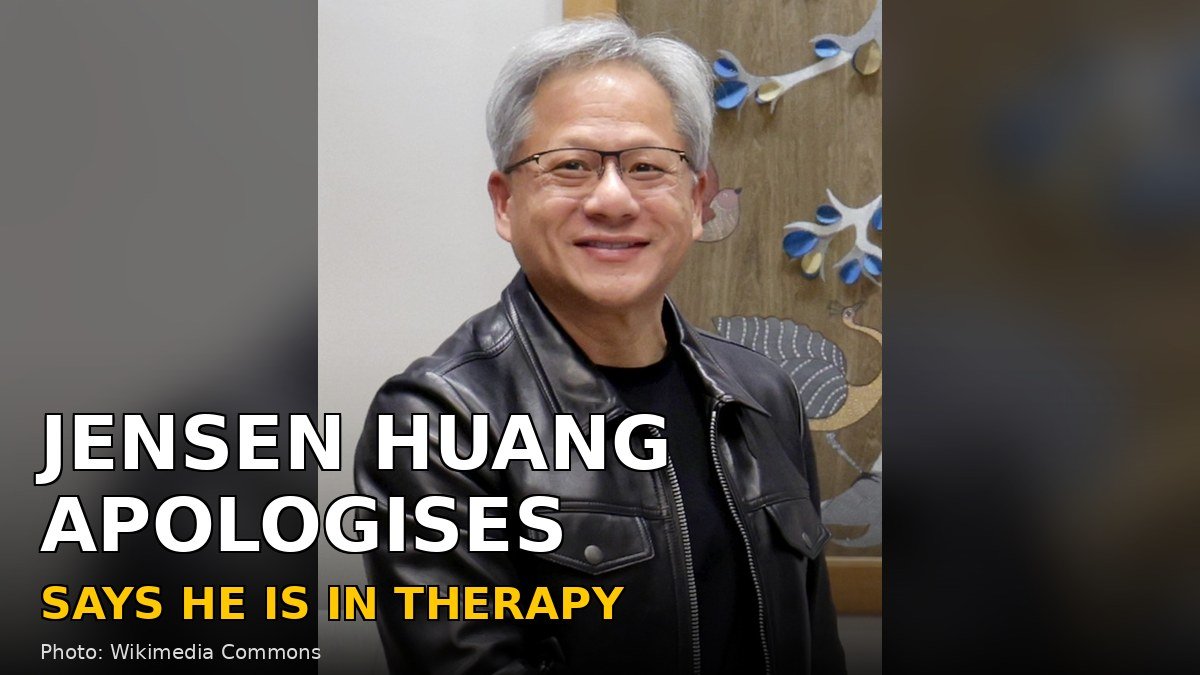
The Jensen Huang apologises therapy revelation came in an hour-long company-wide meeting on Tuesday, just one day after Nvidia’s board reinstated him as chief executive. Speaking to employees at the company he founded more than three decades ago, Huang said he had made “some terrible mistakes”, revealed that he is in therapy for more than an hour every day, and thanked staff for giving him a second chance.

The meeting was, by any measure, an extraordinary moment for a company of Nvidia’s size and standing. A founder who had been forced out less than a fortnight earlier was now standing before the staff he had led since 1993, asking them to judge him not only on what he had built, but on what he was prepared to acknowledge and to change. CNN reported that Huang spoke for an hour, took no questions, and left employees in no doubt about the seriousness with which he regarded the episode.
Jensen Huang Apologises Therapy: “I Made Some Terrible Mistakes”
Huang told employees he resigned because he had broken Nvidia’s code of conduct, according to a source familiar with the meeting — but being reinstated did not put him “above the code of conduct”. He said a breach of the code does not automatically mean dismissal, and that management decides what happens in each case, just as the board did with his. He also apologised to his wife and children, and said he was thankful to have a second chance. His two children, Madison and Spencer Huang, are executives at Nvidia, along with his son-in-law, Nico Caprez. Huang took no questions, but at one point paused to ask the room: “I need your feedback, do you understand what I’m saying?”
That direct appeal for feedback was striking. Rather than presenting his return as settled, Huang appeared to be testing whether his explanation had landed with the people whose trust he most needed to rebuild. For employees who had watched the leadership of the company change, and then change again, within a matter of days, the question was as much about the future as it was about the past.
Why Huang Resigned on November 12
Huang resigned on November 12 after reports of extramarital affairs, including one with a woman US officials feared was a Chinese intelligence asset, and one with a subordinate. During his absence, chief financial officer Colette Kress served as interim chief executive while the board said it would consider internal and external candidates for the job.
The resignation had followed weeks in which the personal conduct of Nvidia’s chief executive had become inseparable from questions about the company itself. The affair at the centre of the wider controversy was also linked to the US blacklisting of Megaspeed in the Nvidia scandal, a development that underlined how far the episode had travelled beyond the boardroom. With Kress holding the company steady as interim chief executive, the board’s first decision was to look elsewhere — a position it held for only a matter of days.
The Board’s U-Turn — and Donald Trump’s Role
On Monday, in a surprise reversal, Nvidia announced it was hiring Huang back as chief executive. The board acted after an unprecedented pressure campaign from the West Wing, orchestrated by President Donald Trump and other senior government officials. Trump took credit for the return in a lengthy CNBC interview on Monday, saying he had appealed directly to the board on Huang’s behalf. But during Tuesday’s meeting, Huang dismissed the idea that Trump had orchestrated his return, saying the board had made the decision on its own, and rejected the suggestion that his comeback was because he is a “tech bro”.
The contrast between those two accounts is likely to remain one of the most closely examined parts of the story. Trump presented himself as the decisive voice; Huang presented the board as the decisive voice. What is not in dispute is the speed of the change: a board that had decided against reinstatement one week reversed course the next, and the founder was back in charge within a day of the announcement. The Jensen Huang apologises therapy meeting the following day was his attempt to explain that reversal to the people most affected by it.
Therapy, Family and the Hardest Meeting
Huang told staff he is in therapy for more than an hour each day. The Jensen Huang apologises therapy disclosure was the most personal part of the meeting. He described the company-wide meeting as the hardest he had ever held, and said his biggest regret was the pain his conduct had caused his family. His wife, Lori Huang, had stood beside him throughout the ordeal, he said, and had urged him not to resign.
By speaking openly about therapy, and about the cost to his family, Huang framed his apology as part of a continuing process rather than a single act of contrition. It is a striking departure for a chief executive of a company whose market value rests so heavily on the confidence of investors, employees and customers alike — and it is likely to shape how his second tenure is judged as much as any product announcement or earnings call.
No Successor and No Change to Nvidia’s Flat Structure
Huang also spent time defending Nvidia’s unusually flat management structure, in which he has dozens of direct reports. That model, he said, was not a reason for his downfall, and he had no plans to change it, as he still ran the company in the same hands-on way as before. It remains in place, too, with no successor plan — but he made clear that, if he does leave the company again, a new chief executive will be appointed by the board.
That defence matters because the past fortnight exposed the risk at the heart of the arrangement. When Nvidia depended so heavily on a single leader, it was also vulnerable when that leader was suddenly gone. Even if Huang’s model is not to change, the crisis will have underlined why so many other companies build a succession plan into their boardroom structures. The Jensen Huang apologises therapy disclosure, in that sense, was as much about leadership accountability as it was about his personal life.
What Huang’s Return Means for Nvidia
Huang’s return closes one of the most extraordinary fortnights in the history of a major American company. In less than two weeks, Nvidia has lost its founder, considered life without him, and then brought him back. The Jensen Huang apologises therapy episode also reveals the limits of that first decision: the board’s view of his conduct was, in the end, outweighed by the view of its founder, its workforce and, apparently, the White House.
For now, the immediate questions have been answered: Huang is back, he has apologised, and he has promised to learn from what happened. The longer question — whether staff, investors and customers will accept that apology — will be answered in the weeks and months ahead. The Jensen Huang apologises therapy story will be judged over time, in actions rather than in words.