
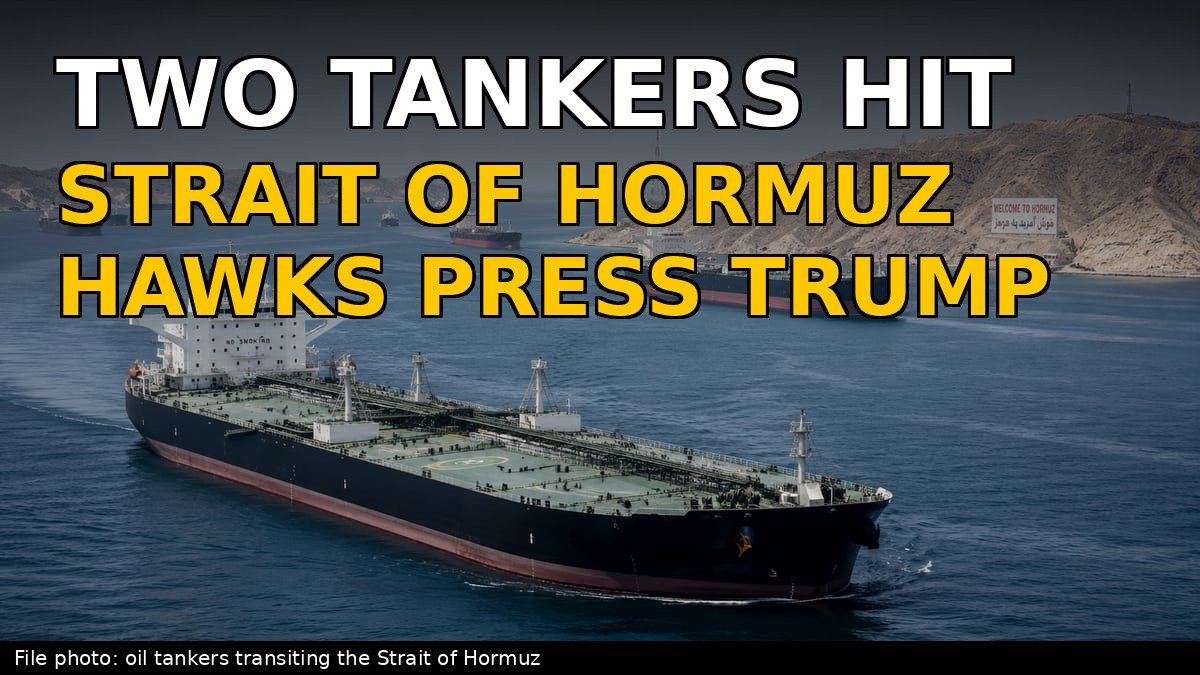
Two tankers hit in the Strait of Hormuz on Saturday, struck by projectiles in the world’s most important oil-shipping chokepoint, raising fresh fears of a wider escalation as hawks in Washington and Jerusalem press President Donald Trump to resume major strikes on Iran.
One tanker attempting to leave the strait was struck in the stern, according to the United Kingdom Maritime Trade Operations agency, while a second vessel reported a projectile hitting its engine room. No casualties were reported in either incident, but the attacks landed in a corridor that carries a large share of the world’s seaborne oil — and where more than 120 commercial vessels have now been attacked since the conflict began.
Two tankers hit in Strait of Hormuz: what happened on Saturday
The two strikes came a day after President Trump accused Iran of refusing to negotiate a deal acceptable to Washington. The timing matters: the attacks hit vessels in and around the narrow waterway between Iran and Oman, the route through which roughly a fifth of global oil shipments pass, and they arrived as both Israel and hardliners inside the Trump administration argue that the pause in major strikes on Iran — in place since the summer — should end.
October alone accounted for 28 attacks on shipping in the region, the highest single-month toll of the conflict, according to figures cited in the reporting. The pace has not slowed since.
More than 120 ships attacked since the war began
Since the United States’ war with Iran began in late February, more than 120 commercial vessels have been attacked in and around the Strait of Hormuz, killing at least 24 seafarers, according to the International Maritime Organization. The toll has turned what was once a shipping risk into a running casualty count — and a political argument in Washington about whether the current strategy is working.
For the shipping industry, the arithmetic is grim: every new strike pushes insurance costs higher, forces longer routes, and raises the odds that a crew — rather than just a hull — pays the price. The two tankers hit on Saturday escaped without casualties, but the margin between a damaged stern and a lost crew has been narrowing all year.
Israel presses Trump to act — and hints it may go it alone
Israel’s ambassador to the United States, Michael Leiter, told the New York Post this week that his country “believes ousting the Tehran regime is now the only long- or even medium-term answer,” adding that Israel “will not hesitate to go it alone” because the situation is “existential.”
Leiter also drew backlash after telling Newsmax: “You get American soldiers back here to the United States, to their families, when Iran is defeated.” Iran’s Foreign Minister Abbas Araghchi mocked the remarks on X, writing: “We did not know that the Israeli Ambassador to Washington was the commander-in-chief of the U.S. Military.” Leiter later clarified that only the President of the United States decides when and where American troops are deployed.
Hawks inside the administration push for renewed strikes
Hawks within the US administration are also pushing to resume strikes, Britain’s Financial Times reported. But the push is meeting resistance from the military itself: US Central Command has reportedly warned officials about the strain a prolonged military buildup is placing on American forces, even as congressional Democrats prepare to challenge funding for the campaign. “Centcom is telling the administration that they’re running out of time, burning money and readiness,” a source told the paper. A US official disputed that characterization.
President Trump, speaking to reporters on Friday, said Iran wants a deal “but they don’t want to make a deal that’s acceptable to me. We want to make a real deal, not a real deal that they’ve been doing for 51 years.” He repeated his vow that “Iran will never have a nuclear weapon ever,” but his administration faces a potential congressional battle over the cost of the conflict as Democrats prepare to take control of both chambers.
Iran prepares to challenge the US naval blockade
Iran, meanwhile, appears to be preparing a challenge to the US naval blockade. More than a dozen Iranian oil tankers have reportedly gathered near Kharg Island, the country’s principal oil-export terminal, as Tehran weighs ways to move crude despite the blockade, Defense News reported. Iran’s state-affiliated Fars News Agency has floated the idea of a tanker convoy through the Gulf of Oman to get Iranian oil to market.
The United States has launched repeated strikes on Iran’s Qeshm Island this month, while Iran has continued to lob attacks at US allies, including drone and missile strikes at Kuwait.
On the nuclear front, Foreign Minister Araghchi said Iran had not changed its official position on nuclear weapons despite international pressure and debate over its nuclear doctrine. China and Russia oppose any change in Tehran’s nuclear doctrine, he said, according to Iran Daily. Iran is a signatory to the Nuclear Non-Proliferation Treaty, but its nuclear programme has long drawn international scrutiny over undeclared activities, underground facilities and restrictions on UN inspections.
What happens next in the Strait of Hormuz
The question now is whether Saturday’s strikes tip the balance inside the White House. The hawks’ argument is that the pause has let Iran regroup; the military’s warning is that the buildup is already burning through money and readiness. With a tanker convoy reportedly being weighed in Tehran and a congressional funding fight looming in Washington, the strait is unlikely to stay quiet for long. For the crews sailing through it, that is the bleakest part of the story: the attacks have become routine, and routine is exactly what makes the next one so dangerous.
Source: New York Post