
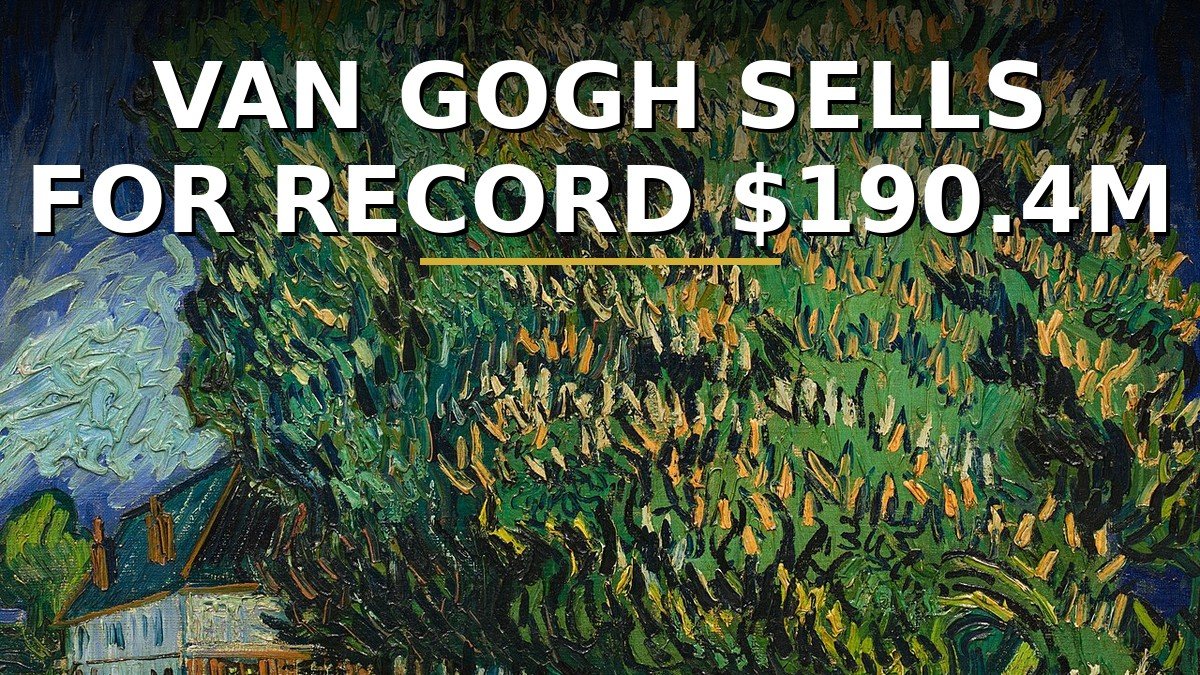
Van Gogh record 190.4 million is the new headline from New York, where Vincent van Gogh’s Châtaigniers en fleurs — Blossoming Chestnut Trees — sold for $190.4 million at Sotheby’s on Wednesday night, November 18, setting a new auction record for the Dutch master. The price, which includes fees, smashed the artist’s previous record and instantly became one of the most talked-about results of the autumn art season.

Vincent van Gogh, Blossoming Chestnut Trees (Châtaigniers en fleurs), 1890. Public domain, via Wikimedia Commons.
The sale was not simply a big number. It was a fast, tense, closely watched contest in a packed saleroom, a deal with a difficult history behind it, and the centrepiece of a collection assembled over more than half a century. In the space of about three minutes, a painting made in the final weeks of Van Gogh’s life became the most expensive work by the artist ever sold at auction.
Van Gogh record 190.4 million: How three minutes in New York rewrote the market
The bidding began at a level that would already have been a landmark for most artists. Auctioneer Oliver Barker opened the bidding at $135 million, and the price climbed in brisk $5 million increments. The room, and the phones connected to it, stayed in the contest as the figure moved past $150 million and then $160 million, before the pace finally slowed.
At $165 million, the hammer price, the bidding stalled. Barker worked the room, urging the remaining bidder to go further — “Try one more,” he said, and later, “The moment of no return.” No further bid came, and the hammer fell. With the buyer’s premium and fees added, the total reached $190.4 million.
The speed of the contest was part of its drama. Three minutes is a short time for a nine-figure decision, and the result showed how concentrated demand has become at the very top of the art market, where a small number of collectors and dealers can move a price by tens of millions of dollars in a single evening.
Who bought the painting?
The buyer was New York dealer Bill Acquavella, who confirmed the purchase to Artnet News after the sale. Acquavella did not say on whose behalf he was bidding, leaving open the question of whether the painting was bought for a client, for his gallery, or for his own collection. The Van Gogh record 190.4 million result was confirmed to Artnet News by Acquavella himself.
Acquavella is one of the best-known dealers in modern art, and his past clients have included the casino magnate Steve Wynn and the hedge-fund manager Steven A. Cohen. His presence in the room, and his willingness to go to $165 million at the hammer, underlined the painting’s status as a work that the market’s most serious buyers were prepared to chase.
The underbidder was a phone bidder working with Julian Dawes, Christie’s head of Impressionist and modern art for the Americas. That detail added a familiar rivalry to the evening: two of the great auction houses, represented in the room by their specialists, contesting a Van Gogh that had not been on the market for 50 years.
A sale shadowed by history
The record price came only after a dispute over the painting’s past had been resolved. The heirs of Samuel Fischer, a German Jewish publisher, said Fischer had sold the painting under duress through an Amsterdam gallery in 1936, during the Nazi era. The claim raised the painful question that now accompanies many major sales of European art from that period: how a work changed hands, and under what pressure, before the Second World War.
The parties announced a settlement the day before the sale, clearing the way for the auction to go ahead. The timing meant that the painting entered the saleroom with its title settled, but the dispute remained part of the story of the night — a reminder that a record price does not erase the history a painting carries with it.
Such settlements have become a familiar feature of the market for important works with wartime histories. They allow a sale to proceed, and they acknowledge, at least in part, the claims of families whose collections were dispersed under persecution.
The Blaquier-Arrieta collection
Blossoming Chestnut Trees was the top lot of “Legendary: The Blaquier-Arrieta Collection,” a dedicated 12-lot sale at Sotheby’s. The group carried an estimate of $180 million, was guaranteed by Sotheby’s, and was backed by an irrevocable bid — a sign of the house’s confidence that the collection would sell strongly. It was also the top lot of a $2 billion auction season in New York.
The collection belonged to Nelly Arrieta de Blaquier, who died in 2020, and Carlos Pedro Blaquier, who died in 2023. The couple’s fortune came from Ledesma, the Argentine sugar giant, and they had been collecting since the 1960s. Over the decades they built a collection that ranged widely, but the Van Gogh was its centrepiece.
The Blaquiers bought the painting from Wildenstein & Co. in 1975. It had not appeared at auction since, which helped explain the excitement around the sale: for many collectors, this was a once-in-a-generation chance to own a major Van Gogh that had been out of circulation for half a century.
The painting itself
Painted in 1890, around May 24, in Auvers-sur-Oise, the village north of Paris where Van Gogh spent the last months of his life, Blossoming Chestnut Trees shows a cluster of large chestnut trees in the centre of the village. Beneath them, women in colourful dresses stroll and a man in a straw hat stands in the shade. The trees, heavy with blossom, dominate the canvas, their branches reaching across a bright sky.
It is a work of extraordinary energy. The brushwork is thick and urgent, the greens and blues of the foliage set against the pale dresses and the sunlit ground. In its subject — a quiet village scene, observed closely — and in its execution, it is unmistakably a painting of Van Gogh’s final spring, when he was working at a furious pace and producing some of the most admired pictures of his career.
Van Gogh’s final months in Auvers
Van Gogh arrived in Auvers-sur-Oise in May 1890, after leaving the asylum at Saint-Rémy-de-Provence. In the roughly 70 days that remained to him, he painted 74 paintings and made more than 50 drawings — an astonishing burst of work that included portraits, landscapes and the village scenes that now define his late style.
He died by suicide on July 29, 1890, about two months after painting Blossoming Chestnut Trees. That short interval gives the picture a particular poignancy: a bright, blossoming spring scene, painted by an artist who had only weeks to live, and who could not have known that his work would one day command a price of $190.4 million.
The painting’s freshness is part of its appeal. It does not look like a late work in decline. It looks like a painter looking hard at the world in front of him, and finding in an ordinary village green a subject worthy of his most intense attention.
The previous record, and what this one means
The previous Van Gogh auction record was $117.2 million, set in 2022 when Christie’s sold Verger avec cyprès (1888) from the collection of the Microsoft co-founder Paul Allen. The new price of $190.4 million beats that figure by more than $73 million — a jump of more than 60 percent in four years. The Van Gogh record 190.4 million total therefore resets the artist’s market by a wide margin.
That leap says something about the market for the very best works by the most famous names. While the broader art market has been uneven, the top end has remained strong for works that are rare, fresh to the market, and free of doubt about their quality and provenance. A Van Gogh of this scale, from a named collection, with a settled title, fits that description almost perfectly.
It also says something about Van Gogh’s standing with the public. He is not only a museum artist; he is a household name, and a record price for his work is news far beyond the art world. As with other record-breaking nights in entertainment — including Ella Langley’s record-breaking night at the CMA Awards — the story travelled quickly because the figure itself was so striking.
What happens next?
For now, the painting’s next home is not public. Acquavella has not said who he bought it for, and it may be some time before the work is seen in public again. If it was bought for a private collector, it could disappear from view for years; if it was bought for a museum, or with a museum in mind, it could eventually return to public display.
Whatever its destination, the sale has reset the market for Van Gogh. The next time a major work by the artist comes to auction, $190.4 million will be the number against which it is measured. And for the art world, the three minutes in a New York saleroom on Wednesday night will be remembered as the moment when a painting of chestnut trees in a French village became, by price, the greatest Van Gogh ever sold.
Source: Artnet News reported the sale, the buyer and the bidding details.