
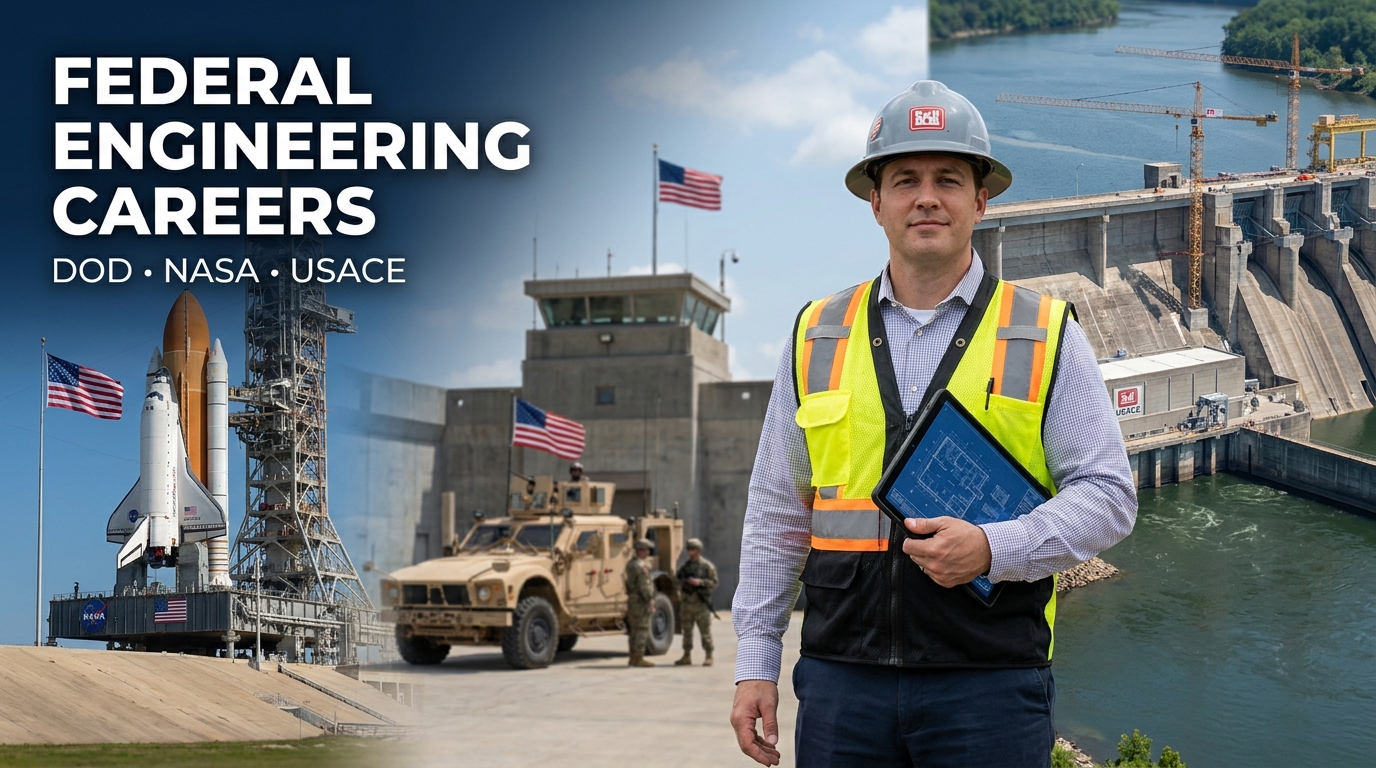
Federal Engineering Careers Across the DOD, NASA, and Army Corps of Engineers: Shaping the Future of Innovation and Infrastructure
Going after federal engineering careers opens the door to some of the most dynamic, high-impact work available to civil, mechanical, and electrical engineers. Engineering underpins national security, public infrastructure, and modern technology itself. And for engineers who want scale and purpose beyond the usual corporate track, government service delivers both.
Also read:
Super El Niño 2026: Forecast, US Winter Impacts & NOAA Updates
At the Department of Defense (DOD), the National Aeronautics and Space Administration (NASA), and the U.S. Army Corps of Engineers (USACE), engineers take on projects of staggering scale — designing next-generation aerospace vehicles, hardening national defense infrastructure, managing critical water resources and public works. Federal engineering careers bring real job stability, competitive pay, and the rare chance to work on things that genuinely serve the public.
The options can feel overwhelming at first. USAJOBS is the main gateway — the official portal where these coveted positions land. This guide breaks down what it’s like to enter federal engineering careers at these premier agencies, what to expect, and how to get hired.
1. The Role of Civil, Mechanical, and Electrical Engineers in Federal Service
Federal engineering is rarely business-as-usual. Engineers building federal engineering careers face multi-disciplinary problems that demand technical precision, creative problem-solving, and real leadership.
- Civil Engineers: They design, build, and maintain the physical world. In federal service that means military bases, flood risk management systems, navigation locks and dams, and large-scale structural projects.
- Mechanical Engineers: They work with forces, thermal systems, and mechanical devices. Inside federal agencies, that translates to aerospace propulsion systems, weapon defense mechanisms, robotics, HVAC for specialized facilities, and heavy equipment.
- Electrical Engineers: Electricity, electronics, electromagnetism. Federal electrical engineers power naval vessels, design avionics and satellite communication networks, run smart-grid energy systems for military installations, and lock down cybersecurity for critical infrastructure.
2. Spotlight on Key Federal Agencies
The Department of Defense (DOD)
The DOD is the largest employer in the United States, and it needs an enormous engineering workforce to stay technologically ahead and operationally ready. Engineers pursuing federal engineering careers at the DOD work in research labs, logistics commands, and field installations around the world. Upgrading combat vehicle systems, designing secure communications, modernizing military housing and bases — DOD engineers make sure service members have the tools and infrastructure to succeed.
National Aeronautics and Space Administration (NASA)
For engineers driven by exploration, NASA is the pinnacle. Civil, mechanical, and electrical engineers building federal engineering careers at NASA work on deep-space exploration, planetary rovers, aeronautics research, and the Artemis lunar missions. That’s physics and materials science at their limit: spacecraft built to survive extreme heat, complex electrical architectures for orbital stations.
U.S. Army Corps of Engineers (USACE)
USACE runs a unique dual mission — backing national security by constructing military facilities, and managing civil works that protect the nation’s water resources. Civil and environmental engineers here build levees, dredge federal waterways, respond to natural disasters, and construct public infrastructure that safeguards communities across the country.
3. Benefits of Working in Federal Engineering Careers
Choosing federal engineering careers comes with advantages that look quite different from the private sector:
- Job Security and Stability: Civil service positions carry strong job security, real civil service protections, and predictable progression up the General Schedule (GS) pay scale.
- Comprehensive Benefits: Competitive federal healthcare, solid dental and vision options, and the Federal Employees Retirement System (FERS) — including a Thrift Savings Plan (TSP) with government matching, much like a 401(k).
- Work-Life Balance: Generous annual and sick leave, federal holidays, and modern options like alternative work schedules (AWS) and telework or remote flexibility.
- Continuous Learning and Professional Development: Agencies routinely sponsor continuing education, professional engineering (PE) license acquisition, certifications, and advanced degrees.
4. Frequently Asked Questions (FAQs)
Q1: Do I need a Professional Engineer (PE) license to secure federal engineering careers? A: Not always at entry level — but it’s highly valued and often required to advance into supervisory roles or take on certain civil design responsibilities. Many agencies actively help employees earn their PE credentials.
Q2: Are U.S. citizenship and security clearances required? A: Yes, essentially. These agencies handle national security, defense technology, and sensitive infrastructure, so applicants are almost always required to be U.S. citizens. Depending on the project or agency — especially at the DOD and NASA — you may also need to obtain and maintain a Secret or Top Secret clearance.
Q3: How do I apply for engineering positions in these agencies? A: Almost everything goes through USAJOBS, the official federal hiring platform. Build a comprehensive federal resume, upload your transcripts, and tailor your materials to the exact qualifications in each job announcement.
Q4: Are there opportunities for recent graduates and students? A: Absolutely. NASA and USACE recruit heavily through the Pathways Programs, which offer internships and recent-graduate tracks designed to move students straight into permanent, full-time federal careers.
5. Conclusion
Entering federal engineering careers brings a sense of purpose that’s hard to replicate. Build flood-protection systems with the Army Corps of Engineers. Design deep-space flight hardware with NASA. Fortify technological infrastructure inside the DOD. Either way, your work protects and advances the nation. Through official federal hiring platforms, qualified civil, mechanical, and electrical engineers can unlock long, rewarding careers defined by innovation, leadership, and public service.
Official News Links & Trusted Resources
- Explore Open Engineering Positions: USAJOBS Search Portal
- U.S. Army Corps of Engineers Career Portal: USACE Careers
- NASA Official Careers Information: NASA Careers and How to Apply
1 thought on “Federal Engineering Careers: DOD, NASA & USACE Jobs Guide”