Apple’s Lineup Adjustments and the Continued Dominance of AI Integration in Hardware
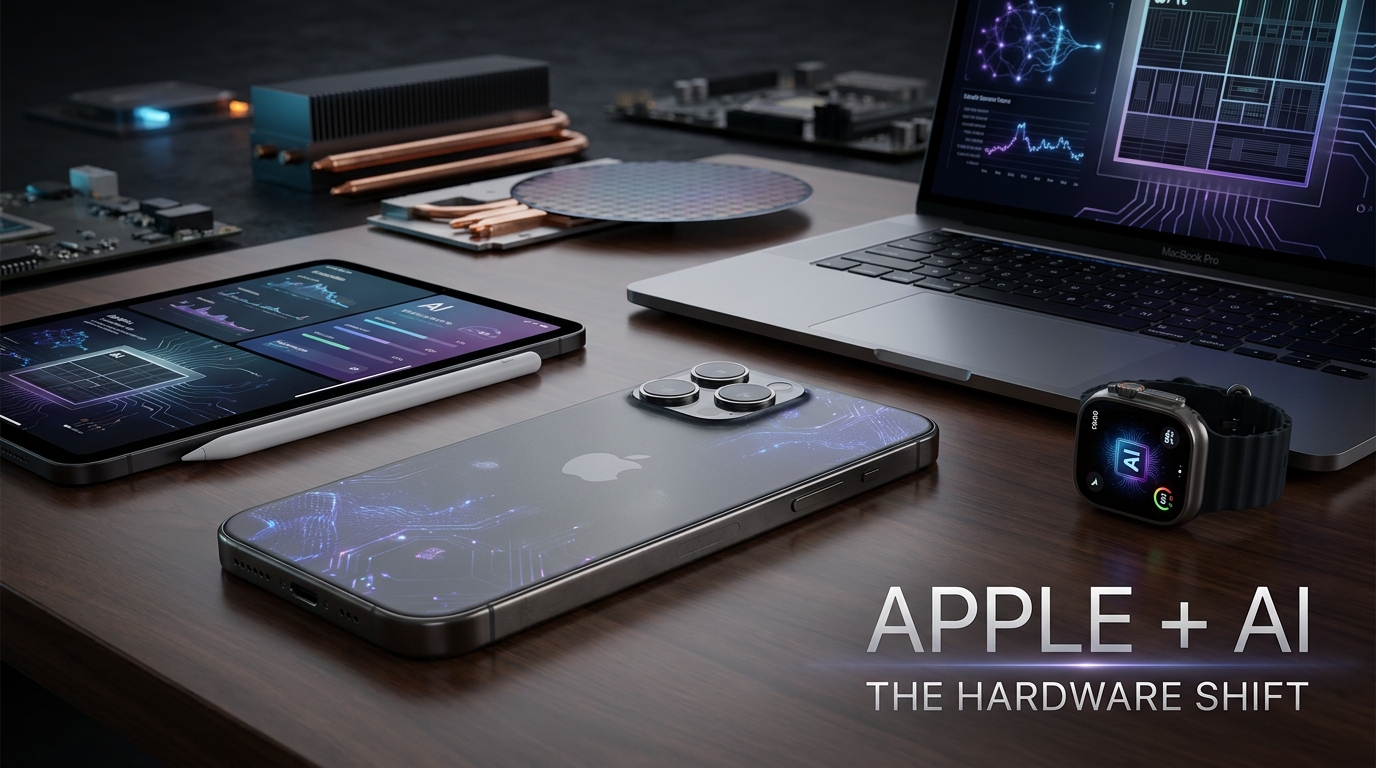
Apple AI hardware integration has fundamentally altered how the technology giant designs its device ecosystem. Over recent product cycles, line adjustments—ranging from the introduction of ultra-slim profiles and foldable form factors to sweeping chip architectures—have not been random aesthetic choices. Instead, they are deliberate engineering concessions required to sustain the heavy demands of on-device artificial intelligence. As Apple Intelligence scales across generations of Apple Silicon, the symbiotic relationship between silicon limits, thermal management, and user-facing features dictates the shape of every iPhone, Mac, iPad, and wearable.
Also read:
NFL Season Start: High-Stakes Early Matchups & Week 1 Preview
The Silicon Bottleneck: Why Hardware Must Adapt to AI
Integrating large language and multimodal foundation models directly onto consumer electronics introduces intense pressures on thermal and power management. Standard processing pipelines are no longer sufficient when a device must execute billions of parameters locally while preserving all-day battery life.
Apple’s strategy relies heavily on custom neural engines and unified memory architectures. To prevent the severe performance throttling traditionally associated with mobile AI workloads, recent hardware lineups have adopted advanced thermal mitigation techniques, such as custom vapor chambers and graphite-layered chassis designs. Furthermore, the strategic separation between standard devices and “Pro” or “Ultra” tiers has widened. Entry-level models receive baseline neural engine configurations capable of managing contextual shortcuts and basic text tools, whereas flagship hardware features expanded unified memory pools necessary to run dense, on-device models without defaulting to cloud relay.
Redesigning Form Factors for Contextual Computing
Hardware adjustments across Apple’s portfolio reflect an acute need to place sensors closer to the user to feed contextual data into artificial intelligence systems.
The iPhone and Wearable Evolution
The evolution of the iPhone lineup—highlighted by structural shifts toward thinner profiles, variable-aperture optics, and expanded display real estate like foldable configurations—serves a dual purpose. It satisfies consumer desire for fresh industrial design while accommodating specialized sub-processors. On the wearable front, devices like the Apple Watch Series and Ultra lines have integrated dense health-sensing arrays. These hardware adjustments feed continuous biometric streams into software ecosystems where machine learning models translate raw physiological metrics into predictive health insights.
Mac and iPad Performance Scaling
In the personal computer segment, the integration of M-series silicon with dedicated neural accelerators has redefined the MacBook Air, iPad Pro, and Mac Studio lineups. By pushing local machine learning capabilities into tablets and lightweight notebooks, Apple has decentralized heavy computational tasks. Developers can compile code, render spatial video, and run localized coding or image-generation models natively, reducing cloud latency and keeping sensitive user inputs entirely private.
Privacy-First Architecture as a Hardware Constraint
A defining pillar of Apple’s AI integration is its insistence on localized processing and Private Cloud Compute infrastructure. Unlike competitors who rely entirely on massive remote server farms, Apple’s hardware roadmap is explicitly constrained by the goal of executing sensitive tasks on the user’s physical device.
This philosophy dictates component selection. High-speed NAND flash memory configurations and increased baseline RAM are no longer luxury upgrades; they are structural requirements for caching foundational models and executing rapid parameter routing. By embedding security features directly into the silicon architecture—such as isolated secure enclaves for biometric data and encrypted neural processing, Apple ensures that hardware adjustments reinforce consumer trust alongside raw performance gains.
Balancing Consumer Choice and Market Fragmentation
These aggressive hardware realignments do not come without friction. By drawing a hard line between devices that support deep intelligence features and legacy hardware left behind by strict RAM and Neural Engine thresholds, Apple risks accelerating upgrade cycles while alienating users of older generations. However, the company’s historical trajectory suggests a willingness to accept short-term fragmentation in exchange for long-term ecosystem uniformity. Every tier of the modern hardware catalog is being systematically steered toward an ecosystem where artificial intelligence is the baseline operating assumption rather than an optional application.
As Apple continues to refine its manufacturing processes and scale its proprietary foundation models, the line between software utility and physical hardware design will continue to blur. The adjustments seen in recent product generations prove that future hardware iterations will not merely run applications—they will function as active, context-aware extensions of an ambient artificial intelligence network.
Frequently Asked Questions
Why are older Apple devices excluded from advanced AI features? Advanced artificial intelligence features require immense computational bandwidth, specifically high amounts of unified memory (RAM) and powerful dedicated Neural Engines. Older hardware lacks the physical silicon capacity required to process these models locally while maintaining acceptable battery life and thermal limits.
How does Apple maintain privacy while integrating AI into hardware? Apple utilizes a hybrid approach anchored by on-device processing and Private Cloud Compute. Sensitive personal data is processed directly on the device’s secure silicon, ensuring that personal interactions and context are never stored or used to train public models without explicit user consent.
Will future Apple hardware lineups continue to feature specialized AI chips? Yes. Dedicated neural accelerators and expanded memory architectures have become core components of Apple Silicon, meaning future iterations across iPhone, Mac, and iPad lineups will feature increasingly advanced processing blocks built specifically for machine learning workloads.