
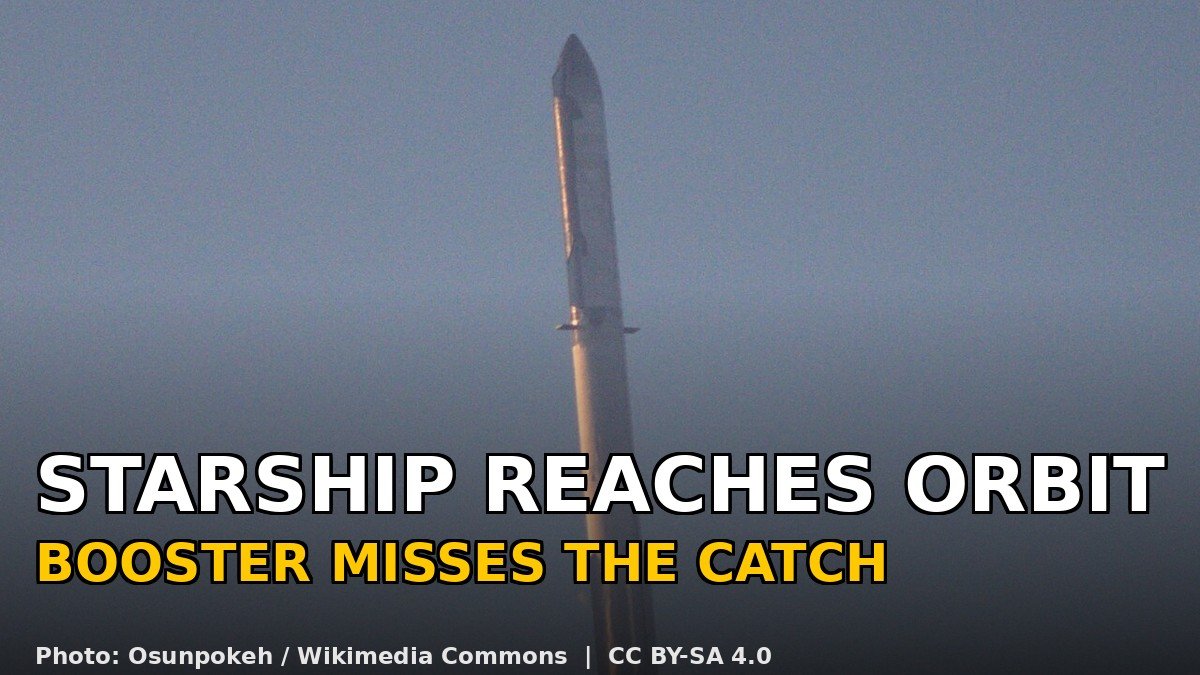
SpaceX Starship reaches orbit again — but the rocket’s 15th test flight ended with a reminder that full reusability is still the hardest problem in spaceflight. The giant rocket lifted off from Starbase on the Texas Gulf Coast on Friday evening, and while the Starship upper stage climbed smoothly into space, the Super Heavy booster missed its planned landing and splashed down in the ocean offshore.
The flight, which began at 5:45 p.m. EST on November 13, 2026, was billed as a milestone: a 22-hour mission designed to demonstrate the full reusability of an orbit-class rocket — something no one has ever achieved. On that measure, the mission delivered a split result: the ship made it, the booster did not.
SpaceX Starship Reaches Orbit on Its 15th Test Flight
The numbers behind the launch are hard to overstate. The full stack stands 407 feet tall. The first stage alone, the Super Heavy booster, is 236 feet tall and powered by 33 methane-burning Raptor engines. At liftoff it carried 8 million pounds of supercold liquid oxygen and methane fuel.
The booster did its main job well. It pushed the rocket out of the thick lower atmosphere and separated about two minutes and 20 seconds after liftoff. The 171-foot-tall Starship then fired its own six Raptor engines and continued the climb to space, beginning a mission planned to last about 22 hours.
For SpaceX, reaching orbit is no longer the surprise it once was. The test programme has moved past the question of whether Starship can fly and into the harder question of whether it can come back — cheaply, quickly, and intact.
What Went Wrong With the Booster Catch
The booster’s return was the flight’s most ambitious element. After separation, it was programmed to flip around, fire 13 of its engines to reverse course, and fly back to the launch site for a landing — the kind of return that would let SpaceX catch and reuse the largest booster ever flown.
It did not make it. Instead of landing, the booster splashed down in the waters offshore. SpaceX has not yet said precisely what went wrong in the final phase of the return, and the company will now work through flight data to find out whether the problem was in the flip, the engine relight, or the guidance back to the pad.
A splashdown is not a crash in the usual sense — the booster came down in the ocean rather than on land — but it is a long way from the goal. A booster that lands in the sea cannot be caught, refurbished, and flown again, which is the entire point of the exercise.
Why Full Reusability Is the Whole Point
SpaceX’s case for Starship has always been economic as much as technical. A rocket that can be flown, landed, and flown again — both stages — would cut the cost of reaching orbit by an order of magnitude and make rapid, airline-style operations possible.
That is why the booster catch matters so much. The fact that SpaceX Starship reaches orbit proves the rocket works as a launcher. The booster coming home proves it works as a reusable system. Until both halves of that equation close, Starship remains a very large expendable rocket with a very expensive first stage.
The stakes go beyond SpaceX. NASA is counting on Starship to land astronauts on the Moon under the Artemis programme, and Elon Musk’s Mars ambitions depend on a vehicle that can be refuelled and reflown many times. Every test flight, success or setback, feeds directly into those timelines.
What Happens Next for Starship
SpaceX will now sift through the flight data, and the Starship upper stage’s own 22-hour mission will continue. The company has typically moved fast after test flights — fixing what failed, adjusting what almost worked, and flying again within weeks or months.
The pattern of the programme so far suggests the booster catch will be attempted again, with whatever the data says changed. The question is not whether SpaceX will try again, but how quickly it can turn a splashdown back into a landing.
For now, the flight leaves a clear picture: SpaceX Starship reaches orbit, and it can do it on a rocket of staggering scale. Getting the booster back in one piece remains the work still to be done.