
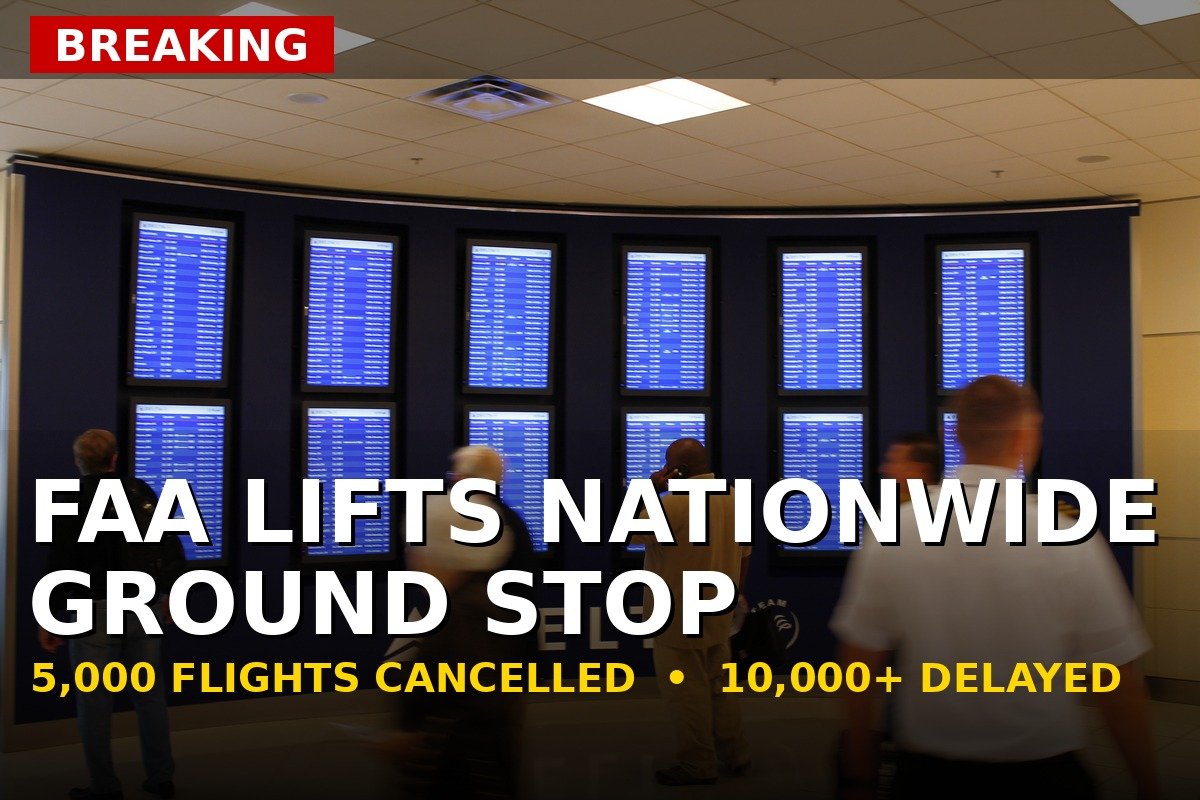
The FAA nationwide ground stop that brought American aviation to a standstill on Friday has been lifted, ending one of the most disruptive days in the history of United States air travel. After roughly five hours in which no domestic flights were allowed to depart, planes began moving again on Friday evening, but the effects of the shutdown are expected to be felt for days as airlines work to get aircraft, crews and passengers back where they belong.
For millions of travellers, the day was defined by crowded terminals, cancelled holidays and business trips, and long waits for information. For the Federal Aviation Administration, it was a stark warning about the fragility of the technology that keeps American skies moving. Officials were quick to stress that there was no indication of a cyberattack. The problem, they said, was far more ordinary and, in many ways, more worrying: an ageing communications system that could not cope with the demands placed on it.
FAA nationwide ground stop: what happened on Friday
The halt was issued at around 4 p.m. on Friday, November 13, and lifted shortly before 8:30 p.m., making it a stoppage of roughly five hours. During that time, domestic departures were held across the country. Inbound international flights were not treated in the same blanket way; instead, they were handled case by case, with controllers deciding whether each aircraft could safely continue to its destination.
The decision to stop departures nationwide is not taken lightly. A ground stop is one of the most powerful tools available to air traffic managers, and it is used only when safety demands it. In this case, communications problems at regional air traffic control centres had made it impossible to manage traffic normally. Rather than risk aircraft flying without reliable contact with controllers, the FAA chose to keep them on the ground.
As the evening wore on, engineers and controllers worked to restore the affected systems and to confirm that communications were stable enough to resume normal operations. Only when they were satisfied did the FAA lift the order, allowing a slow and carefully managed restart. Even then, the return to normal was far from instant. Airports that had spent hours with parked aircraft and stranded passengers could not simply clear the backlog in minutes.
The scale of cancellations and delays
The numbers behind the FAA nationwide ground stop are staggering. Nearly 5,000 flights were cancelled across the United States, and more than 10,000 were delayed. Those figures cover only the direct effects on Friday. Because every cancelled flight leaves an aircraft in the wrong place and a crew out of position, the knock-on effects were already building before the stop was even lifted.
Atlanta’s Hartsfield-Jackson International Airport, the busiest airport in the world, illustrated the scale of the problem. As of 10:21 p.m. on Friday, more than 750 flights there had been delayed and 628 had been cancelled. For passengers trying to connect through Atlanta, one of the main hubs for flights across the south-eastern United States and beyond, the disruption was especially severe.
Airlines warned that schedules would take days to recover. A plane that should have flown from Chicago to Miami on Friday evening, for example, might instead have spent the night in Chicago, meaning its Saturday morning departure from Miami could not operate either. Crews, who are bound by strict rules on working hours and rest, also found themselves in the wrong cities. Rebuilding a national flight schedule from that position is a slow, complicated task, and passengers were urged to check the status of their flights before travelling to the airport.
Delta Air Lines, one of the carriers most affected, issued a travel waiver for affected passengers, allowing them to change their plans without the usual penalties. Other airlines were expected to offer similar flexibility as the scale of the disruption became clear.
What caused the FAA nationwide ground stop?
According to officials, the cause of the FAA nationwide ground stop was a failure in the communications systems that link air traffic control centres. New technology introduced into the old system overwhelmed it, triggering problems that spread through regional centres. The FAA and the Department of Transportation were at pains to say there was no indication of a cyberattack, a point repeated as speculation circulated online during the stop.
Transportation Secretary Sean Duffy described the system as “incredibly old” and said it still relies on an analog system that has been overloaded with data. In other words, the technology that guides some of the busiest airspace in the world was not designed for the volume and complexity of modern air travel. The introduction of newer equipment, rather than solving the problem on its own, appears to have placed still more strain on infrastructure that was already stretched.
The explanation will alarm many frequent flyers, not least because it suggests the failure was not a freak event but a symptom of a system operating close to its limits. Aviation experts have warned for years that American air traffic control needs substantial investment, and Friday’s events have given those warnings a new and urgent force.
What Duffy and Mullin said about modernising air traffic control
Secretary Duffy used the FAA nationwide ground stop to renew his call for Congress to authorise billions of dollars to modernise the system. The argument, in his view, is straightforward: the United States cannot run a 21st-century aviation network on technology that belongs to an earlier era. Modernisation would mean replacing ageing communications, radar and data systems with equipment designed for today’s traffic levels and capable of being upgraded as demand grows.
Homeland Security Secretary Markwayne Mullin put a figure on the scale of the task, saying a full overhaul of the system would cost about $50 billion. That is a huge sum, but supporters of modernisation argue that the cost of inaction is also large. A single day like Friday costs airlines, airports and passengers hundreds of millions of dollars in lost business, refunds, hotel stays and missed connections, quite apart from the damage to confidence in the system.
Whether Congress will act quickly remains to be seen. Funding a project of this size requires political agreement, long-term planning and a willingness to spend heavily on infrastructure that most travellers never see. Friday’s ground stop, however, has made the case in a way that reports and speeches alone could not. For five hours, the consequences of an ageing system were visible in every crowded departure lounge in America.
Recovery outlook for travellers
For passengers affected by the FAA nationwide ground stop, the immediate advice is patience and preparation. Airlines are still working through the backlog, and some flights are likely to be cancelled or delayed into the weekend and beyond. Travellers should check their flight status before leaving home, allow extra time at the airport, and keep their airline’s app and contact details close at hand.
Those with flexible tickets may find it easier to rebook, and travel waivers such as the one issued by Delta can help passengers change dates without extra charges. Passengers whose flights were cancelled should also check their rights to refunds or rebooking, which vary by airline and by the terms of the ticket.
Beyond the immediate disruption, the incident has also affected people who never set foot in an airport. Dozens of college football teams were stranded ahead of weekend games, with players and staff unable to reach their fixtures. It was a reminder of how deeply air travel is woven into American life, from sport and business to family visits and holidays.
Why this ground stop was historic
Friday’s FAA nationwide ground stop was the longest in 25 years. It was the first since January 2023, when a separate system failure also halted departures across the country, and only the second since the aftermath of the September 11, 2001 attacks, when American airspace was closed for security reasons.
That history puts the scale of the FAA nationwide ground stop in perspective. Nationwide ground stops are rare precisely because they are so disruptive. When one happens, it means that the normal safeguards of the aviation system have been judged insufficient and that the safest course is to stop altogether.
The challenge now is to ensure that Friday’s FAA nationwide ground stop remains a rare exception rather than a sign of things to come. That will require investment, planning and a clear-eyed look at how the system failed. For now, flights are moving again, but the questions raised by five hours of silence on the runways will not be answered as quickly as the departures resumed.
For more US news, read our report on US measles cases climbing to 5,412 as the CDC warns of the worst outbreak in decades. For the original reporting on the ground stop, see the source article from WVLT.