
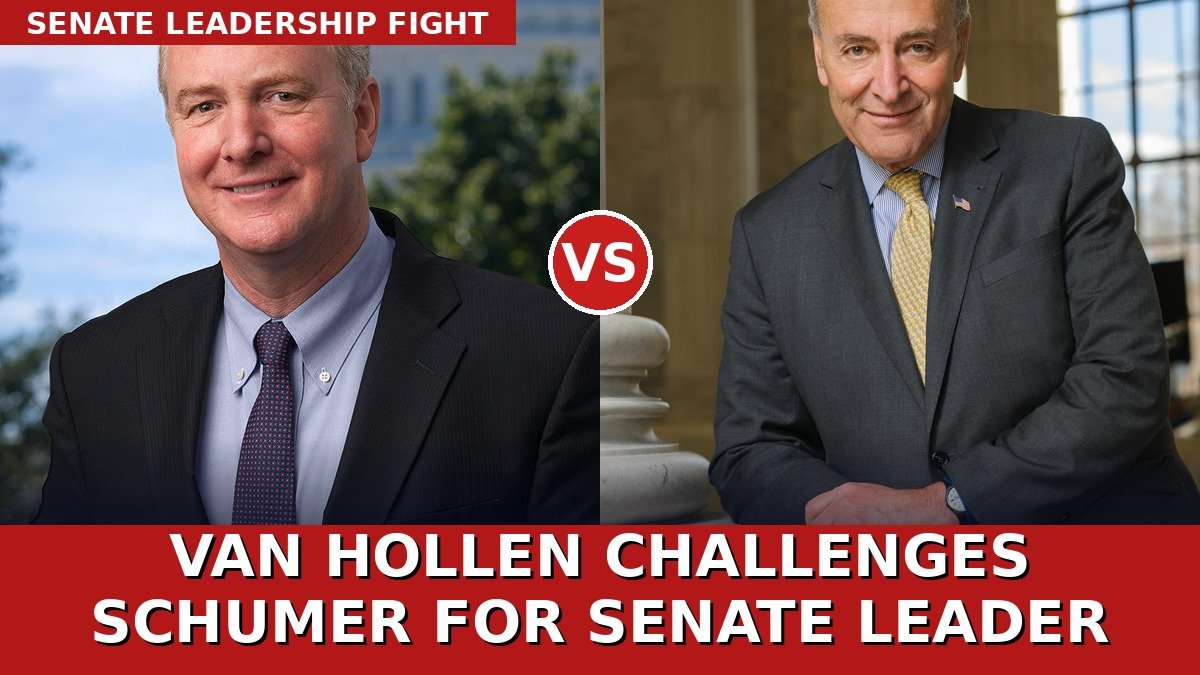
Maryland Senator Chris Van Hollen has thrown down the gauntlet. Van Hollen challenges Schumer for the job of Senate majority leader, launching an uphill fight to lead the chamber’s Democrats just days after the party’s sweeping midterm victory handed it a much bigger majority than anyone expected.
Van Hollen announced the challenge on Thursday in an interview on MS NOW, framing his candidacy as an answer to what voters demanded on election night. “This is not about any one individual, but it is about answering the call of the American people,” he said, calling his run a response to the “huge outburst of democracy” in the midterms. “The call was really to reject the status quo and to reject business as usual,” he added. “And to do that, I think we need new leadership.”
The contest will be settled by a closed-ballot leadership election on December 1. Democrats flipped eight seats in the midterms and will enter January with at least 55 senators, a result that has only sharpened the debate inside the caucus about who should lead it.
Why Van Hollen Challenges Schumer Now
The timing is no accident. Democrats’ stronger-than-expected midterm performance has not quieted longstanding frustrations many liberals have with Schumer, who has led the Senate Democratic caucus since 2017. If anything, the bigger majority has emboldened the critics: with more seats in hand, they argue, the party should be bolder, not safer.
Van Hollen has long said Senate Democrats should have a debate over their next leader, though his publicly stated interest in the job has evolved quickly in recent days. He told CNN on Saturday that seeking the position was “not my focus,” noting that he was also interested in running for president. As of Thursday afternoon, he said he was “still actively listening to members” on the topic — and then he announced.
The 67-year-old has served in Congress for more than two decades, including 14 years in the House and multiple leadership roles, making him a somewhat unlikely candidate to carry an anti-establishment banner. But he has emerged as a favorite of some progressives over the past two years, thanks to his criticism of Israel and his advocacy for a more confrontational approach to President Donald Trump.
The December 1 Vote: How the Leadership Election Works
The leadership election is a secret, closed-ballot vote of the Democratic caucus, scheduled for December 1. Schumer needs only majority support from his caucus to win — and he insists he already has it.
“I welcome any discussion about the future of our caucus and the important work ahead,” Schumer posted on X. “I’m proud of what we’ve accomplished together — 55 seats and counting is an amazing result — and I have the votes to continue serving as Democratic Leader.”
Van Hollen, pressed by MS NOW host Jen Psaki about how many commitments he had secured, said he had “more than 10” but expressed confidence his support could grow now that colleagues know he is running. He conceded he is the “underdog,” and said he believes the race “is very much in flux.”
Several returning Senate Democrats — and most incoming freshmen — have declined to publicly back Schumer for the job. That silence is itself a signal: in a caucus that will number at least 55, a leader who cannot count on public endorsements from his own new members has a problem, even if he still holds a majority in private.
Van Hollen vs Schumer: Where They Differ
Van Hollen has offered at least one specific critique of Schumer, and it goes to the heart of how the party runs its campaigns. He said he and the Democratic Senatorial Campaign Committee were too involved in Senate Democratic primaries this cycle.
“We have two members in that room, newly elected senators, who would not be there if Schumer and the DSCC had had their way,” Van Hollen said Tuesday at a post-election Democratic conference in Washington. “(They) sided with the crypto industry and AIPAC against these candidates, and my strong view is only under very, very rare exceptions should the DSCC be weighing in.”
Van Hollen said he would be different from Schumer because he would use the “full power” of the Senate to respond to voters’ desires to end the Iran war and lower the cost of living. And he promised he would not intervene in primaries for open Senate seats, as Schumer has.
The contrast extends to foreign policy. Van Hollen has accused the Israeli government of “ethnic cleansing” in Gaza, called Israeli Prime Minister Benjamin Netanyahu a “wanted war criminal,” and denounced the influence of the American Israel Public Affairs Committee. Schumer, a longtime supporter of the US-Israeli relationship, has faced growing skepticism from Democrats as the war in Gaza has divided the party.
Schumer, 75, also faces the prospect of a primary challenge — potentially from New York Representative Alexandria Ocasio-Cortez — if he runs for reelection in 2028. “I am confident I will be elected majority leader,” Schumer told reporters Tuesday, adding that there was “great unity” among Senate Democrats.
Who Is Backing Whom
Van Hollen quickly received the support of one incoming Democratic freshman, Abdul El-Sayed of Michigan, who has suggested for weeks he could back Van Hollen if he ran. El-Sayed was the first Democratic senator-elect Van Hollen endorsed in the Michigan primary, in which El-Sayed faced Representative Haley Stevens, who had Schumer’s quiet backing. Schumer supported El-Sayed after he defeated Stevens in the primary.
“He’s willing to take risks when it matters,” El-Sayed told NPR in an interview published Thursday. “Flying down to meet Kilmar Abrego Garcia was a real risk” — a reference to Van Hollen’s trip to El Salvador to meet the Maryland resident who had been mistakenly deported there, a move that drew the administration’s ire and raised Van Hollen’s national profile.
Senator Bernie Sanders, a Vermont independent who caucuses with Democrats, has also said he will not support Schumer. “If this campaign was about anything, it was about change and the need for the Democratic Party, in my view, to move in a new and bold direction,” Sanders said, adding that he has known Schumer for more than 30 years and likes him. “But in my view, the time is now for change, and I will not be supporting Chuck to be reelected as the Democratic leader.”
Sanders held a news conference Tuesday with Senator Elissa Slotkin, a Michigan Democrat, where they both made clear they wanted a new leader. Incoming Democratic Senators Adam Hamilton of Kansas, Troy Jackson of Maine, Annie Andrews of South Carolina and Peggy Flanagan of Minnesota have also reaffirmed their belief that they need a new leader.
“I think whether it’s fair or not, Chuck Schumer is seen as a more divisive figure by many people, and I think we need somebody who’s going to bring us together,” Hamilton told CNN’s Dana Bash on “State of the Union” on Sunday.
Schumer, meanwhile, got a swift endorsement from Maine Senator Angus King, an independent who caucuses with Democrats. “Chuck has outlined an aggressive plan for the new Democratic majority which is directly responsive to the message we heard from the voters, and he has the experience and unique mastery of the Senate process to make it happen,” King said in a statement.
Other Senate Democrats have said they will support Schumer based on his work to retake the majority. “When the manager takes you to the World Series, you give them another contract,” Senator Ruben Gallego, an Arizona Democrat, told reporters earlier this week. Senator Kirsten Gillibrand of New York, who ran the Senate Democrats’ campaign arm this year, praised Schumer at a news conference for overseeing what became a standout cycle for Senate Democrats. “This caucus is grateful for the hard work of Sen. Schumer,” Gillibrand said Tuesday. “No one has put in the time and effort that anyone has put into this cycle than he did.”
Even Scott Colom, who will become Mississippi’s first Black senator since Reconstruction, was noncommittal when asked whether he would back Schumer. Colom said Schumer “did initially understand that our party had to look South for future leadership. I think that it’s not accurate to say that he recruited me, though.” Asked if he would back Schumer, Colom replied: “I don’t know my options. What are my options?”
What Happens Next
With the vote less than three weeks away, both men now face the same task: counting, quietly. Van Hollen’s bet is that the race is fluid — that senators who have so far stayed silent will move once they see a real alternative on the ballot. Schumer’s bet is that the caucus will not trade the leader who just delivered its biggest majority in years for an insurgent, however popular his message.
The result will shape more than one man’s career. It will decide whether Senate Democrats spend the next two years playing defense under the leader who rebuilt their majority, or whether they hand the gavel to a challenger promising to use “the full power” of the chamber against the Trump administration — on the Iran war, on the cost of living, and on the party’s own primaries.
Either way, the December 1 ballot will be the first real test of the new Democratic majority: not against Republicans, but against itself.
Frequently Asked Questions
Who is challenging Chuck Schumer for Senate majority leader?
Maryland Senator Chris Van Hollen announced on November 12 that he will challenge Chuck Schumer for Senate majority leader, with the leadership election scheduled for December 1.
When is the Senate Democratic leadership election?
The closed-ballot leadership election is scheduled for December 1, 2026. Schumer needs majority support from the Democratic caucus to keep the job.
How many seats will Democrats hold in the Senate?
Democrats flipped eight seats in the 2026 midterms and will enter January with at least 55 senators.
Who supports Van Hollen’s challenge?
Incoming Senator Abdul El-Sayed of Michigan backs Van Hollen, as does Senator Bernie Sanders, who said he will not support Schumer. Several incoming freshmen have also said they want new leadership.
Disclaimer: This report is based on CNN’s coverage of the announcement and public statements from Senators Chris Van Hollen and Chuck Schumer. The leadership election is scheduled for December 1, 2026, and vote counts may change as senators declare their positions.