
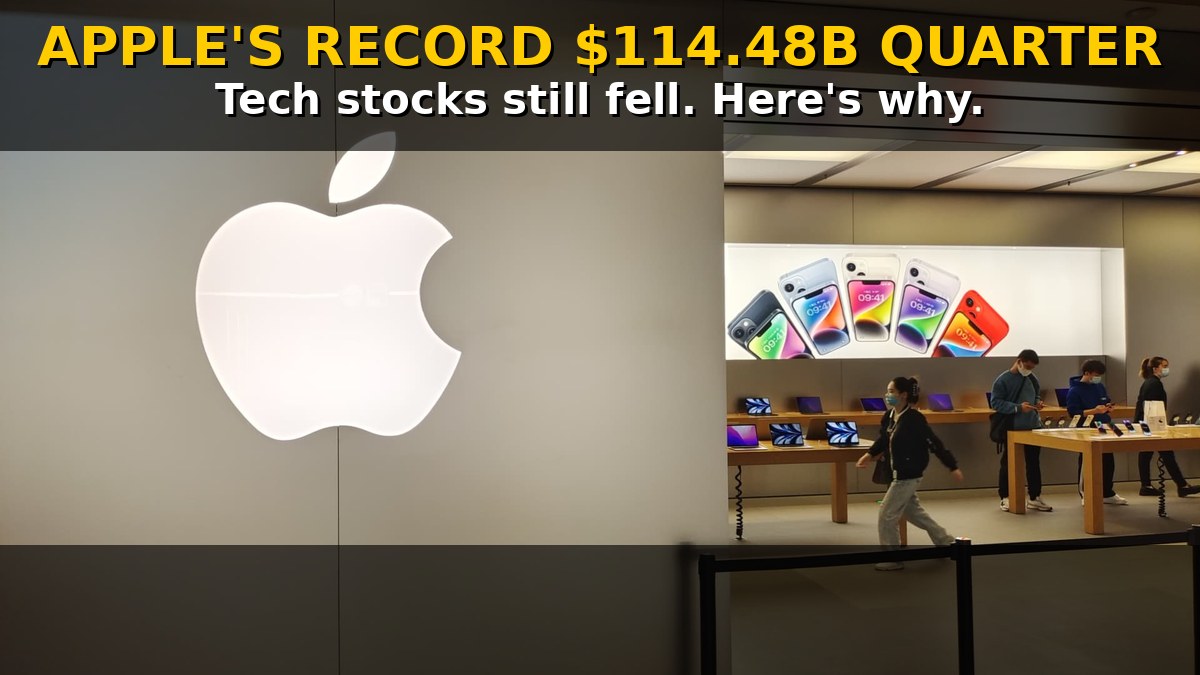
Wall Street got exactly what it asked for this week — and sold anyway. The Apple Palantir earnings beat delivered the kind of headline numbers that usually send markets higher: record revenue at Apple, nearly doubled revenue at Palantir, and guidance that topped expectations on the top line. Yet shares of both companies sank, tech stocks dropped for a third straight session, and the Nasdaq 100 slid into correction territory. When good news can’t lift the market, it tells you something uncomfortable about the mood on Wall Street.
The Apple Palantir Earnings Beat That Wasn’t Enough
On paper, Apple’s fiscal fourth quarter was a triumph. The company posted revenue of $114.48 billion, comfortably ahead of the $113.39 billion analysts expected, with GAAP earnings per share of $2.10 against a $1.99 consensus. Net income climbed 11.8% from a year ago to $30.7 billion. The iPhone — still the engine of this company — brought in $57.58 billion, up 17.5% year over year, while Mac revenue surged 23.7% to $10.79 billion. Services, the quiet growth story Apple has been building for years, delivered $31.57 billion, essentially matching expectations.
But markets rarely react to the numbers themselves. They react to what the numbers mean for the next quarter, and that’s where Apple’s story got complicated. Shares fell in after-hours trading despite the beat, and the reasons were hiding in the guidance.
What Actually Disappointed Investors About Apple
Apple’s gross margin guidance for the holiday quarter came in at 45% to 46% — below the 46.3% analysts had penciled in. The company guided fiscal first-quarter 2027 revenue growth of 7% to 10%, which did beat the 6.1% consensus, but the margin compression told investors the growth is getting more expensive to deliver.
The CFO pointed to two culprits: rising memory chip costs and heavy spending on Siri’s AI infrastructure. CEO John Ternus confirmed that memory prices rose sequentially through the September quarter and that Apple has been raising prices on iPhones, Macs, and iPads just to keep up. It worked in Q4 — the company’s 47.9% gross margin beat the 47.5% estimate — but roughly one percentage point of that margin, and about five cents per share, came from one-time tariff refunds. Strip those out, and the underlying picture is a company paying more for the chips and AI data centers it needs while trying not to scare customers with price hikes.
The spending is staggering. Research and development jumped 32.3% to $11.7 billion, and operating expenses rose 20.6% to $19.2 billion. Apple also confirmed it will start charging for advanced Siri AI features — server-based tools like AI photo editing will have usage limits, with paid upgrades sold through iCloud+. Siri already handles more than 2.5 billion requests a day, and Ternus said the company wants to be certain about privacy and user awareness before it pushes its agentic AI tools more broadly.
Then there’s the supply problem. The iPhone Duo — Apple’s new form factor — remains supply-constrained, with the company offering no timeline for when supply and demand will balance. The immediate bottleneck is availability of the advanced 2-nanometer chip node; for Macs and iPads in the December quarter, memory supply is expected to be the constraint. Apple sold almost everything it could make, and it still wasn’t quite enough.
There were soft spots in the report too. iPad revenue of $6.23 billion and wearables at $8.30 billion both missed estimates. Greater China brought in $17.54 billion against an $18.58 billion estimate — though it was up 21% in absolute terms year over year, a reminder that the comparison base there keeps moving.
Palantir: The Rare Bright Spot That Still Wasn’t Enough
If Apple was a story of a great quarter overshadowed by costs, Palantir was close to a clean win. The data-analytics company reported third-quarter revenue of $2.31 billion, beating estimates by $130 million, with adjusted earnings of $0.44 per share against a $0.41 consensus. Total U.S. revenue rose 119% from a year earlier.
The detail that mattered most: for the first time ever, Palantir’s U.S. commercial revenue surpassed its government revenue. This is a company that was born serving intelligence agencies, and its commercial business is now the bigger engine. CEO Alex Karp said demand for its AI tools is “much larger than we can service” — the kind of sentence executives usually only say in private.
Palantir also threw some shade at the competition, disclosing that a fine-tuned Nvidia Nemotron model with just 4 billion parameters beat both GPT-6 Astra and Claude Sonnet 5.5 on a real-world construction task — at roughly 75% accuracy and $0.10 per million tokens, against 62% accuracy and $20 per million tokens for the flagship models. The point was unmistakable: the expensive models may not be worth their cost.
The $7 Trillion Question Haunting Tech Stocks
All of this landed in a market that had stopped believing the AI story, at least at current prices. The Nasdaq 100 entered correction territory on November 2, falling 1.39% on the day, while the S&P 500 lost 0.51%. Oracle plunged 8.8% after announcing a $20 billion combined debt and equity raise — money markets assumed would fund more AI buildout. AMD slid 7.5%, Datadog 6.3%, Micron 5.8%.
The worry crystallized in a single comment from Oaktree co-chair Howard Marks, who questioned whether an estimated $7 trillion in AI infrastructure investment can ever generate enough profit to justify itself, calling the spending “in large part an arms race.” The evidence for skepticism keeps arriving: Anthropic disclosed nearly $900 billion in AI infrastructure commitments ahead of its IPO even as its quarterly compute costs jumped 77%, outpacing revenue growth. Elon Musk admitted the costs of running SpaceX’s Grok Bot AI agent were “unsustainably high relative to revenue,” despite reaching 800,000 paid weekly users in October.
That’s the real context for the Apple Palantir earnings beat. Investors aren’t doubting that these companies can grow. They’re doubting what the growth costs — and whether anyone, including the AI industry’s biggest spenders, knows how to turn hundreds of billions in data-center spending into matching profits.
What This Means for Investors
There are two ways to read this week. The pessimistic one is that even the best quarter Apple has ever posted can’t hold up its stock when margins are under pressure, which suggests the bar for the entire market has moved beyond reach. The optimistic one is that the selloff is exactly the kind of fear-driven reset that creates opportunity — Apple is still growing iPhone revenue at 17.5%, Palantir’s commercial business is exploding, and both companies are generating real cash while spending on AI.
The truth is probably somewhere between. Apple is a $5 trillion company transitioning into an AI-driven cost structure, and transitions are messy. Palantir is the exception proving the rule — it’s monetizing AI right now, which is exactly why its report stood out. Until the rest of the industry can show the same, markets are likely to keep punishing even the good quarters. The earnings were fine. The fear is about everything else.