
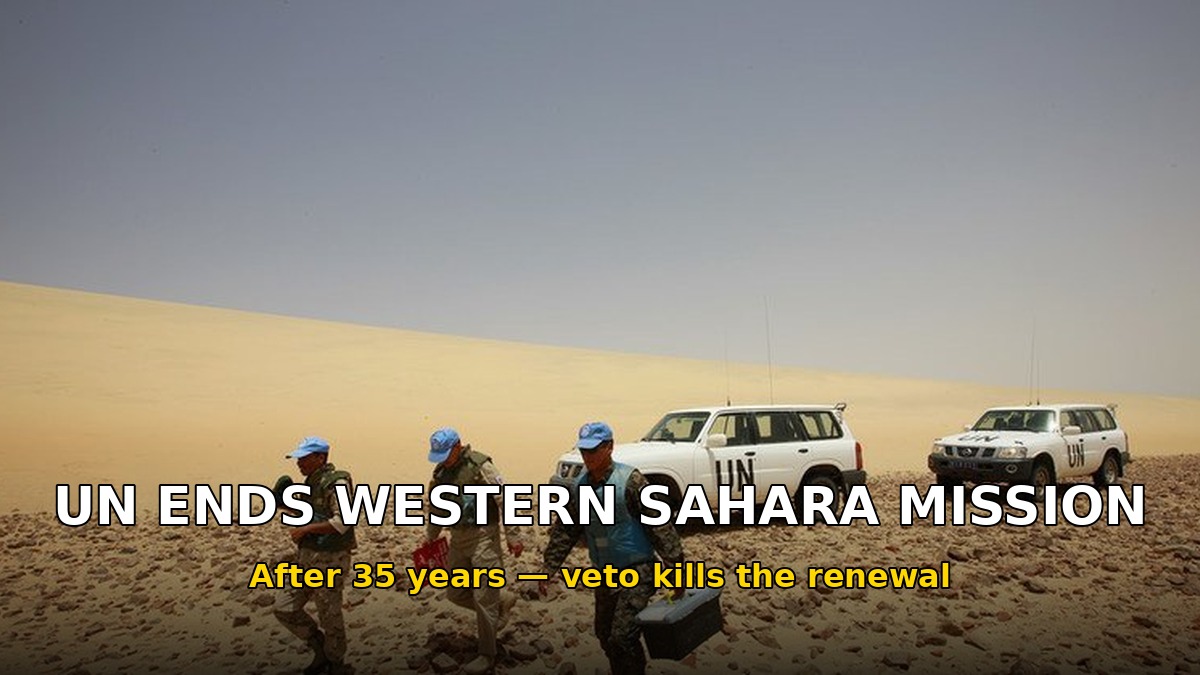
Thirty-five years of blue berets ended with a shrug in New York. On Sunday, the United Nations began switching off the Western Sahara mission — a peacekeeping force that arrived with a ceasefire and a promise of a referendum, and leaves with neither the vote nor the peace fully settled.
The mission, known by its French acronym MINURSO, stopped operating after its mandate expired at midnight on Saturday. The United Nations confirmed Sunday that the force has entered what it calls a liquidation phase: a smaller team, reporting to the Department of Operational Support, will pack up equipment and send assets back to the countries that contributed troops.
Secretary-General António Guterres warned that the departure carries real risks. In a statement delivered by his spokesperson, he cautioned that the security situation in the disputed territory remains fragile and that the risk of renewed hostilities is increasing. He added, pointedly, that the end of the mission “does not abrogate” the people’s “inalienable right to self-determination” — a line aimed at anyone tempted to read the withdrawal as a political verdict.
How the mandate died: Friday’s Security Council deadlock
The mission did not end because anyone agreed it should. It ended because the Security Council could not agree on anything at all.
On Friday, the United States put forward a draft resolution that would have renewed MINURSO for another year — but on new terms. The American text sought to strip the word “referendum” from the mission’s name and to make Morocco’s autonomy proposal the sole basis for future negotiations. Eleven of the fifteen Council members backed it, including France and the United Kingdom. Russia vetoed it.
Moscow then offered its own draft: a straightforward one-year extension to October 31, 2027, with no changes to the mandate’s language. That text won only three votes in favor, with the United States voting against and eleven members abstaining — well short of the nine votes needed. With neither resolution adopted, the mandate simply ran out.
Washington and Moscow blame each other
US Ambassador to the UN Mike Waltz did not hide his frustration. Speaking after the vote, he said it was “truly unfortunate” that in 2026, the veto had been used to “preserve the letter R [in the mission’s name] for referendum.” Washington, he said, had tried to support the principle of self-determination while moving a “50-year conflict” forward, and called the status quo unacceptable.
Russia’s position was that the American draft tilted the field. Moscow argued the proposal favored one side by removing the referendum — the mechanism the mission was founded to deliver — and replacing it with Morocco’s autonomy plan as the only path forward.
The Polisario Front, which seeks independence for the territory, said it was “concerned at the deadlock in the Security Council meeting.” Pakistan abstained on both drafts, urging a mutually acceptable political solution reached through dialogue and consensus.
A mission built for a vote that never came
MINURSO was created in 1991 under Security Council Resolution 690, after Morocco and the Polisario Front accepted a UN-brokered ceasefire. The settlement plan was elegant on paper: the UN would watch the truce and organize a referendum on self-determination, with independence among the options on the ballot.
The vote never happened. Thirty-five years on, the two sides still cannot agree on the most basic question — who gets to vote. Morocco expanded settlements and administration in the territory; the Polisario, backed by Algeria, held to its claim of independence; the ceasefire held, mostly, and the mission settled into a long routine of patrols, mine clearance, and waiting.
The mission was not cheap to maintain either. A UN budget proposal put its operating cost at about $62.7 million for the July 2026 to June 2027 period — money that will now not be spent, at least not on MINURSO.
What happens next in Western Sahara
In practical terms, the buffer is gone. For three and a half decades, UN patrols separated Moroccan forces from Polisario fighters along the berm — the long sand wall dividing the territory. No successor force has been agreed, and no new vote has been scheduled.
The United Nations insists it is not walking away from the diplomacy. Guterres said the organization “stands ready to continue supporting efforts to advance dialogue and pursue a peaceful resolution,” with his Personal Envoy, Staffan de Mistura, remaining the channel for political talks. But an envoy is not a presence on the ground, and in a region where a single incident can unravel a ceasefire, the distinction matters.
Why this matters beyond the desert
The Western Sahara file has always been about more than sand. It is a stress test for how the international system handles frozen conflicts — and the Council’s failure to renew even a routine mandate, with a veto on one side and eleven abstentions on the other, says something bleak about the current state of great-power agreement.
It is also, notably, the second time in two years that Washington tried to reshape the mission in Morocco’s favor. A year ago, the Council passed a US-drafted resolution describing Morocco’s autonomy plan as the most viable option. Friday’s failed draft would have gone further — removing “referendum” from the mission’s name entirely. Russia’s veto has now killed the mission instead, an outcome neither capital says it wanted.
For the Sahrawi people, the symbolism is stark: the force that was supposed to organize their vote has left without organizing it. For the region, the question is whether the fragile truce can survive without the watchers. The coming weeks — the first without UN patrols since 1991 — will provide the answer.