
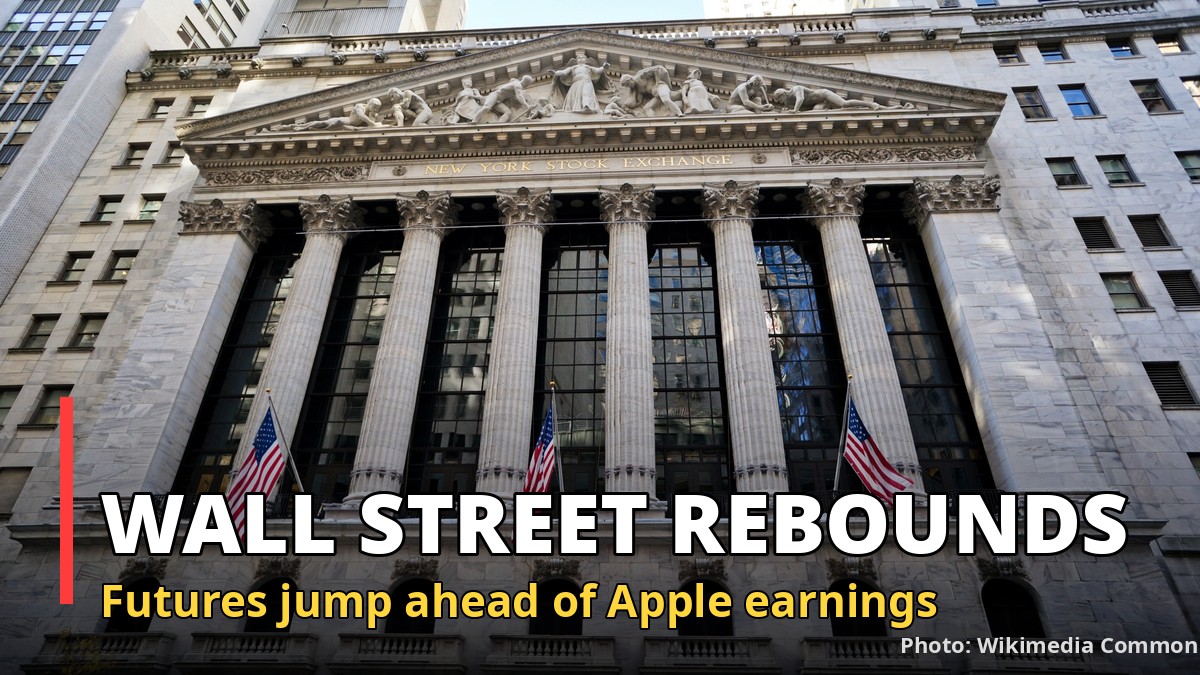
Wall Street woke up in a better mood on Monday. After a Friday sell-off that erased more than a trillion dollars of market value in a single session, U.S. stock futures pointed higher as traders reset for one of the most consequential weeks of the year — Apple earnings after the closing bell, midterm elections on Tuesday, and the October jobs report on Friday.
Contracts tied to the Dow Jones were up more than 165 points on Sunday evening, with S&P 500 futures adding 30 points and Nasdaq futures climbing close to 200 points. By Monday morning the recovery had gathered pace: Dow E-minis were up 270 points, S&P 500 E-minis had gained nearly 40 points, and Nasdaq-100 futures were up more than 250 points in the premarket. For a market that spent October flinching at artificial-intelligence spending, it was a badly needed exhale.
What happened on Friday
The rebound only makes sense against what came before. Friday was the market’s worst session in four months. The Nasdaq Composite tumbled 2.86 percent to close at 25,437.00, the S&P 500 fell 1.82 percent, and the Dow dropped 1.09 percent — a rout that wiped out more than $1 trillion in capitalisation before the weekend.
The damage was concentrated where it has been all autumn: big technology and artificial intelligence names. Intel logged its worst one-day fall since the 1980s after forecasting quarterly revenue below Wall Street’s estimates and admitting it does not expect positive cash flow this year. The Nasdaq-100 has shed more than $2.5 trillion in market value over the past month, and at Friday’s close it was hovering on the edge of correction territory.
October, as it turned out, was a tale of two markets. The Dow managed to finish the month higher, while the S&P 500 and Nasdaq both closed October in the red. One striking detail from Yahoo Finance’s tally: the biggest AI and chip stocks have lost roughly $5 trillion since October 6, while the other 625 large U.S. companies actually gained about $1.3 trillion. The sell-off was a rotation out of AI, not a broad-based panic.
Apple’s earnings are the main event
All eyes are now on Apple, which reports quarterly results after Monday’s close. The iPhone maker ended Friday worth about $5.03 trillion — once again the world’s most valuable company, ahead of Nvidia at roughly $4.93 trillion. It is also the only one of the so-called Magnificent Seven stocks beating the S&P 500 this year, up about 27 percent against the index’s 11 percent.
Analysts expect quarterly earnings of around $2 a share on revenue of roughly $113 billion, up from $1.85 a share a year earlier. The number investors will really be watching, though, is demand for the new iPhone 18, which is expected to set the tone for the holiday quarter. Apple shares eased about 0.4 percent in Monday’s premarket — a sign of how much is riding on the print.
It is not alone on the calendar. Palantir also reports after Monday’s close, offering a read on enterprise demand for AI software, while AMD, Amgen, Pfizer, Qualcomm and Arm Holdings follow later in the week. Berkshire Hathaway closes out the earnings run on Friday.
Tuesday’s midterm vote looms over everything
The biggest single trigger this week, though, may not be an earnings call at all. Voters head to the polls on Tuesday for the U.S. midterm elections, which will decide all 435 seats in the House of Representatives and about a third of the Senate. Polls cited by CNBC point to Democrats taking control of both chambers, while other surveys say the House is likely to flip and the Senate remains a toss-up.
President Donald Trump has refused to accept an adverse outcome, saying he would veto it — a statement that adds a political wildcard to an already nervous market. For traders, the risk is not just who wins but whether the result is contested. A Democratic House could also complicate the administration’s agenda on data-centre development and technology policy.
The jobs report and the Fed
Friday brings the October jobs report, the week’s heaviest economic data. Economists polled by Dow Jones expect payrolls to have grown by about 55,000 — a modest number that will feed directly into the debate over whether the Federal Reserve has room to keep easing. The October policy decision is now behind the Fed, and its blackout period has lifted, with three officials scheduled to speak this week.
Markets are still pricing roughly a 72 percent chance of a rate hike in December, even as the 10-year Treasury yield has eased to around 4.94 percent, below its October peak. The data week also includes the ISM manufacturing report on Monday, job openings on Tuesday, and services PMI on Wednesday, while the central banks of Australia, the UK, Norway and Sweden all make rate decisions.
Morgan Stanley’s veteran says buy the dip
Not everyone is running for cover. Morgan Stanley’s Mike Wilson told Bloomberg that while elections, AI anxiety and liquidity concerns could drag the S&P 500 down toward 7,100, he expects it to recover back toward 8,000 once the stress clears — and he remains firmly bullish.
Monday’s early trading suggested at least some investors agree. Megacap and growth stocks rose in the premarket, with SpaceX and Alphabet among the top gainers and beaten-down chip names like AMD, Nvidia and Micron all bouncing back. Crude oil eased on hopes for a diplomatic solution between the U.S. and Iran, with negotiators meeting for a third day in Doha — though reports that Iran’s supreme leader ordered the armed forces to brace for attack kept the rally modest.
The setup for the rest of the week is about as full as it gets: election results, Apple and a wave of tech earnings, and the jobs report that could decide the Fed’s next move. Monday’s rebound buys the bulls some breathing room. Whether it lasts will depend on what Apple says after the bell — and what the voters say on Tuesday.