
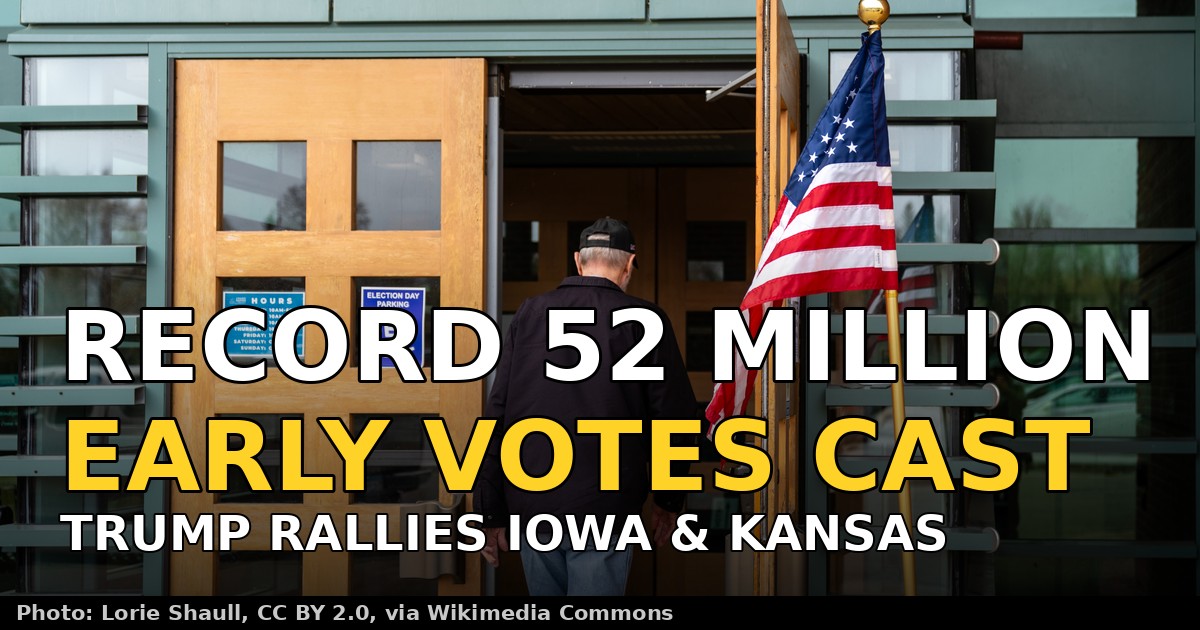
52 million early votes have already been cast before most Americans have even reached Election Day. More than 52 million people had voted in person or by mail by Sunday, according to the University of Florida Election Lab, a midterm record that beats the nearly 46 million who had voted early before Election Day in 2022. That number, released as Donald Trump campaigned through Iowa and Kansas, tells a story about enthusiasm, about worry, and about a country that is deciding its future in stages, not all at once on Tuesday.
Trump spent Sunday in the Farm Belt, in states where Republicans are fighting to hold US Senate seats and where rural voters have long been a core part of the party’s coalition. Iowa and Kansas are not the states that dominate national news every day, but in a midterm where control of the Senate could turn on a few seats, they matter enormously. Trump rallied in both, urging supporters who had not yet voted to turn out, and urging those who had to bring friends, family and neighbours with them.
The 52 million early votes total puts those rallies in context. When 52 million ballots are already cast, a rally is no longer just about persuading undecided voters. It is about banking votes, about making sure supporters who promised to vote actually do, and about creating a final surge that can carry a candidate over the line in a close race. In Iowa and Kansas, where Senate races are being watched closely, that final surge could be the difference between holding a seat and losing it.
What 52 million early votes really mean
Voting early has become a normal part of American elections, not an exception. States now offer in-person early voting for days or weeks, or mail ballots that voters can return at their own pace. That system changes how campaigns work. Instead of a single day of persuasion, campaigns run a weeks-long effort to get their supporters to vote as soon as they can, then spend the final days chasing the voters who have not yet returned a ballot.
The jump from nearly 46 million in 2022 to more than 52 million this year is large, and it is worth pausing on what it does and does not prove. It proves that a lot of people wanted to vote early, and that both sides did a lot of work to make it happen. It does not, by itself, prove who will win. Early voters include Democrats, Republicans and independents, and the mix varies by state, by age and by how each party has talked about early voting in recent years.
Polls show Democrats tied or leading in many Iowa races, a sign that the state, once seen as reliably Republican, is competitive again. That competitiveness is one reason Trump was there in the final days. Iowa is also a place where Trump’s approval among rural Americans fell to a new low of 45% in October, according to Reuters/Ipsos polling, a figure that will worry Republicans who count on rural turnout to win statewide races.
Why the 52 million early votes record matters for Tuesday
A record early vote does not decide Tuesday, but it does change Tuesday. It means fewer votes are left to be cast on Election Day itself, and it means campaigns have a clearer, though still incomplete, picture of who has already voted. Parties use that information, where they can, to focus their final efforts on the voters who have not yet voted, rather than wasting time on people who have already cast a ballot.
For voters, the 52 million early votes record is also a reminder of how much has already been decided, and how much is still open. Millions of ballots are in, but millions more will be cast on Tuesday, and in close races, those Tuesday votes, together with mail ballots that arrive late and are counted after Election Day, can still change the result. That is why both parties, even after a record early vote, are still campaigning as if everything is on the line. In many races, it is.
The Iowa and Kansas rallies fit that pattern. Trump was not just speaking to the people in the room. He was speaking to voters who had not yet voted, to voters who were thinking about voting, and to voters who could persuade someone else to vote. In a midterm, where turnout is lower than in a presidential year, that kind of personal push, repeated in state after state, is often what decides a close Senate race.
Sources and Resources
Source: Reuters – Trump heads to Iowa, Kansas rallies before midterms. The report covers Trump’s Sunday rallies in Iowa and Kansas, the more than 52 million early votes counted by the University of Florida Election Lab, the nearly 46 million early votes in 2022, and Trump’s approval among rural Americans at 45% in October, according to Reuters/Ipsos. More coverage is available on the WorldReach Daily homepage.
Frequently Asked Questions
How many people voted early?
More than 52 million people voted in person or by mail before Election Day, according to the University of Florida Election Lab, a midterm record.
How does that compare with 2022?
In 2022, nearly 46 million people had voted early before Election Day. This year’s total of more than 52 million is higher, by more than 6 million votes.
Why was Trump in Iowa and Kansas?
Trump rallied Sunday in Iowa and Kansas, Republican-leaning Farm Belt states where his party is fighting to hold US Senate seats, two days before the midterms.
Does 52 million early votes mean we know who will win?
No. Early voters include Democrats, Republicans and independents, and the mix varies by state. Tuesday’s votes, and mail ballots counted after Election Day, can still change close races.
What did the polls say about Iowa and rural voters?
Polls show Democrats tied or leading in many Iowa races, and Trump’s approval among rural Americans fell to a new low of 45% in October, according to Reuters/Ipsos.
Conclusion
The 52 million early votes record is a sign of a country that is already voting, in large numbers, before Election Day. It is also a sign of a campaign that is not over. Trump’s rallies in Iowa and Kansas, the polls in Iowa, and the rural approval figure all point to the same thing: Tuesday will decide the rest, and in the closest races, the rest could decide everything.