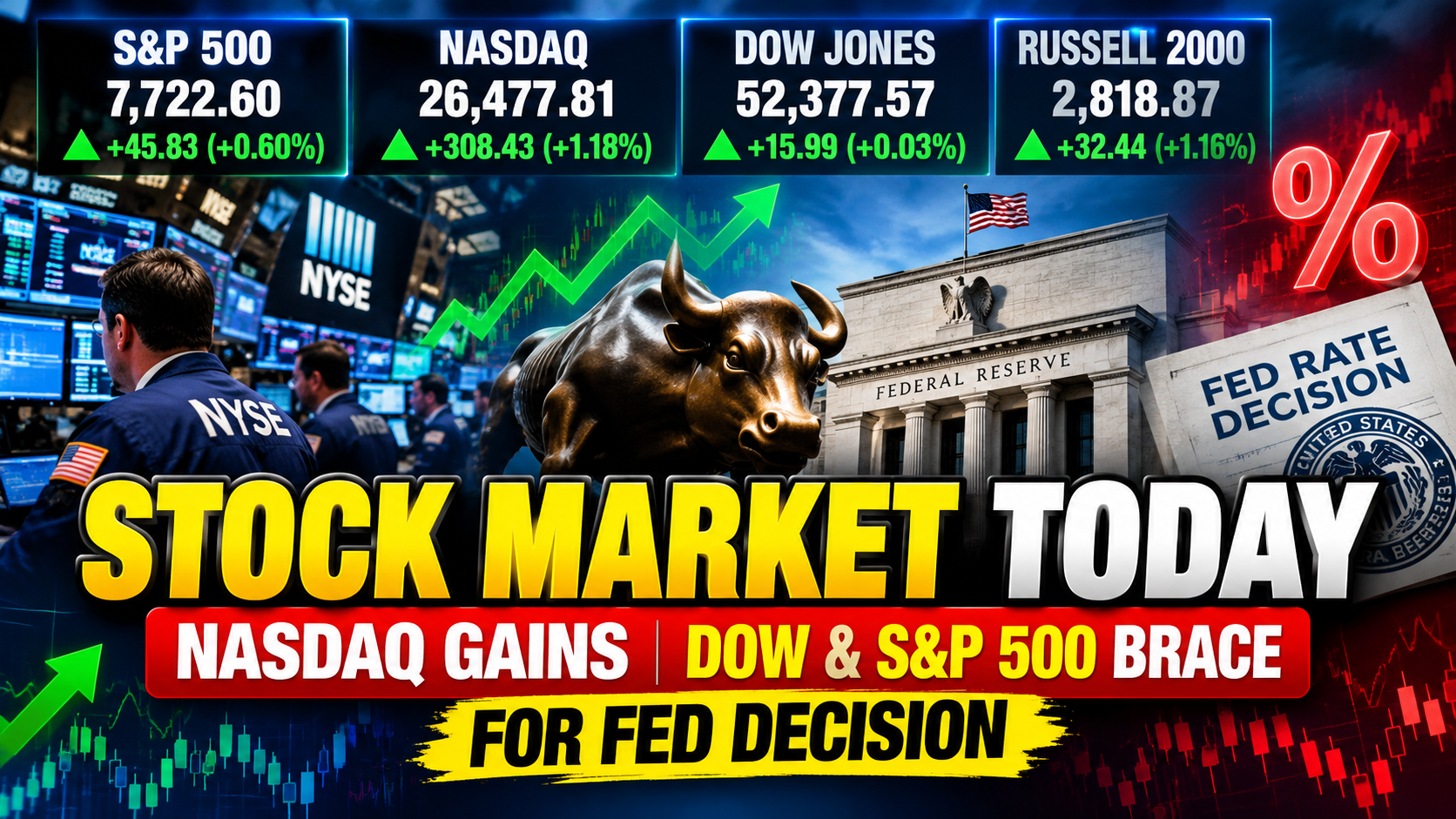
The Amazon Q3 earnings Nasdaq story on Thursday was a harsh one for big tech. Amazon fell 4.25% after its third-quarter report, closing at $243.79, down $10.81 on the day. The Nasdaq Composite finished at 26,185, down 1.38%, as a sharp fall in Alphabet shares dragged the whole tech sector lower. A day that started with hopes for another strong earnings season ended with investors asking how much more they are willing to pay for growth.
Amazon’s headline numbers explain part of the reaction, but not all of it. Revenue came in at $201.9 billion, up 12% from a year earlier, and diluted earnings per share were $1.89. Those are large numbers by any measure. The market, though, was looking past the quarter just ended and towards what comes next, especially the cost of building the infrastructure behind cloud computing and artificial intelligence.
Amazon Q3 Earnings Nasdaq: Why the Shares Fell
Trading in Amazon was heavy. Volume reached 70.8 million shares, about 81% above the three-month average of around 39 million. When volume jumps that much on a down day, it usually means big holders are changing their minds, not just small traders taking profits. Investors were reacting to two things at once: the earnings report itself, and concern about capital spending.
Amazon has committed to huge infrastructure spending, with $220 billion in capital expenditure in focus in the Motley Fool report. Management also projected that AWS revenue growth rates will exceed 40% in both 2027 and 2028. That is a bold forecast, and it raises a fair question. If growth that strong is coming, why spend so much now, and when will the spending start to pay off? Markets hate uncertainty, and a large spending plan is a form of uncertainty, even when it is tied to a growing business.
AWS, Amazon’s cloud division, remains the engine of the company’s profits. Cloud growth has been the story behind Amazon’s share price for years, and investors watch it more closely than the retail business. A forecast of growth above 40% in 2027 and 2028 should, in theory, reassure them. On Thursday, it did not outweigh worries about the bill for getting there.
Alphabet’s Plunge Pulled the Nasdaq Down
Amazon did not fall alone. Alphabet, the parent company of Google, dropped 12.3% to $282.32, down $39.57, according to the market data in the report. A fall that large in one of the biggest companies in the index is enough to move the Nasdaq on its own. When the largest stocks fall together, index funds and pension funds that hold them feel it at once, and the selling can spread to other tech names.
The wider market reflected that mood. The S&P 500 closed at 7,720, down 0.31%, while the Dow finished at 52,342.56, down 0.3%. The Nasdaq’s 1.38% drop was far steeper, which tells you where the pain was concentrated. This was a tech sell-off, not a broad market panic. Investors were not dumping everything. They were dumping the stocks that had risen furthest and fastest, and asking whether their valuations still made sense.
Not every stock fell. Walmart closed at $121.25, up 2.09%, and eBay finished at $121.19, up 2.69%. Those gains are a useful reminder that a bad day for tech is not always a bad day for every company. Shoppers still shop, and companies tied to everyday spending held up better than companies tied to cloud spending and AI bets.
What Investors Will Watch Next
The next test for Amazon is simple: can AWS growth stay strong while spending is kept under control? If the cloud business grows as management projects, the spending will look like an investment. If growth slows, the same spending will look like a burden. Earnings calls and quarterly updates will be judged on that balance, not on revenue alone.
The same test applies to Alphabet and the rest of big tech. Investors have paid high prices for these companies because they expected rapid growth. When a company misses expectations, or even when it meets them but warns about costs, the share price can fall hard. That is what happened on Thursday, and it is likely to happen again before this earnings season ends.
For ordinary investors, the lesson is not to panic on one day’s trading. A 4.25% fall in Amazon and a 1.38% fall in the Nasdaq are painful, but they do not change the underlying businesses overnight. What matters is whether the growth forecasts hold up over the next few quarters, and whether the spending that worries the market today turns into profits tomorrow.
Sources and Resources
Read the original reporting on the Amazon Q3 earnings Nasdaq sell-off here:
See more finance coverage on World Reach Daily.
How much did Amazon fall?
Amazon closed at $243.79, down 4.25%, or $10.81, on Oct. 29, after its Q3 earnings report.
What did Amazon report for Q3?
Revenue of $201.9 billion, up 12% year over year, and diluted earnings per share of $1.89.
How far did the Nasdaq fall?
The Nasdaq Composite finished at 26,185, down 1.38%, while the S&P 500 fell 0.31% and the Dow fell 0.3%.
Why did Alphabet matter so much?
Alphabet fell 12.3% to $282.32, and a fall that large in such a big index stock drags the Nasdaq lower with it.
What is Amazon spending on?
Infrastructure for cloud and AI growth, with $220 billion in capital expenditure in focus, while management projects AWS revenue growth above 40% in 2027 and 2028.
Conclusion
The Amazon Q3 earnings Nasdaq sell-off was a reminder that even strong companies can fall when the market doubts the cost of future growth. Amazon’s revenue grew 12% and AWS is forecast to grow above 40% in 2027 and 2028, yet the shares fell 4.25% and the Nasdaq dropped 1.38% as Alphabet plunged. Investors will now watch AWS growth and capital spending closely. If growth holds, Thursday will look like a buying opportunity. If it does not, the tech sell-off may have further to run.
The Amazon Q3 earnings Nasdaq reaction was not just about one company’s quarter. The Amazon Q3 earnings Nasdaq story shows how a single earnings miss can drag an entire index when the missing company is as large as Amazon, and when a second giant, Alphabet, falls even harder on the same day. The Amazon Q3 earnings Nasdaq sell-off hit the stocks that had carried the market higher for months, and traders spent Thursday asking whether the prices they had paid for growth still made sense.
For ordinary investors, the Amazon Q3 earnings Nasdaq drop is a reminder that a 4.25% fall in Amazon and a 1.38% fall in the Nasdaq do not change the underlying businesses overnight. The Amazon Q3 earnings Nasdaq question now is whether AWS growth stays strong while spending is kept under control, and whether the spending that worries the market today turns into profits tomorrow. The Amazon Q3 earnings Nasdaq verdict will come from the next few quarters, not from one day’s trading.