
The Israel election deadlock is now official. With all the votes counted, no bloc in Israel’s 120-seat Knesset has reached the 61 seats needed to form a majority government. Prime Minister Benjamin Netanyahu’s bloc finished with 53 seats, the opposition bloc with 48, and Arab parties with 19, according to final results published by CNN from Israel’s Central Electoral Commission.
That split leaves Israel in a familiar but uncomfortable place: a prime minister who has not won, an opposition that has not won either, and a parliament where the path to a government runs through parties that neither side can take for granted. As CNN’s Tal Shalev put it, Netanyahu hasn’t won — but he hasn’t lost either, at least not yet.
Israel Election Deadlock: The Final Numbers
The arithmetic is stark. Netanyahu’s bloc is eight seats short of a majority. Its 53 seats come from Likud with 27, United Torah Judaism with seven, Otzma Yehudit with seven, Shas with six, and Religious Zionism with six. The opposition bloc, led by Gadi Eisenkot’s Yashar party, is 13 seats short. Its 48 seats come from Yashar with 21, Together with 12, the Democrats with eight, and Yisrael Beiteinu with seven.
Then there are the Arab parties, with 19 seats between them: 11 for the Joint List and eight for Raam. Add the three blocs together and you get the full Knesset: 53 plus 48 plus 19 equals 120. No combination is simple, and no single bloc can govern alone.
The result is a step on from the exit polls, which had already pointed to no clear winner. Final counts confirmed that picture rather than overturning it, and that confirmation is what makes the next stage so hard. Both main blocs need help from outside their own camp, and the parties outside it know it.
Why the Arab Parties Now Hold the Balance
The 19 seats won by Arab parties are unprecedented, CNN reported, and analysts linked record turnout by Arab or Palestinian citizens of Israel in part to a backlash during the campaign. That turnout turned a group often treated as a side note in coalition maths into the centre of it.
The maths, though, gets complicated fast. Raam is an Islamist party that draws heavily from Israel’s Arab community, and its politics do not sit neatly with either main bloc. On Wednesday, Yair Golan, leader of the left-wing Democrats party, called on his partners to count the Arab parties in, and the Joint List said it was ready for political cooperation. Eisenkot then held separate meetings with Golan and with Naftali Bennett, where they discussed their options.
For Netanyahu, the Arab parties present a different kind of problem. He campaigned against them throughout the election, and his camp has since tried to cast doubt on parts of the result. Likud issued a statement on Thursday calling into question aspects of the vote, after the Central Elections Committee chair raised concerns. But the committee’s director general, Dean Livne, rejected claims of widespread fraud, and the opposition broadly backed an investigation while framing the allegations as an effort by Netanyahu’s camp to shape what comes next.
What Will Netanyahu Do?
Netanyahu’s career has spanned more than three decades, and he has been written off too many times to count. A source close to him told CNN his main post-election goal is to stop his rivals from forming a minority government. The source said Netanyahu is very concerned about a minority government and plans to neutralise that possibility by all means, including launching legal challenges.
The opposition, for its part, fears Netanyahu could use a security crisis to stall or block a new government. That fear, voiced by an opposition source to CNN, shows how tense the coming weeks could be. Neither side trusts the other to play this straight, and both are preparing for a fight over process as much as over policy.
Qatar, meanwhile, which ministers named as the foreign power involved in the fraud allegations, called those allegations ridiculous. The exchange underlines how quickly a domestic coalition dispute can pick up an international edge, and how much noise there will be around every procedural step from here.
What Comes Next: Herzog Holds the Key
The next step runs through President Isaac Herzog, whose post-election role is now pivotal. Herzog will hold consultations and collect recommendations from the parties, and the candidate who emerges from that process gets the first chance to form a government. Eisenkot is likely to collect more recommendations than Netanyahu, CNN reported.
Herzog himself has urged restraint. “We must do everything to avoid another round of elections,” he said on Wednesday, calling on parties to work towards a government rather than another campaign. It is a plea that will be tested quickly, because the numbers give nobody an easy route.
Once Herzog picks a candidate, the clock starts ticking. The chosen candidate has 28 days, with a possible 14-day extension, to negotiate with other parties and put together a coalition that can win a confidence vote. Netanyahu, as caretaker prime minister, has a built-in advantage in that period: he stays in office while the talks go on, and time spent without a new government is time he remains in charge.
Eisenkot, a former Israel Defense Forces chief of staff, is not out of options entirely. Even without a straightforward majority, the opposition can use its parliamentary weight to shape what happens next. But he is not on his preferred battlefield. Netanyahu’s coalition partners are disciplined, his camp knows how to run a long negotiation, and Eisenkot will need to hold together parties that agree on little beyond wanting a change at the top.
Sources and Resources
Read the original reporting on the Israel election deadlock here:
- CNN: The final Israeli election results are in. Netanyahu hasn’t won – but he hasn’t lost either
- World Reach Daily
Who actually won the Israel election?
Nobody won outright. Netanyahu’s bloc got 53 seats and the opposition got 48, and neither reached the 61 needed for a majority in the 120-seat Knesset.
How many seats did Netanyahu’s bloc win, and from which parties?
53 seats in total: Likud 27, United Torah Judaism seven, Otzma Yehudit seven, Shas six, and Religious Zionism six. That leaves the bloc eight seats short of a majority.
How many seats did the opposition win?
48 seats: Yashar 21, Together 12, the Democrats eight, and Yisrael Beiteinu seven. That leaves the opposition 13 seats short of a majority.
Why do the Arab parties matter so much this time?
They won 19 seats, 11 for the Joint List and eight for Raam, after record turnout. With neither main bloc near 61, those 19 seats are the difference between a government and a stalemate.
What happens next in Israel?
President Isaac Herzog holds consultations and picks a candidate to try to form a government. That candidate gets 28 days, plus a possible 14-day extension, to build a coalition. If no one manages it, Israel could face more weeks of talks, or another election.
Conclusion
The Israel election deadlock leaves the country exactly where the exit polls suggested it would be: split down the middle, with a caretaker prime minister who has survived again and an opposition that has come close but not close enough. The final numbers — 53, 48 and 19 — tell the story in one line. What happens next depends on Herzog’s consultations, on whether Eisenkot can turn recommendations into a coalition, and on whether Netanyahu can block a rival government without triggering the election nobody says they want. For now, Israel waits, and the waiting could last weeks.
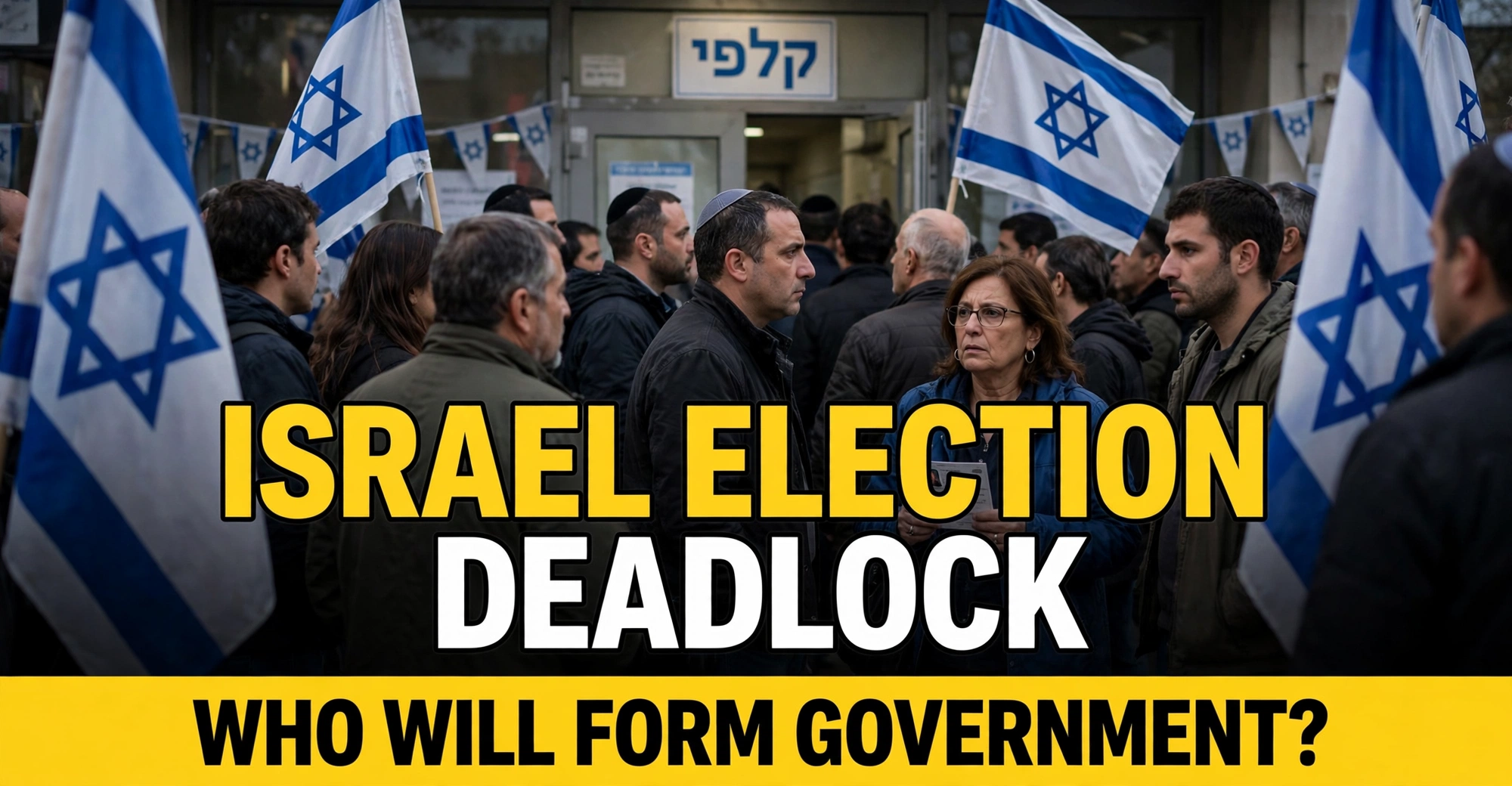
Voters in Israel cast ballots in an election that ended with no bloc reaching a majority.
The Israel election deadlock will now move into its hardest phase. The Israel election deadlock is not just a numbers problem: it is a test of whether parties that campaigned against each other can sit in the same room and agree on a government. The Israel election deadlock also puts Herzog in the spotlight, because his choice of candidate will shape every negotiation that follows.
For ordinary Israelis, the Israel election deadlock means more waiting. The Israel election deadlock could still end with a coalition, a minority government, or another election, and the Israel election deadlock will only be resolved when one candidate can count to 61.