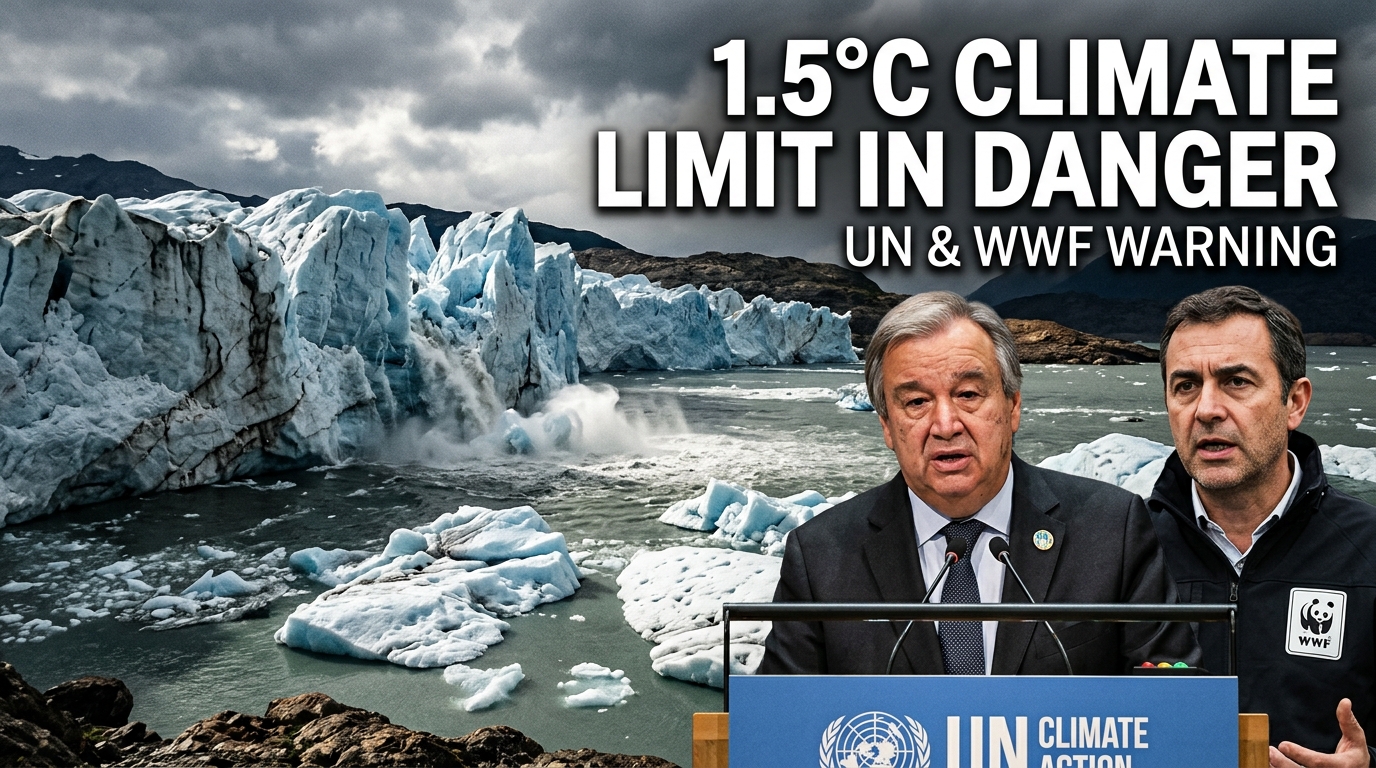
The Fight for Humanity: UN and WWF Issue Dire Warning on the 1.5°C Climate Limit
The global community stands at a critical historical crossroads. In a major joint wake-up call, the United Nations Environment Programme (UNEP) and the World Wide Fund for Nature (WWF) have warned that the Earth is dangerously close to permanently breaching the critical 1.5°C climate limit pre-industrial global warming threshold. Characterized by international environmental leadership as the ultimate “fight for humanity,” this stark assessment underscores an urgent need for immediate, aggressive cutbacks in fossil fuel dependency and fugitive methane emissions before irreversible ecological tipping points are triggered.
Also read:
iPhone 18 Launch Strategy: Why Apple is Delaying the Base Model to 2027
The Anatomy of an Approaching Catastrophe
Decades of relentless greenhouse gas emissions have pushed the planet’s vital signs to the brink. Under the landmark 2015 Paris Agreement, nations committed to pursuing efforts to limit long-term global temperature increases to 1.5°C above pre-industrial levels, recognizing that every fraction of a degree exponentially amplifies climate risks. However, recent data from comprehensive assessments like UNEP’s Emissions Gap Report underscore that current national climate pledges (NDCs) still leave the world on a trajectory toward a catastrophic multi-decadal warm-up unless ambition scales up dramatically.
While individual calendar years have already danced past this crucial boundary during intense natural anomalies and compounding human emissions, scientists emphasize that the looming multi-decadal average breach marks a more profound systemic danger. Crossing this threshold permanently risks activating unstoppable feedback loops across the globe.
Tipping Points and Earth Systems in Peril
When global temperatures sustain an average increase beyond the strict boundaries of the 1.5°C climate limit, the planet faces severe, compounding vulnerabilities:
Cryosphere Collapse: Rapid, irreversible melting of mountain glaciers, polar ice sheets, and the abrupt thawing of northern permafrost, locking in centuries of sea-level rise.
Marine Devastation: Severe ocean acidification and widespread coral reef die-offs, destroying marine nurseries and coastal buffers.
Circulation Disruptions: Potential breakdowns or major slowdowns in critical ocean circulation systems, radically reshaping regional weather patterns, monsoons, and agricultural viability.
Extreme Weather Amplification: Unprecedented frequencies of lethal heatwaves, prolonged megadroughts, uncontrollable wildfires, and catastrophic flooding events.
These interconnected disruptions translate directly to human costs, threatening food security, displacing vulnerable coastal and rural populations, and intensifying public health crises globally.
The Immediate Mandates: Fossil Fuels and Methane
Averting a permanent climate overshoot requires an immediate paradigm shift away from incremental policy adjustments. UNEP and WWF leadership stress that the solutions remain technologically and economically within reach, but the political will must match the scale of the crisis to safeguard the global 1.5°C climate limit.
Phasing Out Fossil Fuels
Carbon dioxide emissions from coal, oil, and gas continue to act as a thick thermal blanket trapping heat in the atmosphere. Transitioning rapidly to decentralized, booming renewable energy infrastructure—such as solar and wind—is non-negotiable.
Targeting Methane Reductions
Because methane has a much higher short-term warming potential than carbon dioxide, cutting fugitive emissions from fossil fuel operations, agriculture, and waste management provides an essential brake pedal. Rapid methane mitigation can temporarily suppress near-term heating rates, buying crucial time for broader economic decarbonization.
FAQs
What does the 1.5°C climate limit actually mean?
The 1.5°C climate limit refers to the average global surface temperature increase compared to pre-industrial baseline periods. Staying below this level is internationally recognized as the boundary necessary to avoid the most catastrophic and irreversible impacts of climate change.
Does a single year above the 1.5°C climate limit mean the Paris Agreement has failed?
No. The Paris Agreement targets long-term temperature averages over decades. However, touching or temporarily exceeding this threshold in individual years serves as a severe warning sign that the multi-decadal average is perilously close to crossing the line permanently.
What are climate tipping points?
Tipping points are critical thresholds where a natural system undergoes a self-amplifying, often abrupt, and irreversible shift to a new state—such as the collapse of major ice sheets or the dieback of tropical rainforests.
How can individuals contribute to this fight?
While systemic, government-level transformations in energy and industrial policy are paramount, individuals can support climate action by advocating for robust public policies, adopting sustainable consumption patterns, reducing energy waste, and supporting conservation organizations like the WWF.
Conclusion
The joint warnings from the UN and WWF leave no room for complacency. Protecting the 1.5°C climate limit is the defining challenge of our era, transforming environmental objectives into an absolute prerequisite for human survival. Meeting this challenge demands unprecedented international cooperation, massive financial backing for developing nations, and an unyielding commitment to phase out the drivers of planetary heating before the damage becomes permanent.
Official News Links & Resources