
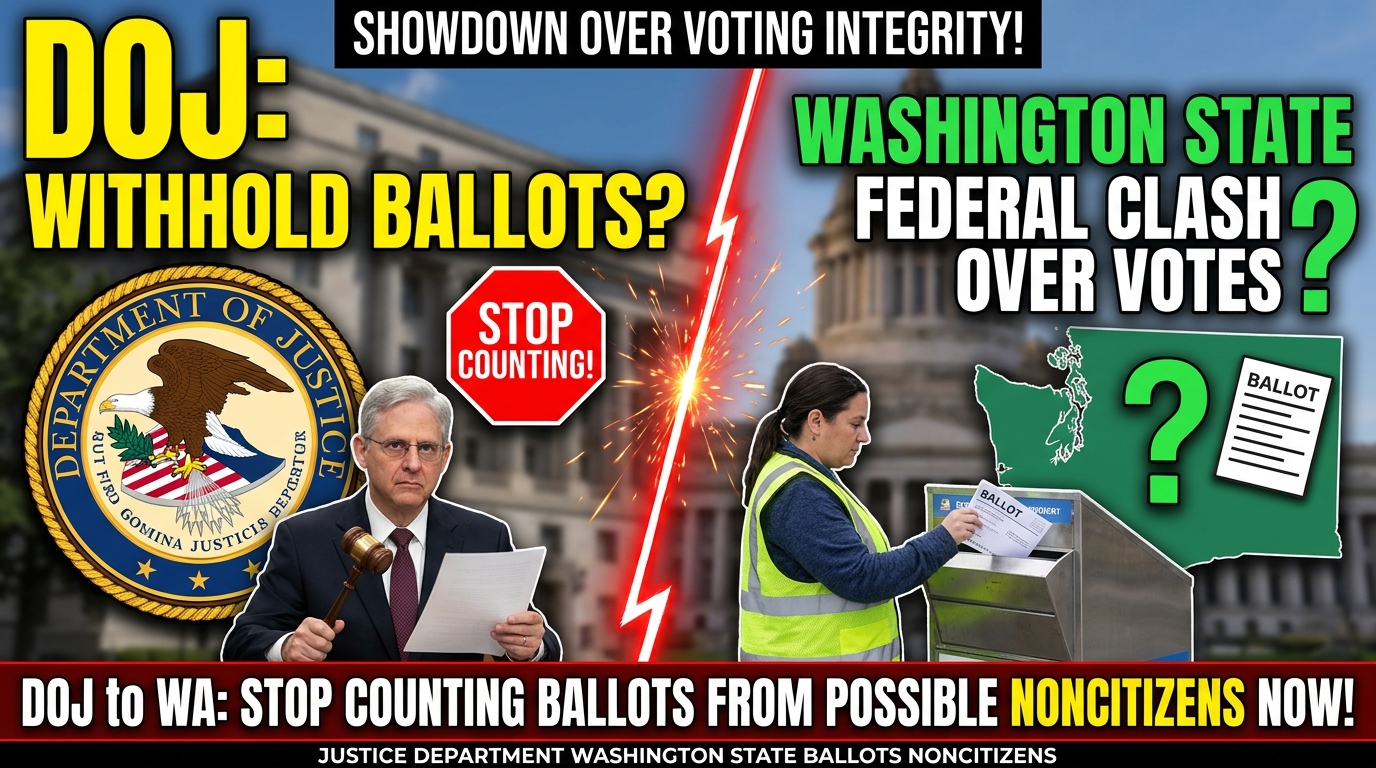
Justice Department Asks Washington State to Withhold Counting Ballots from Possible Noncitizens
Introduction
As the nation prepares for the upcoming electoral cycles, voting integrity has taken center stage in legal and political debates across the United States. The Justice Department Washington state ballots noncitizens directive has sparked widespread national discussion after federal officials formally requested that election authorities in Washington state withhold the counting of specific ballots flagged as belonging to potential noncitizens.
The federal intervention highlights escalating tensions between federal oversight mechanisms and state-administered voting systems. With millions of mail-in and absentee ballots already being processed under Washington’s universal vote-by-mail framework, the DOJ’s urgent request has ignited fierce legal and constitutional questions regarding voter rolls, federal authority, and the protection of lawful ballots.
Also Read:
Trump Campaigns in Texas as Talarico and Paxton Lock in Tight Senate Race
Background of the Federal Inquiry and Voting Rolls
The Justice Department’s inquiry stems from ongoing federal scrutiny over state voter registration databases and cross-agency data verification processes. Federal attorneys and election integrity watchdogs have increasingly focused on whether state motor vehicle departments and public assistance programs inadvertently register non-U.S. citizens to vote during routine transactions.
In Washington state, where voter registration is integrated with state agency services, state officials maintain that rigorous verification protocols are in place. However, federal authorities argued that sufficient anomalies warrant precautionary measures to ensure that ineligible individuals do not participate in federal elections.
Federal Concerns: The DOJ emphasizes that federal law strictly prohibits noncitizens from voting in federal elections, asserting that safeguarding the franchise requires immediate audits before votes are certified.
State Pushback: Local election administrators and voting rights advocates counter that federal directives issued so close to election day risk disenfranchising eligible naturalized citizens whose records may be temporarily misclassified or delayed in database updates.
Legal and Constitutional Arguments
The standoff between federal agencies and state election boards brings fundamental constitutional questions to the forefront of American jurisprudence.
[Federal Data Audit] ---> [DOJ Requests Ballot Separation] ---> [State Legal Challenge] ---> [Judicial Review & Certification Stakes]
The Tenth Amendment & State Authority: State officials in Washington argue that election administration is primarily delegated to states under the U.S. Constitution, giving local secretaries of state primary authority over ballot tabulation rules.
Federal Enforcement Power: Conversely, the Justice Department relies on statutory authorities under federal civil rights and voting statutes to ensure that federal election integrity is uniformly upheld across state lines.
Due Process for Voters: Civil rights organizations have expressed alarm over preemptive ballot withholding, noting that flagging voters without individualized due process hearings risks stripping legally registered citizens of their constitutional right to vote.
Impact on Washington’s Vote-by-Mail System
Washington state has operated as a pioneer in all-mail voting, boasting high voter turnout rates and efficient processing timelines through county election offices in King, Pierce, Snohomish, and surrounding counties.
The introduction of federal scrutiny regarding potential noncitizen registrations places an immediate operational burden on local election workers. County auditors must balance adherence to federal communications with strict state statutory deadlines for processing, curing, and tabulating ballots. Any mandated separation or manual auditing of flagged ballots requires meticulous tracking to prevent administrative chaos while safeguarding voter privacy and franchise rights.
Broader National Implications
The situation in Washington mirrors similar legal battles unfolding in states like Texas, Virginia, and Georgia, where federal and state authorities have clashed over voter roll purges and eligibility verifications.
Precedent Setting: Legal scholars note that how federal courts handle the DOJ’s request in Washington will establish a critical precedent for executive branch intervention in state-level ballot counting procedures.
Voter Confidence: While proponents of the DOJ action argue that such measures reinforce public trust by preventing illegal voting, critics contend that unverified challenges sow widespread distrust and confusion among the electorate.
Frequently Asked Questions (FAQs)
Q1: What did the U.S. Justice Department ask Washington state to do regarding ballots?
A: The Justice Department formally requested that Washington state election officials withhold the counting of specific ballots flagged as potentially cast by noncitizens pending further verification.
Q2: Why are noncitizen voting registrations a focal point for federal authorities?
A: Federal law strictly restricts voting in federal elections to U.S. citizens. Federal agencies examine cross-agency registration data to ensure that ineligible individuals are not mistakenly added to active voter rolls.
Q3: How does Washington state normally process mail-in ballots?
A: Washington operates under a universal vote-by-mail system where county election offices verify signatures and process ballots according to established state guidelines and statutory deadlines.
Q4: What are the main concerns raised by voting rights advocates?
A: Advocates argue that preemptive ballot withholding or broad flagging can disenfranchise eligible naturalized citizens whose records have not been updated in state databases in a timely manner.
Disclaimer
Disclaimer: This article is for informational and educational purposes only and does not constitute legal or professional advice. Ongoing legal proceedings and Department of Justice directives are subject to continuous updates and judicial review in federal courts.