
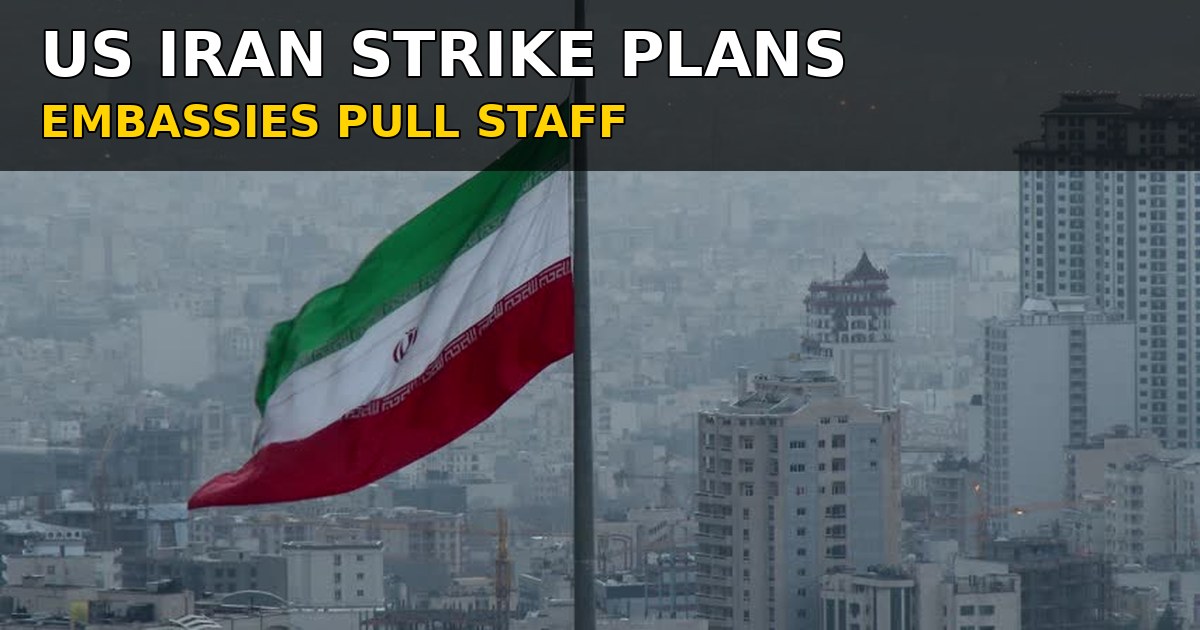
US Iran strike plans are ready if President Donald Trump decides to order them, according to CNN reporting on October 26, and American embassies across the Middle East are quietly scaling back staff as the risk of escalation grows.
It is a familiar, uneasy pattern: a war that was supposed to be over, a ceasefire that has held on paper since February, and a slow build-up of warnings, troop movements and diplomatic departures that suggest neither side is confident the quiet will last.
US Iran strike plans: What CNN reported on Monday
CNN reported that US Iran strike plans are in place and ready for a presidential decision, citing sources familiar with the planning. The report also said the US is continuing to quietly pull personnel from embassies across the Middle East in the coming days.
The only American diplomatic facility in the region currently under a formal ordered departure is the US Embassy in Riyadh, Saudi Arabia, according to CNN’s sources. Other posts are expected to receive similar directives, while those that do not will be scaled down under a personnel cap.
Non-essential US military personnel who were expected to deploy to the Middle East as part of the next troop rotation have also been told they are no longer being sent, a US official told CNN — a small detail that, in military planning terms, speaks loudly about how seriously Washington is taking the risk of a sudden escalation.
Why tensions are rising again
The immediate trigger, according to CNN’s earlier reporting, is an unclassified October 23 memo from Director of National Intelligence Jay Clayton to Secretary of State Marco Rubio. The memo said US intelligence had found that Iran had “substantially increased efforts to target US personnel” and that plotting efforts had “reached advanced stages in both the Middle East and certain other countries.”
US intelligence officials believe Iran and the Houthis are unlikely to launch pre-emptive attacks against American personnel or Israel at this point, one source familiar with the assessments told CNN. The same assessment, however, warned that Tehran and its allies would not hesitate to respond if Iran is targeted first by US or Israeli forces.
That distinction matters. It means Washington is not necessarily expecting an attack tomorrow — but it is preparing for a chain reaction if US Iran strike plans are carried out.
The human cost of another departure
For diplomats and their families, the latest moves are, in CNN’s words, a frustrating and chaotic déjà vu. Many of those now leaving had only recently returned to their posts after being ordered out during the height of the Iran war earlier this year.
One US diplomat told CNN: “To say it has been chaotic is an understatement,” explaining that the financial support offered so far does not cover the cost of moving an entire family out of the region again.
Nikki Gamer, spokesperson for the American Foreign Service Association, told CNN: “This echoes the chaos families experienced earlier this year. Some had barely settled back in before being told to leave again. They are understandably upset, confused, and angry.”
A US official told CNN that staffing decisions are constantly reviewed against the security environment, adding: “The threat of Houthi attacks and of Iranian terror plots targeting US officials are informing our decisions on staffing adjustments for embassies on RO Status in the region.”
What the military is doing in the Gulf
On Sunday, Adm. Brad Cooper, the commander of US Central Command, visited the Strait of Hormuz as the US military maintains its blockade on Iranian ports and assists shipping through the critical waterway.
Cooper flew over the strait in a helicopter and met service members who had cleared the waterway of Iranian mines, CENTCOM said. “We continue to stand shoulder to shoulder with our Gulf partners and the shipping industry,” Cooper said in a news release. “This visit underscores our strong commitment to continued freedom of navigation through the Strait of Hormuz.”
The Strait of Hormuz is one of the world’s most important oil chokepoints. Any disruption there would ripple through global energy markets within hours — a fact both sides understand, and one reason the current standoff is being watched so closely by markets as well as militaries.
What happens next
Trump himself has kept both options open in public on US Iran strike plans. He has previously said the US could strike Iran as early as “tomorrow” or reach what he called a “beautiful deal.” That dual message — threat and negotiation in the same breath — has defined much of his approach to Iran.
For now, the concrete facts are these: US Iran strike plans exist, embassy drawdowns are under way, a troop rotation has been paused, and the top US commander in the region has just toured the waterway at the centre of it all. None of that guarantees a strike. All of it means the next decision, whenever it comes, will not be starting from scratch.
Source: CNN reporting, October 26, 2026, and CNN’s earlier reporting on the October 23 DNI memo. Claims about intelligence assessments are attributed to CNN’s sources, not independently verified by World Reach Daily.
US Iran strike plans in summary
In short, the facts reported above are:
- US Iran strike plans are ready for a presidential decision, according to CNN reporting on October 26.
- The US Embassy in Riyadh is under a formal ordered departure, while other posts are expected to receive similar directives or be scaled down under a personnel cap.
- Non-essential US military personnel expected to deploy to the Middle East as part of the next troop rotation have been told they are no longer being sent.
- An unclassified October 23 memo from Director of National Intelligence Jay Clayton to Secretary of State Marco Rubio said Iran had substantially increased efforts to target US personnel, with plotting efforts at advanced stages.
- Adm. Brad Cooper visited the Strait of Hormuz on Sunday as the US military maintains its blockade on Iranian ports and assists shipping through the waterway.
For now, US Iran strike plans remain ready, embassy drawdowns are under way, and the next decision, whenever it comes, will not be starting from scratch.