
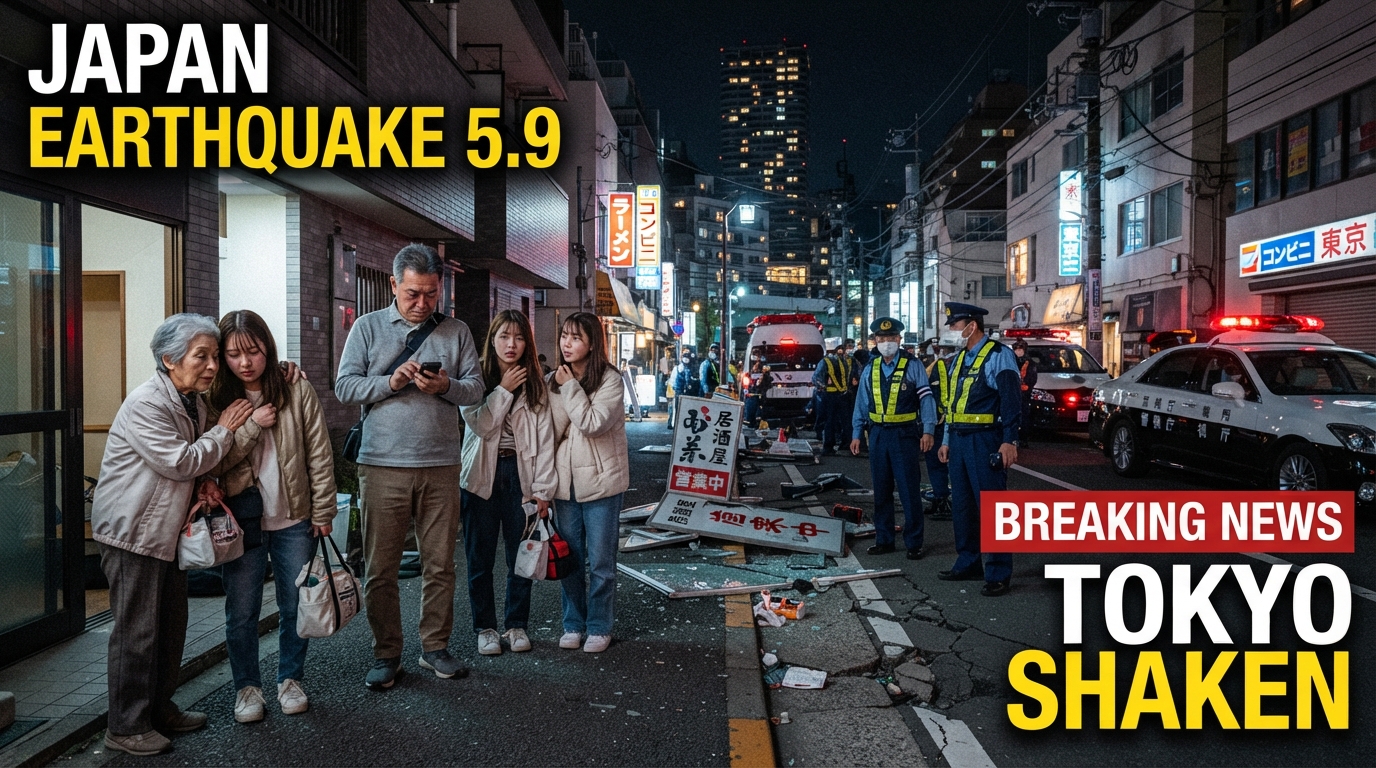

A moderate yet unsettling earthquake struck eastern Japan early Sunday morning. The Japan earthquake 5.9 magnitude event woke residents across the Greater Tokyo area, Ibaraki, and surrounding prefectures, causing widespread panic, light to moderate injuries among dozens of individuals, temporary public transit delays, and brief localized utility disruptions.
And then, almost immediately, the two things everyone holds their breath about: national authorities confirmed that no tsunami threat was declared, and nuclear monitoring facilities reported zero anomalies. Japan exhaled.
Also read:
Bitcoin Short Squeeze: BTC Surges Past $79,000 After U.S. Treasury Buyback
Epicenter and Seismic Intensity Details
According to the Japan Meteorological Agency (JMA), the Japan earthquake 5.9 magnitude event struck at approximately 2:00 a.m. local time — the worst hour for this sort of thing. Its epicenter was located in the southern section of Ibaraki Prefecture at a relatively deep focal depth of roughly 70 kilometers (43 miles).
The US Geological Survey (USGS) registered the preliminary magnitude slightly lower at 5.8. The tremor registered a lower 5 on Japan’s intensive 7-point seismic intensity scale in parts of Ibaraki and central Tokyo. A lower 5 rating denotes heavy shaking that causes unanchored items to fall from shelves and forces individuals to grab onto stable objects for balance.
Injuries and Infrastructure Impacts
Emergency services and disaster management registries reported that at least 37 people sustained injuries in the Japan earthquake 5.9 magnitude event across Tokyo and neighboring prefectures:
Most Casualties Minor: The majority of injuries occurred because residents were jolted out of deep sleep and suffered minor slips, falls, or collisions with furniture and doors while panicking in the dark.
Severe Cases: Local media outlets reported that an elderly woman in her 80s living in Yokohama suffered a serious hip fracture after falling off her bed during the violent shaking.
Transportation Disruptions: The East Japan Railway Company (JR East) announced brief precautionary delays affecting express trains running to and from Tokyo and Narita Airport, alongside regional local lines. However, major high-speed Shinkansen bullet train lines maintained normal service schedules.
Utilities and Infrastructure: TEPCO Power Grid noted temporary blackouts hitting approximately 460 households in Tokyo, though full power was restored within hours. In Tokyo’s eastern Koto Ward, a localized water pipe rupture spilled water onto a roadway, which was quickly isolated and repaired by municipal work crews.
Government Response and Preparedness
Prime Minister Sanae Takaichi quickly took to official channels to announce the establishment of a specialized government task force dedicated to monitoring damage assessments and coordinating emergency relief in the wake of the Japan earthquake 5.9 magnitude event.
Japan remains one of the world’s most seismically active zones, situated directly along the Pacific “Ring of Fire.” Strict building codes, automated early-warning systems, and regular public earthquake drills continue to minimize structural casualties across the country, preventing minor-to-moderate events from escalating into catastrophic disasters.
Frequently Asked Questions (FAQs)
Was a tsunami warning issued for the Japan earthquake 5.9 magnitude event?
No. Both the Japan Meteorological Agency (JMA) and local emergency management authorities confirmed immediately after the tremor that there was zero tsunami danger. That was the first thing officials ruled out.
Which areas felt the strongest shaking?
The tremor was strongly felt across eastern Japan, with the peak intensity concentrated in southern Ibaraki Prefecture and sections of Tokyo, Saitama, Kanagawa, and Chiba.
Were there any nuclear power plant anomalies?
No. Energy operators confirmed that nuclear facilities located near the affected regions experienced zero anomalies or safety compromises.
Are bullet trains running normally?
Yes. While early morning regional lines and airport express routes experienced short precautionary delays, Shinkansen bullet trains operated on standard schedules.
Detailed Chronology and Regional Impact Analysis
To fully understand the scope of the Japan earthquake 5.9 magnitude event, it is essential to review how the seismic energy propagated through the Kanto plain. Because the focal depth of the Japan earthquake 5.9 magnitude event was registered around 68 to 70 kilometers below the earth’s surface, the shockwaves traveled broadly across central and northeastern Japan. Mobile phone emergency earthquake early warning systems broadcasted alerts seconds before the primary impact, giving residents minimal but crucial time to brace themselves.
High-rise buildings across central Tokyo experienced prolonged, swaying movements categorized under long-period ground motion standards. Although structural damage to major skyscrapers was entirely avoided due to advanced damping technologies and seismic isolation foundations, occupants on upper floors reported significant rocking. Local municipalities, including Adachi Ward in Tokyo and cities in Saitama and Chiba, recorded intensity spikes that triggered automatic safety shutoffs in select gas and utility networks.
Meteorological Agency Warnings and Public Advice
In the aftermath of the Japan earthquake 5.9 magnitude event, officials from the Japan Meteorological Agency (JMA) held emergency briefings urging citizens to remain vigilant. Historical seismic patterns indicate that moderate tremors of this scale can occasionally be followed by aftershocks of similar or lesser intensity over the subsequent week. Residents living throughout the Kanto region were advised to check emergency supplies, secure heavy furniture, and ensure evacuation routes remain clear of obstruction.
Conclusion
While a Japan earthquake 5.9 magnitude tremor causes understandable alarm and structural disruption — particularly when striking in the dead of night — Japan’s robust civil defense framework, prompt early warnings, and earthquake-resistant infrastructure successfully mitigated severe outcomes. With no tsunami warnings, swift power restorations, and manageable injury totals, the country has demonstrated once again its high level of seismic preparedness.
Residents in active fault zones are continuously advised to keep emergency kits ready and review local evacuation protocols. In Japan, preparedness isn’t a campaign — it’s a habit.
1 thought on “Japan earthquake 5.9 magnitude: Tokyo Shaken, 37 Injured, and Transit Disrupted”