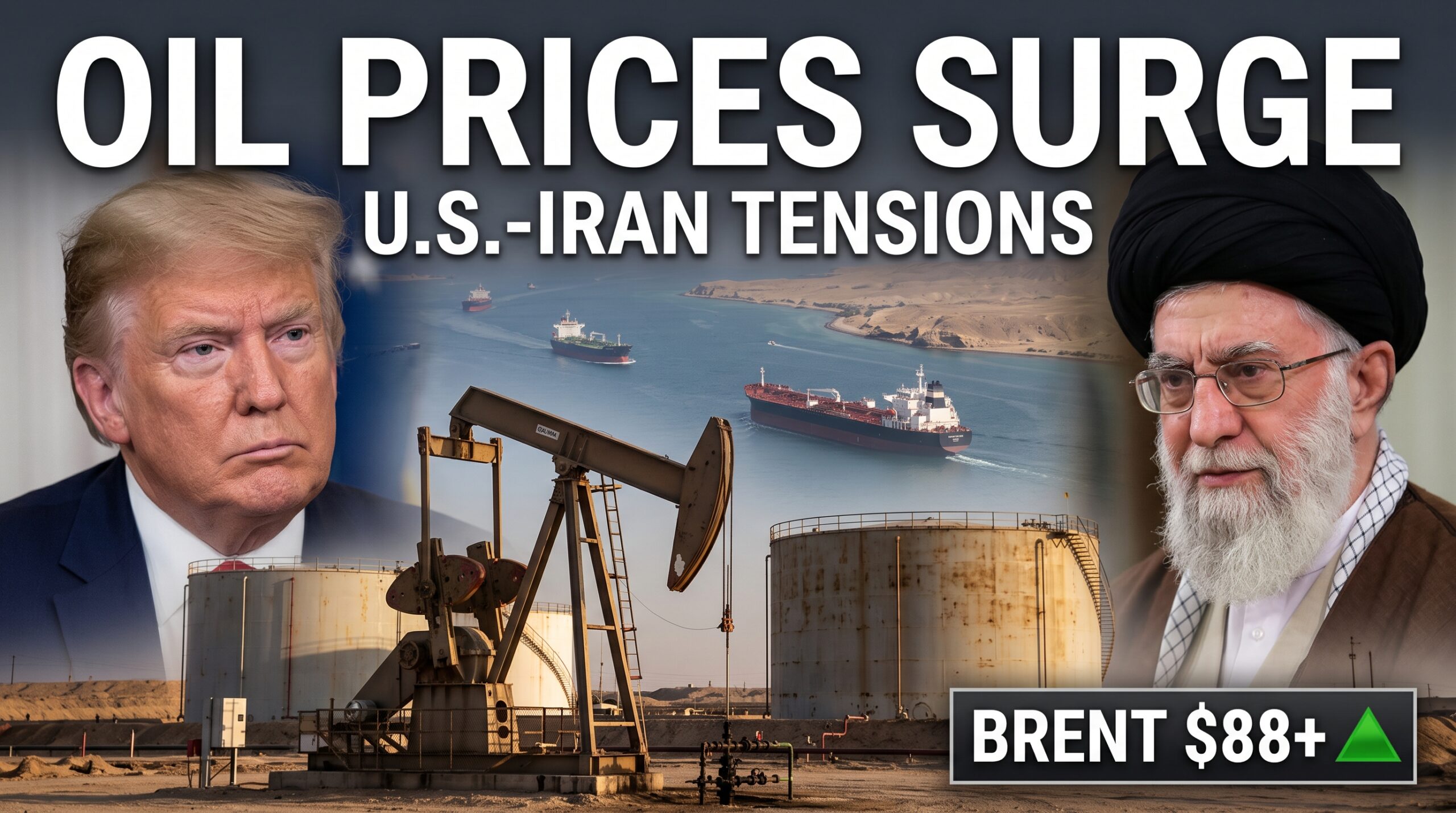
Oil Prices Rise as U.S.-Iran Tensions Raise Inflation and Fed Rate Concerns
Oil prices are rising again as stalled negotiations between the United States and Iran increase uncertainty over the future of the Strait of Hormuz, one of the world’s most important energy shipping routes. The latest market move is renewing concerns about gasoline prices, inflation, business costs and the Federal Reserve’s interest-rate decisions.
Also read:
Border Patrol Agent Jobs 2026: Requirements, Salary, Hiring Process & How to Apply
On Tuesday, August 11, Brent crude was reported around $88.09 per barrel, while U.S. West Texas Intermediate (WTI) crude was around $82.52 per barrel, according to Reuters. Both benchmarks reached their highest levels since July as investors reacted to the lack of progress in U.S.-Iran negotiations and uncertainty surrounding the reopening of the Strait of Hormuz.
Later market reporting showed oil moving even higher, with Brent around $89 and U.S. crude around $83.50, demonstrating how quickly energy markets are responding to geopolitical developments.
The increase is important for the U.S. economy because crude oil prices influence the cost of gasoline, diesel, transportation, manufacturing and many consumer goods. Higher energy prices can also make the Federal Reserve’s battle against inflation more difficult.
Why Oil Prices Are Rising
The latest increase in oil prices is closely connected to uncertainty surrounding U.S.-Iran negotiations and the Strait of Hormuz.
The waterway is strategically important because large volumes of crude oil and petroleum products normally move through it. Any prolonged disruption can reduce available supplies, increase shipping risks and push international oil prices higher.
Reuters reported that stalled U.S.-Iran peace negotiations are hindering efforts to reopen the Strait of Hormuz. The market is therefore adding a geopolitical risk premium to crude oil prices.
Investors are particularly concerned that negotiations could remain deadlocked. If the situation lasts longer than expected, traders may assume that oil supply disruptions will continue, supporting higher prices.
The opposite could also happen. A successful agreement that restores normal shipping through the Strait could increase oil flows and reduce the geopolitical premium in crude prices.
This means oil markets could remain highly sensitive to every major development from Washington, Tehran and the wider Middle East.
Brent Crude and U.S. Oil Prices
Brent crude is one of the world’s major oil benchmarks and is particularly important for international oil pricing. WTI is the primary U.S. benchmark.
The latest reported prices illustrate the market’s renewed concerns:
- Brent crude: approximately $88.09 per barrel
- U.S. WTI crude: approximately $82.52 per barrel
Reuters reported that both benchmarks reached their highest levels since July during Tuesday’s trading.
The move followed a sharp increase on Monday, when oil prices rallied roughly 5% as markets focused on the Strait of Hormuz, inflation and the outlook for Federal Reserve interest rates.
The volatility shows that investors are not simply looking at today’s supply and demand. They are also trying to predict how long geopolitical disruptions could last.
What Higher Oil Prices Mean for Gasoline
One of the most immediate effects for American consumers could be higher gasoline prices.
Crude oil is the largest single input cost in producing gasoline. The U.S. Energy Information Administration has noted that crude oil typically represents about half of the retail price of gasoline.
That means sustained increases in crude oil prices can eventually reach consumers at gas stations.
However, gasoline prices do not move perfectly in line with crude oil prices. Refinery costs, transportation expenses, taxes, regional supply conditions and seasonal gasoline specifications also affect what drivers pay.
The timing of the oil-price increase is particularly important. If crude remains elevated for an extended period, gasoline prices could face additional upward pressure.
For American households, higher fuel prices can reduce disposable income because consumers have less money available for restaurants, entertainment, retail purchases and other discretionary spending.
Oil Prices and U.S. Inflation
Higher energy costs can contribute directly and indirectly to inflation.
The direct effect comes from higher gasoline, diesel and heating costs. Consumers immediately feel the impact when filling their vehicles or paying for energy.
The indirect effect can be broader.
Companies rely on fuel to transport products, operate equipment and move raw materials. If transportation becomes more expensive, businesses may eventually pass some of those costs on to consumers.
For example, higher diesel prices can increase the cost of transporting food, construction materials and manufactured products. Airlines can also face higher fuel expenses, while shipping companies may pay more to move goods.
This creates a potential second-round inflation effect.
The Federal Reserve’s July 2026 Monetary Policy Report already identified energy prices as an important contributor to elevated inflation. The Fed said PCE inflation had reached 4.1% over the 12 months ending in May, while energy prices increased sharply following the Middle East conflict and disruptions involving the Strait of Hormuz.
That background makes the latest oil-price increase particularly important for policymakers.
Why the Federal Reserve Is Watching Oil Prices
The Federal Reserve’s primary inflation target is 2% over the longer run.
When energy prices increase sharply, policymakers have to determine whether the increase is temporary or likely to spread through the wider economy.
If oil prices rise because of a temporary geopolitical event and then quickly fall, the Federal Reserve may look through some of the initial impact.
But if higher energy prices remain elevated for months and begin pushing other prices higher, the situation becomes more complicated.
The Fed could face a difficult choice between supporting economic growth and keeping inflation under control.
Higher oil prices can therefore influence expectations about interest rates.
If investors believe rising energy costs will keep inflation elevated, they may expect the Federal Reserve to maintain restrictive monetary policy for longer or become less willing to cut interest rates.
Reuters reported that the renewed oil-price increase has placed additional focus on U.S. inflation data and the potential implications for Federal Reserve policy.
Could Higher Oil Prices Affect Interest Rates?
Yes, but the impact is not automatic.
The Federal Reserve does not set interest rates based solely on crude oil prices. Officials consider a broad range of economic indicators, including inflation, employment, economic growth, consumer spending and financial conditions.
Oil prices become particularly important when they begin affecting broader inflation expectations.
If consumers and businesses expect higher fuel costs to continue, companies may increase prices and workers may seek higher wages to compensate for increased living expenses.
That could make inflation more persistent.
On the other hand, if oil prices fall after a diplomatic breakthrough, inflationary pressure could ease.
The Federal Reserve’s own recent analysis highlights how developments in the Middle East and expectations surrounding U.S.-Iran negotiations have affected oil markets and inflation expectations.
What Happens If the Strait of Hormuz Reopens?
A reopening of the Strait of Hormuz could significantly change the outlook for oil prices.
More normal shipping conditions would allow crude oil and petroleum products to move more freely through the region. Increased supply availability could reduce the risk premium currently reflected in oil prices.
The U.S. Energy Information Administration previously projected that increased traffic through the Strait and restoration of disrupted production could help global oil production and trade flows return toward pre-conflict levels. Its July forecast expected Brent prices to average around $74 per barrel in the third quarter of 2026 under those assumptions.
The latest geopolitical developments show why those forecasts remain highly dependent on the situation in the Middle East.
If negotiations fail, oil could remain elevated.
If an agreement is reached and shipping normalizes, prices could potentially move lower.
What If U.S.-Iran Negotiations Continue to Stall?
A prolonged stalemate would increase uncertainty for energy markets.
Oil traders would have to consider the possibility that shipping restrictions remain in place for longer than previously expected. That could keep crude prices elevated and potentially push them toward higher levels.
Reuters reported that analysts see the possibility of oil trading within a broad range if the impasse continues, illustrating the uncertainty facing the market.
However, oil prices are also influenced by global demand, inventories, production outside the region and the ability of other suppliers to compensate for disruptions.
Therefore, geopolitical tension does not automatically mean oil prices will continue rising indefinitely.
Impact on American Consumers
For U.S. consumers, the most visible effect would likely be at the gas pump.
Higher gasoline prices can affect household budgets, particularly for people who drive long distances for work or live in areas where public transportation options are limited.
Higher diesel prices can also affect transportation and logistics costs.
Over time, those increases can influence the prices of goods and services across the economy.
Consumers could respond by reducing discretionary spending, driving less, combining trips or switching to more fuel-efficient vehicles.
The impact is therefore not limited to the energy sector. Oil prices can influence consumer behavior and overall economic growth.
Impact on Businesses
Businesses face several potential consequences from higher oil prices.
Transportation companies can experience higher fuel expenses. Manufacturers may face increased costs for shipping raw materials and finished products. Retailers can also encounter higher logistics costs.
Some businesses may absorb the additional expenses, reducing profit margins.
Others may pass higher costs to customers through higher prices.
Energy companies, however, can benefit from higher crude prices if their production costs remain relatively stable. Higher oil prices can improve revenue and cash flow for some producers.
This creates different winners and losers across the economy.
What Investors Are Watching
Investors are likely to focus on several major developments in the coming days.
1. U.S.-Iran negotiations
Any indication of a diplomatic breakthrough could cause oil prices to fall quickly.
2. Strait of Hormuz shipping
The volume and reliability of oil shipments through the waterway will remain a critical market indicator.
3. U.S. inflation data
Investors will closely watch inflation reports for evidence that energy prices are affecting broader price pressures.
4. Federal Reserve communication
Statements from Federal Reserve officials could influence expectations for future interest-rate decisions.
5. Global oil inventories
Inventory data can provide clues about whether global markets are tightening or becoming better supplied.
6. Gasoline prices
American drivers will watch whether higher crude prices translate into higher retail gasoline costs.
Oil Market Outlook
The outlook remains highly uncertain.
A diplomatic agreement and normalization of shipping could push oil prices lower. Additional supply could remove some of the geopolitical premium that has recently entered the market.
However, continued negotiations without a breakthrough could keep prices elevated.
The EIA’s previous analysis shows just how volatile oil markets have become. Brent crude traded from approximately $118 per barrel in April to around $72 by late June as conditions changed.
That wide range demonstrates that geopolitical developments can produce rapid changes in energy markets.
Investors should therefore be cautious about assuming that today’s price will remain unchanged for the rest of the year.
Frequently Asked Questions
What are oil prices today?
On August 11, 2026, Reuters reported Brent crude around $88.09 per barrel and U.S. WTI crude around $82.52 per barrel, with both benchmarks reaching their highest levels since July during the session.
Why are oil prices rising?
Oil prices are rising primarily because stalled U.S.-Iran negotiations are creating uncertainty over the reopening and normal operation of the Strait of Hormuz. Concerns about supply disruptions are increasing the risk premium in crude prices.
Will higher oil prices increase U.S. gasoline prices?
They could. Crude oil is typically about half of the retail price of gasoline, so sustained increases in crude prices can place upward pressure on gasoline prices.
Could oil prices increase inflation?
Yes. Higher gasoline and diesel prices can directly increase household energy costs and indirectly raise transportation and production expenses throughout the economy.
Will the Federal Reserve raise interest rates because of oil?
Not necessarily. The Federal Reserve considers many economic indicators. However, persistent energy-price increases could make it more difficult for inflation to return to the Fed’s 2% long-run target.
What is the Strait of Hormuz?
The Strait of Hormuz is a strategically important waterway connecting the Persian Gulf with the Gulf of Oman and the Arabian Sea. It is a major route for international energy shipments.
Could oil prices fall again?
Yes. A diplomatic agreement, improved shipping conditions, increased global supply or weaker demand could put downward pressure on oil prices.
Why does oil affect the U.S. economy?
Oil affects transportation, manufacturing, electricity and many other economic activities. Higher fuel costs can increase business expenses and consumer prices.
Conclusion
Oil prices rise as U.S.-Iran tensions continue to create uncertainty over the Strait of Hormuz and global energy supplies. Brent crude has moved toward $90 per barrel, while U.S. WTI has climbed above $80, putting renewed attention on gasoline prices, inflation and Federal Reserve policy.
For American consumers, the biggest concern is whether higher crude prices will translate into more expensive gasoline and other goods. For businesses, the key issue is whether higher transportation and energy costs will reduce profit margins or lead to higher prices.
For investors and policymakers, the next major signals will come from U.S.-Iran negotiations, developments around the Strait of Hormuz, inflation data and Federal Reserve communication.
The direction of oil prices could change quickly. A diplomatic breakthrough could bring prices down, while continued tensions or further supply disruptions could keep them elevated.
For now, the oil market remains highly sensitive to geopolitical news, making energy prices one of the most important factors to watch for the U.S. economy and inflation outlook in the weeks ahead.
Trusted and Official Sources
- Reuters — Oil prices rise on U.S.-Iran stalemate
- Associated Press — Oil prices and Strait of Hormuz developments
- U.S. Energy Information Administration — Gasoline prices and crude oil
- U.S. Energy Information Administration — 2026 oil-market analysis
- Federal Reserve — July 2026 Monetary Policy Report
- Federal Reserve — July 2026 Monetary Policy Report Summary
1 thought on “Oil Prices Rise as U.S.-Iran Tensions Raise Inflation and Fed Rate Concerns”