
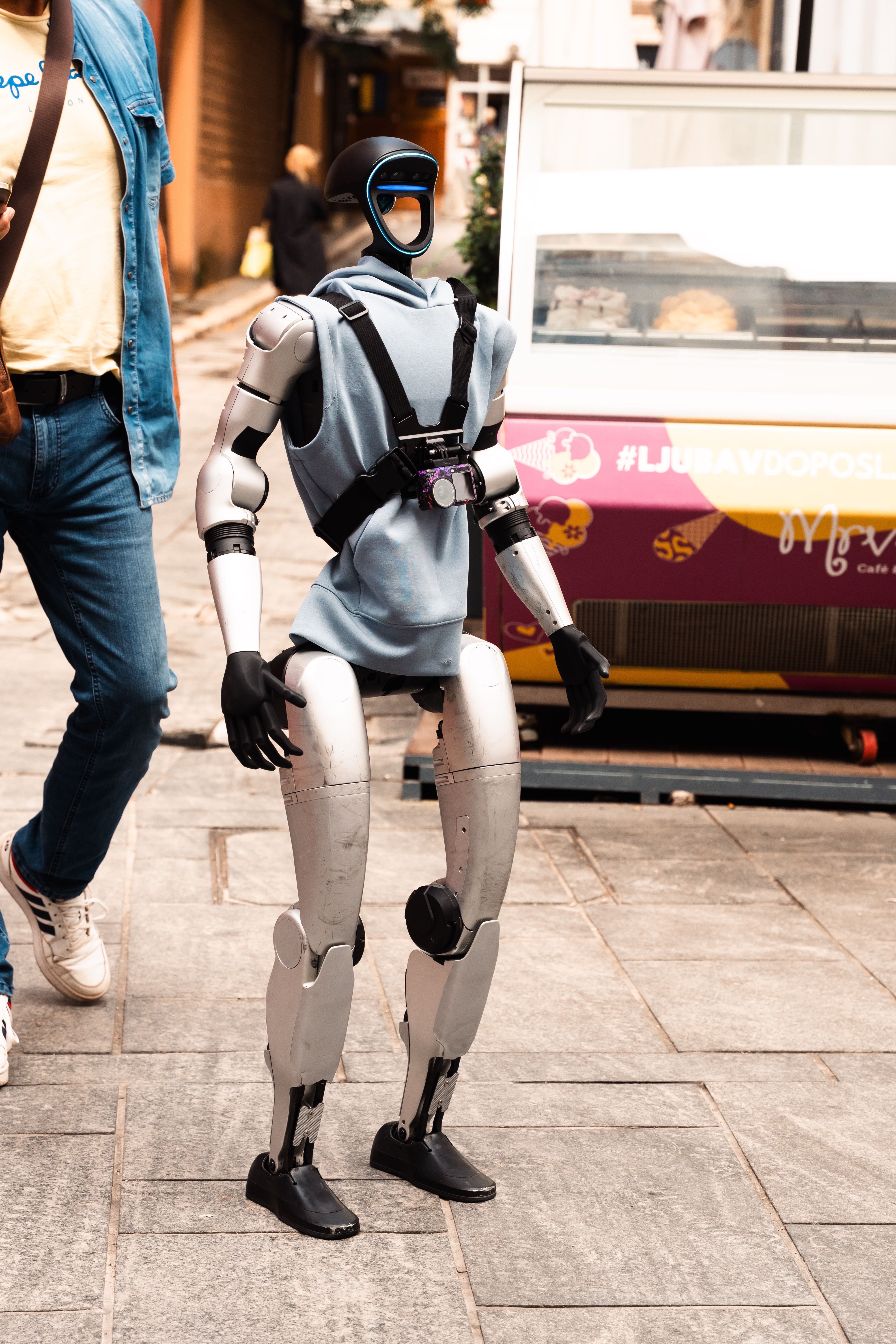
Robot Learns to Babysit: On a Sunday in Brooklyn Bridge Park, the newest attraction was not a street performer or a skyline view. It was a life-sized, AI-powered humanoid robot, walking among real people, singing to children, dancing with passersby and taking in the view of Manhattan — all in an apparent attempt to learn how to interact with humans and, one day, how to nurture them.
The robot, designed by California-based company Faraday Future, costs $89,000. Its chief technology officer, Hong Rao, was operating it with a small remote control as it mingled with parkgoers, according to the New York Post’s account of the scene.
A walk in the park, with a purpose
This was not a staged demonstration behind a barrier. The robot walked around the park in the open, in the middle of ordinary Sunday life. Many parkgoers appeared unfazed, the Post reported, treating the machine as just another part of the day.
At one point, a dozen beaming women visiting from Argentina posed for a photo with the bot, framed between the Brooklyn and Manhattan Bridges. It was a fitting image for a machine that is, in effect, studying people by being among them.
The captions that accompanied the Post’s coverage captured the playful tone of the outing: “Is there a charging station around here? Don’t be scared, I don’t byte…” and “This walk in the park is computing very nicely… I can see why the humans find it agreeable.”
Robot Learns to Babysit: Learning to Interact — and, Eventually, to Nurture
The robot’s chaperone told the Post that the outing was part of an attempt to learn how to “interact” and “nurture” so the machine could eventually be used as a babysitter, teacher or companion.
That is a striking ambition, and it is important to be clear about where the project stands. The robot is still in its learning and development stages. It relies on human interaction and real-world experiences to improve its intelligence, its movements and its ability to navigate its surroundings.
In other words, the park was not a debut of a finished product. It was a classroom.
For children, the appeal is easy to see. A robot that sings, dances and moves among them is entertaining, and it invites curiosity rather than fear.
For adults, the questions are more complicated: what does it mean for a machine to learn to nurture, and what kinds of interaction should count as good training?
Brooklyn Bridge Park, an unlikely robot hotspot
Brooklyn Bridge Park has seemingly become a hotspot for AI bots. One was spotted playing with kids there in March, according to The Independent, as cited in the Post’s coverage.
Public parks make sense as testing grounds. They are unpredictable in exactly the ways a laboratory is not: crowds form and disperse, children run in unexpected directions, conversations overlap, and the weather, the light and the noise all change by the hour.
A robot that can navigate that kind of environment is learning something that cannot be taught in a controlled room.
At the same time, a park is a place where people have not necessarily consented to be part of a machine’s education. The Post’s account does not suggest any confrontation over that point on Sunday, but the tension is part of why scenes like this attract so much attention.
Why this moment is drawing attention
Sunday’s scene came a month after a Nobel Prize-winning artificial intelligence expert warned Congress that humans must either befriend increasingly “conscious” robots or face extinction, according to the Post’s context.
The Post also noted that AI robots have already been linked to war, sex assaults and worker displacement, as stated in its coverage.
Those are serious claims, and they sit in sharp contrast to the lightness of a robot singing to children in a park. That contrast is, in a sense, the story. The same technology can be presented as a friendly companion for children, as a tool for work, or as a source of deep unease about the future — sometimes all in the same afternoon.
What is clear from the park visit itself is more modest, and more interesting. A $89,000 machine, guided by a human with a small remote, spent a Sunday learning by watching, moving and interacting. It did not arrive as a finished babysitter. It arrived as a student.
What comes next
Whether a robot learns to babysit and ever becomes a trusted babysitter, teacher or companion will depend on far more than a successful walk in the park. It will depend on safety, on reliability, on how it handles unexpected situations, and on whether parents, teachers and children actually want it in those roles.
For now, as a robot learns to babysit in this early, public way, the Brooklyn Bridge Park visit is best understood as an early, public step: a humanoid robot, out in the world, learning how people move, speak and react — and giving the people around it a first, close look at a future in which machines may be asked to do much more than entertain.
Summary
Robot Learns to Babysit: a $89,000 humanoid robot designed by California-based company Faraday Future spent a Sunday in Brooklyn Bridge Park, singing to children, dancing with passersby and taking in the view of Manhattan, while Hong Rao operated it with a small remote control.
The outing was part of an attempt to learn how to interact and nurture, so the machine could eventually be used as a babysitter, teacher or companion. The robot is still in its learning and development stages, and it did not arrive as a finished babysitter. It arrived as a student.
In short, a robot learns to babysit only as a future possibility described in the Post’s account: for now, the Brooklyn Bridge Park visit was an early, public step in learning how people move, speak and react, in a park that has seemingly become a hotspot for AI bots.
Robot Learns to Babysit is the focus here because the outing was described as learning to interact and nurture for possible future use as a babysitter, teacher or companion.
Read more Technology coverage on World Reach Daily.
Source: New York Post, October 25, 2026. Robot, price, company, location and learning-stage details are as reported in that coverage.