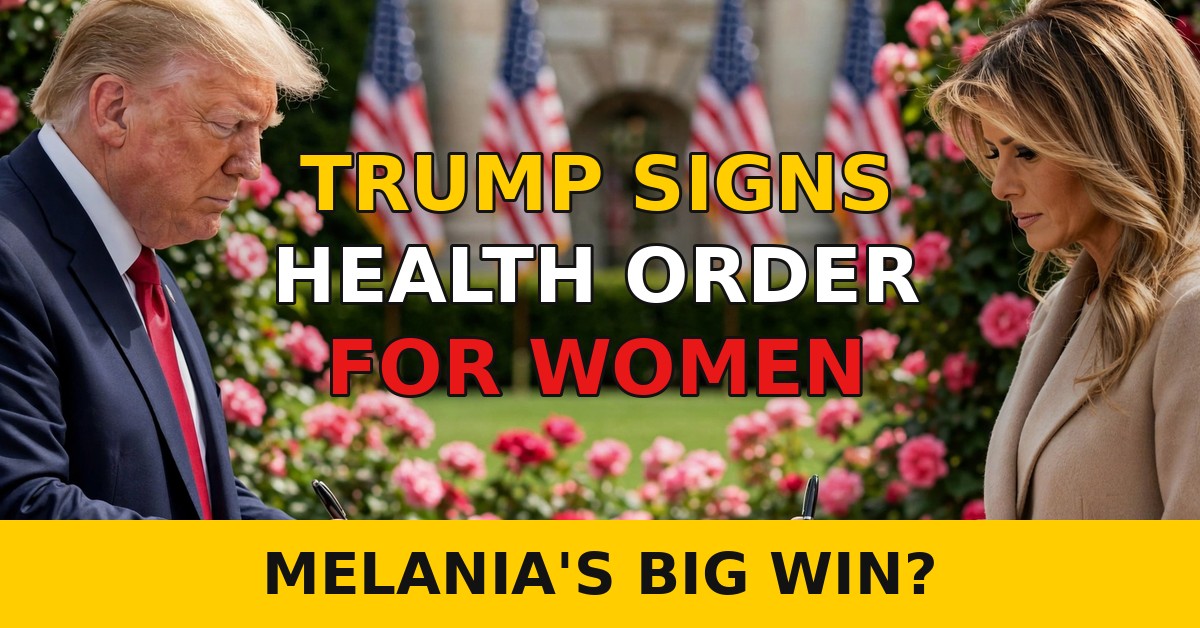
The Rose Garden hasn’t seen a ceremony quite like this in a while. On Monday, October 19, 2026, President Donald Trump signed an executive order creating the Trump women’s health task force — a new White House body plus a dedicated women’s health division inside the National Institutes of Health — with First Lady Melania Trump standing at his side as the initiative’s public face. The couple signed the order together, then exchanged pens the way politicians do when they want the cameras to catch it.
“This is a transformative moment for women in America. Beginning today, we will change the reality of women’s health,” the First Lady told the crowd, calling the move “a new standard for women’s health in America.” It was the most visible policy moment of her second tenure so far — and one the White House clearly wants voters to remember.
What the Executive Order Creates
Two things, actually. First, a Trump women’s health task force charged with driving policy across the federal government. Second, a new division within the NIH — the country’s massive biomedical research agency — focused specifically on women’s health.
The details matter less than the signal right now, because the White House hasn’t published the order’s full text yet. But structurally, this is how Washington tries to move an issue that keeps getting lost between agencies. A Trump women’s health task force with a mandate from the president can knock heads together at HHS, the NIH, the EPA, and anywhere else health policy lives. An NIH division, meanwhile, means a permanent institutional home — staff, budget lines, research priorities — rather than a program that vanishes with the next administration.
Women’s health research has been chronically underfunded for decades. Conditions that primarily affect women — endometriosis, ovarian cancer, maternal mortality, autoimmune disorders — get a fraction of the research dollars that conditions affecting men receive. The NIH itself has acknowledged the gap. So the premise here isn’t controversial. The question is whether an executive order can actually close it, or whether this becomes another well-photographed announcement.
Why the Trump Women’s Health Task Force Could Matter
Here’s the thing about task forces: most of them die quietly. They meet a few times, produce a report nobody reads, and dissolve. The Trump women’s health task force has two features that might keep it alive longer than most.
The first is the leadership. The Trump women’s health task force will be led by White House chief of staff Susie Wiles — who recently announced she is free from breast cancer — alongside HHS Secretary Robert F. Kennedy Jr. Wiles isn’t a figurehead; she’s the person who runs the White House day to day. Putting the chief of staff at the top of a task force is the clearest possible signal that it has the president’s ear. And her personal history with breast cancer gives the whole thing an authenticity that no press release can manufacture.
The second is the First Lady’s ownership. Melania Trump has kept a deliberately low profile through most of her husband’s second term. Choosing women’s health as her signature cause — and standing in the Rose Garden to launch the Trump women’s health task force — suggests this isn’t a one-day story. First Ladies who pick a cause tend to stick with it. Michelle Obama had healthy eating. Jill Biden had community colleges. Now Melania has women’s health, and the White House has given her an institution to run it through.
Of course, the skepticism is fair. The Trump administration has spent the last year cutting federal health programs and shrinking agencies, and HHS under Kennedy has been the epicenter of that fight. Women’s health advocates will be watching closely to see whether new research money actually flows or whether the Trump women’s health task force ends up as a polished front for a bureaucracy that’s being hollowed out elsewhere. Both things can be true at once: a genuine new initiative and a genuine credibility problem.
Susie Wiles and RFK Jr. at the Top Table
The pairing is interesting. Wiles is the ultimate insider — disciplined, camera-shy, effective. Kennedy is the opposite: a provocateur who has upended HHS with his skepticism of the medical establishment. Together they give the Trump women’s health task force both bureaucratic muscle and a headline-grabbing chairman.
Monday’s ceremony drew a notable guest list: Dr. Mehmet Oz, EPA Administrator Lee Zeldin, Cheryl Hines, and Jennifer Hegseth were all in attendance. It’s a mix of health officials, media personalities, and political spouses — the kind of room the White House assembles when it wants an announcement to travel across every kind of outlet. The first official meeting of the Trump women’s health task force was scheduled for Monday afternoon in the Roosevelt Room, which means the task force didn’t wait around to get started.
The Rose Garden Ceremony
Ceremonies are staged, and this one was no exception — but the staging told its own story. Trump praised his wife’s “extraordinary leadership and skills” before the signing, and his own remarks leaned heavily on family language: “These are mothers, daughters, sisters, wives, and under the Trump administration, we’re going to get them the care and support that they need and deserve.”
That’s deliberate framing. The administration knows women’s health is an issue where it has historically struggled with female voters. Putting Melania front and center of the Trump women’s health task force — and letting her do most of the talking — is an attempt to change that conversation. She spoke about a “new standard for women’s health in America,” language that aims higher than any single program.
The pen exchange was the money shot. Couples in politics exchange pens the way they exchange rings — it’s a small ritual that says “we’re in this together.” Whatever you think of the policy, the White House understands the theater. The question, as always, is what survives the news cycle.
There’s also the timing to consider. With the midterms approaching and Trump’s approval at a record low 31 percent in the latest Reuters/Ipsos poll, the administration needs wins it can show suburban women — the demographic that has drifted furthest from Trump. A Trump women’s health task force, fronted by a popular First Lady, is about as direct an appeal as it gets. Whether voters see substance or spin will depend on what the task force actually does in its first hundred days.
Sources and Resources
- New York Post: Trump signs executive order creating women’s health task force with Melania
- The White House
- National Institutes of Health
- U.S. Department of Health and Human Services
Frequently Asked Questions
What does the executive order actually do?
It creates two things: a Trump women’s health task force to coordinate federal policy, and a new women’s health division inside the NIH to focus research. The full text of the order hasn’t been published yet, so the specifics — budgets, staffing, timelines — are still to come.
Who’s running the Trump women’s health task force?
White House chief of staff Susie Wiles and HHS Secretary Robert F. Kennedy Jr. will lead the Trump women’s health task force. Wiles recently announced she’s free from breast cancer, which gives the effort a personal dimension. The First Lady, Melania Trump, is the initiative’s public face and driving force.
What will the new NIH division focus on?
The White House hasn’t released a detailed research agenda yet. But the broader context is clear: women’s health research — covering conditions like endometriosis, ovarian cancer, maternal mortality, and autoimmune disorders — has been historically underfunded compared to research on conditions affecting men. The division is meant to close that gap.
Is there new funding attached to the Trump women’s health task force?
Not yet announced. Executive orders can create structures and set priorities, but real money usually needs Congress. Watch for whether the administration requests new NIH funding in its next budget — that’s the test of how serious the Trump women’s health task force is.
What happens next?
The Trump women’s health task force held its first meeting Monday afternoon in the Roosevelt Room. The next milestones to watch: the published text of the executive order, any funding requests, and the NIH division’s first research priorities. If those land within a few months, the initiative has real momentum. If not, it’s fair to be skeptical.
Conclusion
The Trump women’s health task force is a real institutional move wrapped in a very deliberate piece of political theater. A White House task force plus a permanent NIH division is more than a press release — it’s the kind of structure that can outlast a news cycle if the people running it want it to. With Susie Wiles’ personal stake, Melania Trump’s full-throated ownership, and a first meeting already in the books, the ingredients are there. But the administration’s track record on health funding gives advocates every reason to watch what happens after the Rose Garden cameras leave. The order is signed. Now comes the hard part: the follow-through. Read more U.S. news on World Reach Daily.