
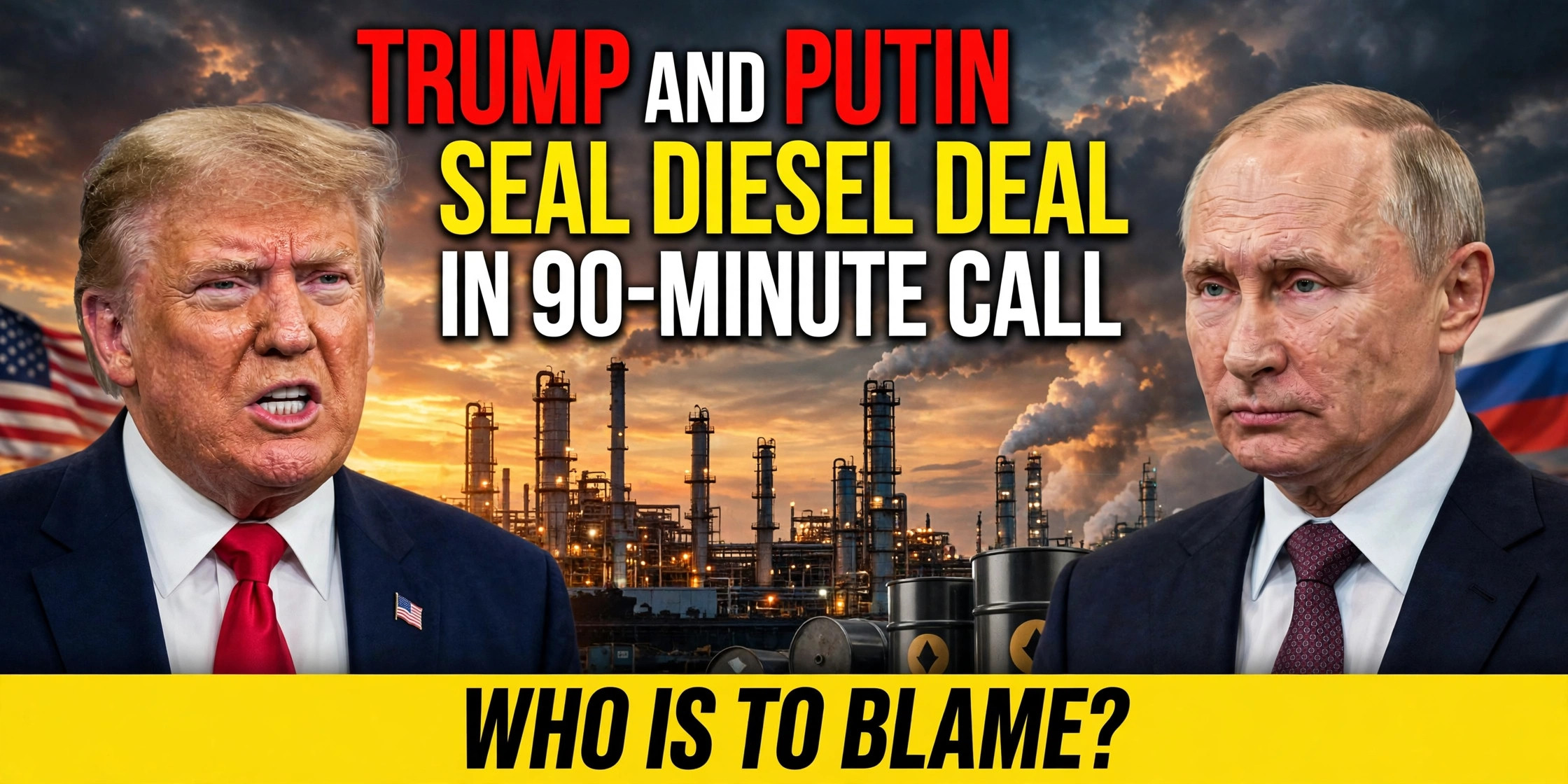
The Trump Putin call on Friday, October 9, was supposed to be about something else entirely. White House aides had said the two presidents would discuss a suspected case of plague in Russia. Instead, the 90-minute conversation ended with a stunning announcement: Russia would ship millions of tons of diesel fuel to the United States and global markets, and Washington would ease sanctions to let it happen.
Ukraine learned about the Trump Putin call’s outcome the same way everyone else did — from social media. And Kyiv’s reaction was swift and furious.
The Trump Putin Call That Nobody Expected
According to both sides, the Trump Putin call was warm. Kremlin foreign policy aide Yuri Ushakov told Russian state media the conversation was “very substantive and friendly,” lasting an hour and a half. He added a detail that quickly traveled around the world: neither leader wanted to hang up first.
“Neither wanted to be the first to hang up,” Ushakov said. “They hung up simultaneously, literally at the same time.”
But beneath the pleasantries, the substance of the Trump Putin call pointed in one direction: economics, not peace. The two men spent most of their time on energy shipments and what Ushakov called “major economic initiatives.” The war in Ukraine — the conflict both sides have been trying, and failing, to end — produced no breakthrough.
President Donald Trump announced the results on Truth Social, calling the conversation a “highly successful discussion.” Russia, he wrote, would “immediately” supply 300,000 tons of diesel fuel to the US and global markets, followed by 500,000 tons in November and another million tons after that. Then, “within a short period of time,” a further 3 million tons would arrive. All told, more than 4.8 million tons of Russian diesel — a volume the White House pitched as a “major diesel deal” to drive fuel prices down.
Trump framed it around people he knows by heart: America’s truckers and farmers. Average US diesel prices had climbed to $6.28 a gallon, according to Reuters, and the midterm elections on November 3 are less than a month away. “Great farmers” and truckers, he wrote, are his “greatest priority.”
A Sanctions U-Turn in a Single Afternoon
Here’s what made the announcement land like a thunderclap in Washington and Kyiv alike: just last month, Trump signed a sweeping Russia sanctions law aimed at choking off the energy revenues that fund Moscow’s war. Now, with one Trump Putin call, he was loosening the very pressure that law was meant to apply.
The Treasury Department didn’t waste time. Its Office of Foreign Assets Control issued General License 135, authorizing the sale, shipment, unloading, and import of Russian-origin diesel fuel into the United States through April 17, 2027. That’s the bureaucratic machinery of sanctions relief, moving at unusual speed.
Analysts were quick to puncture the politics. Diesel futures fell almost 5 percent on the news, but several analysts told Reuters they doubted the shipments would deliver a sustained drop in prices. The amounts matter on paper; whether they reshape a global diesel market is another question.
And the optics were impossible to miss. As Trump’s special envoy Steve Witkoff and his son-in-law Jared Kushner sat down with Ukrainian negotiators in Miami to hash out a unified peace proposal, Trump was striking a fuel deal with the other side of the war. European observers at the Miami talks watched their American partners’ negotiating position wobble in real time.
Kyiv’s Anger: “A Weak Decision”
Ukrainian President Volodymyr Zelenskyy did not mince words. Calling it “a weak decision, unfortunately, a weak decision by strong partners,” he argued the deal would hand Moscow billions more to sustain its military campaign.
“Allowing Russia to sell petroleum products is an investment in the war, which must be ended, not prolonged,” Zelenskyy said. In his view, the Trump Putin call had handed Moscow exactly the wrong signal at exactly the wrong moment.
He went further. With his negotiating team in the United States at the very moment the announcement broke, Zelenskyy said he felt Ukraine was being used: “I believe our team is simply being used as a smoke screen. And that is certainly not fair. It is certainly not how partners should treat each other.”
Ukrainian Foreign Minister Andrii Sybiha took the argument one step further, saying the move told Putin the wrong thing entirely. “Instead, Putin sees weakness,” Sybiha wrote. “And weak strategies never deliver strong results, just as appeasement never brings peace.”
Kyiv also warned that its long-range drone campaign against Russian oil refineries would continue regardless of any Washington-Moscow arrangement. “We will burn [Russian] refineries,” a senior Ukrainian official told the Financial Times.
Bombs Over Zaporizhzhia
Then came Saturday. The Trump Putin call was still being digested when, in the early hours of October 10, Russian guided bombs tore into residential buildings in Zaporizhzhia, a southeastern Ukrainian city whose outskirts sit less than 20 miles from the front line. At least 20 people were killed, including three children. Eighteen others were wounded.
A 6-year-old girl was among the dead when one strike reduced part of an apartment block to rubble. Her grandfather, Anatoliy Chumniy, stood sobbing over her body after rescuers pulled it from the wreckage. “Her birthday would have been at the end of the month,” he said.
Zelenskyy responded with some of his sharpest criticism yet of the White House: “Today, Russia said thank you for the lifting of sanctions on diesel exports by dropping five glide bombs on residential buildings in Zaporizhzhia.”
The strike was the third mass-casualty attack on Ukraine in a single week. Nearly 80 civilians had been killed on Wednesday and Thursday, including at least 30 from a bomb in the eastern garrison city of Kramatorsk and 22 from a missile in Pryluky, east of Kyiv.
No Breakthrough on Peace
Lost in the diesel drama was the reason the Trump Putin call mattered most to Ukraine: the war itself. And there, the Kremlin’s readout offered little comfort.
Ushakov said Putin told Trump that Kyiv had “undermined the possibility of an immediate resumption” of trilateral peace talks by launching a drone attack on Moscow during last month’s Russian parliamentary elections. In the Kremlin’s telling, Moscow had been ready to resume negotiations after the elections, but Ukraine’s strikes on polling stations and organizers put the process in jeopardy.
“And now, as the president said, we will consider when those negotiations can be resumed,” Ushakov added. No date. No timeline. Just a promise to think about it.
Efforts to end the fighting — now past the four-and-a-half-year mark since Russia’s full-scale invasion in February 2022 — have stalled partly over Moscow’s demand for four Ukrainian regions it doesn’t even fully control. Secretary of State Marco Rubio called the war a “dangerous stalemate” just a day before the call, and nothing in the presidents’ conversation changed that description.
Pushback at Home
The deal didn’t just anger Kyiv. In Congress, Republican Representative Don Bacon called for stronger sanctions pressure on Moscow, a notable break from his own party’s president. The criticism also complicates the White House’s position under a bipartisan law that directs the administration to target the top importers of Russian oil and gas — a law Trump now seems unlikely to enforce with much enthusiasm this month. For lawmakers who backed that sanctions push, the Trump Putin call’s diesel arrangement looks like the White House giving away leverage it had just finished building.
Le Monde reported dismay spreading through European capitals. The Russian deputy prime minister for energy, meanwhile, said volumes could reach 3 million tons per month — a figure that, if real, would make Russia a regular feature of American diesel supply.
Sources and Resources
- Reuters: Neither Putin nor Trump wanted to hang up first, Kremlin aide says after ‘very friendly’ call
- Reuters: Kremlin says Putin in phone call with Trump downplays immediate Ukraine talks resumption
- AP: Trump says U.S. to get diesel from Russia, relaxing pressure on Moscow to ease prices before midterms
- Channel News Asia: Russian attack on Ukrainian city kills 20, a day after Trump eases diesel sanctions on Moscow
How long did the Trump Putin call last on October 9?
The Kremlin said the call lasted about an hour and a half. Foreign policy aide Yuri Ushakov described it as “very substantive and friendly” and joked that neither president wanted to hang up first.
How much diesel did Russia agree to supply?
Trump announced more than 4.8 million tons total: 300,000 tons immediately, 500,000 tons in November, 1 million tons after that, and another 3 million tons within a short period. The Russian energy deputy prime minister said monthly volumes could eventually reach 3 million tons.
Why is Ukraine so angry about the diesel deal?
Kyiv sees it as money straight into Russia’s war chest. Zelenskyy called it a “weak decision” and an “investment in a war that must be ended,” arguing it rewards Moscow while his negotiating team was in the US trying to build a peace proposal.
What is General License 135?
It’s a US Treasury OFAC license issued after the call that authorizes transactions for the sale, delivery, unloading, and import of Russian-origin diesel fuel into the United States through April 17, 2027. It doesn’t lift all sanctions on Russia — only diesel transactions.
Did the call move Ukraine peace talks forward?
No. Putin downplayed any quick return to trilateral talks, blaming Ukrainian drone attacks during Russia’s elections. No new date for negotiations was announced, and Russia still demands four Ukrainian regions it doesn’t fully control.
Conclusion
The October 9 Trump Putin call delivered exactly one thing: diesel. It delivered no movement on the war that has now ground on for more than four years, no date for peace talks, and no reason for Ukraine to trust the process. Instead, Kyiv got a sanctions reprieve for Moscow, a feeling of being sidelined while its negotiators sat in Miami, and — within 24 hours — five glide bombs on Zaporizhzhia’s apartment blocks.
Trump got his fuel-price play weeks before the midterms. Putin got sanctions relief and the sight of an American president choosing truckers over the sanctions law he signed last month. Whatever the Trump Putin call achieved for American pump prices, it moved the needle on the war in the wrong direction. The only side that got nothing was the one whose children keep dying in the rubble.