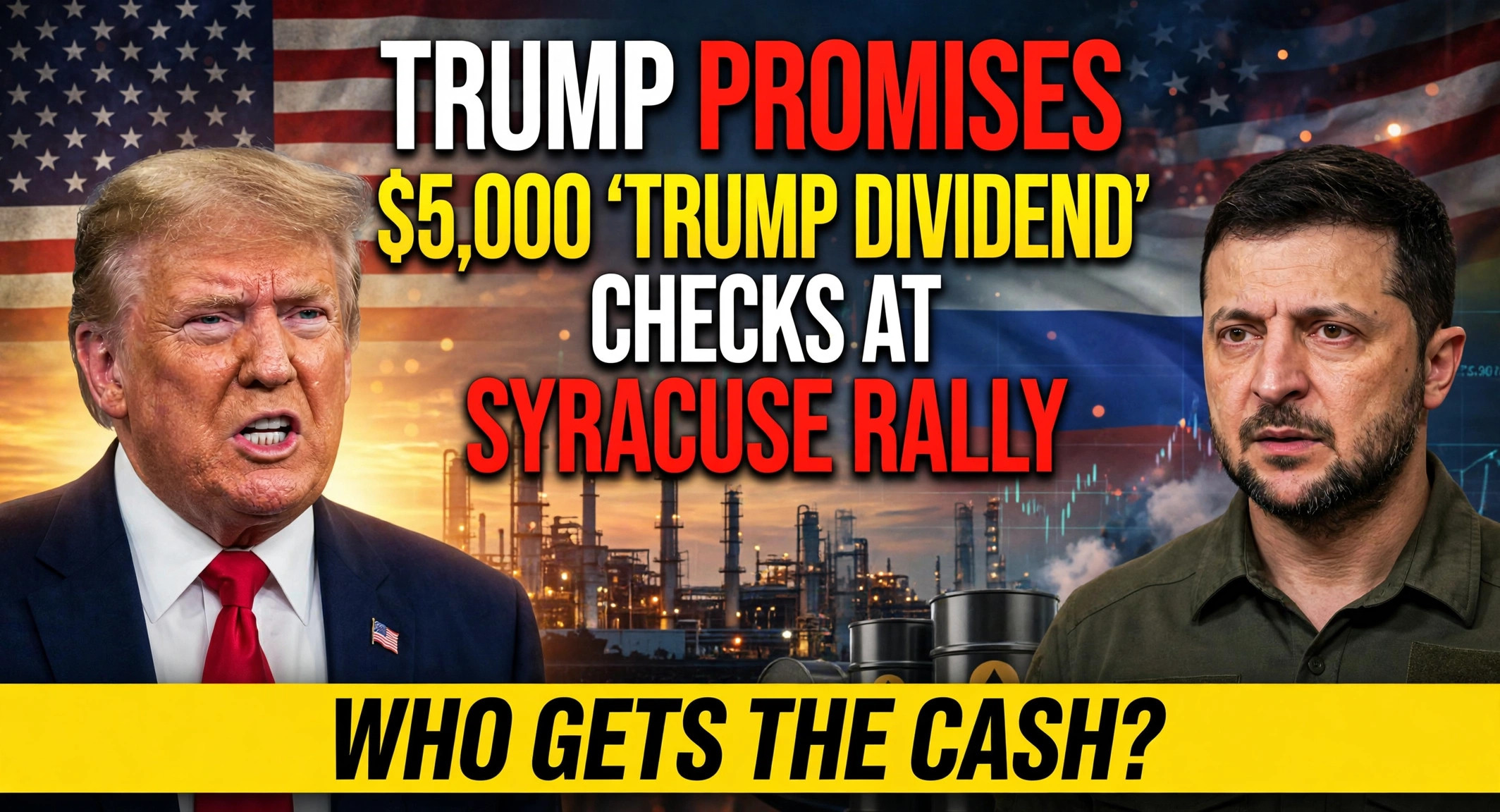
Donald Trump walked onto the stage in Syracuse on Saturday night with a promise wrapped in a deadline. Less than a month before the November 3 midterm elections, the president laid out a sweeping campaign agenda — and its centerpiece was cash: $5,000 for every adult American citizen, a payout he calls the Trump dividend.
The offer comes with a condition. Republicans must keep control of both the House and the Senate. Win, and the checks go out. Lose, and they don’t.
“If Republicans win the House of Representatives and the Senate, I am going to give all adult citizens in the United States of America $5,000 each,” Trump told the crowd. It was the line of the night — and the gamble of the campaign.
The Trump Dividend Pitch
The Trump dividend, as described in Syracuse, would go to every adult U.S. citizen. Non-citizens — including green-card holders and temporary visa workers — would be excluded. Trump said the only catch is that recipients must spend the money inside the United States.
He pegged the total cost at roughly $1 trillion and insisted it would be financed through tariff revenue and economic growth, not new taxes or borrowing. The rally drew loud cheers, which is the point: with inflation crushing households and consumer sentiment near record lows, $5,000 per person is the kind of number that cuts through.
But here’s what needs saying plainly. Congress has not approved any such payment. No legislation creating the Trump dividend exists. It is a campaign promise, not a law — and it would need lawmakers to act before a single check could be printed.
That hasn’t stopped Trump from talking about it like it’s done. Earlier this year he floated checks of $2,000 or more funded by savings from the Department of Government Efficiency and tariff revenue. None of that materialized. House Speaker Mike Johnson has indicated the proposal would require Congress to pass it — directly undercutting Trump’s suggestion that he could do it on his own.
“Tariffs Are Making Us Rich as Hell”
The funding story behind the Trump dividend is tariffs — Trump’s favorite economic weapon. In Syracuse he doubled down on the trade agenda, telling supporters: “Tariffs are making us rich as hell.” His argument: foreign companies can dodge the duties by building factories in America, which creates jobs and fills government coffers.
He claimed his administration has secured more than $21 trillion in investment commitments, which he credited largely to tariffs and incentives for domestic manufacturing. That number is far beyond what independent trackers have reported, but it drew the loudest applause after the $5,000 pledge.
As a local example, he cited Micron’s planned semiconductor investment in central New York — a multi-billion-dollar chip project the administration has held up as proof its manufacturing strategy is working. Standing in Syracuse, with Micron’s promised fabs not far away, the message was tailored for the room: the tariff strategy is building things here, not somewhere else.
The Rest of the Pre-Midterms Agenda
The checks were the headline, but Trump laid out far more — a full second-term legislative wish list, all contingent on Republicans holding Congress. The Trump dividend may be the hook, but the rest of the agenda is what would actually fill a legislative calendar:
Tax cuts made permanent. He pledged to lock in his second-term tax breaks forever, including no tax on tips, no tax on overtime, and no tax on Social Security benefits for seniors. “If I weren’t here, they have the right to end that,” he said, warning a Democratic Congress would let them expire.
Tougher immigration enforcement. He promised a “No Invasion of our Country Act” that would bar any future president from reopening the border to illegal immigration — a direct shot at the politics that put him back in office.
Healthcare overhaul. He vowed to stop payments to big insurance companies and “give the money directly to you, the people,” so Americans can buy their own coverage and keep the difference. No details on how the money would move.
Crime and punishment. He called for ending cashless bail and imposing the death penalty for large-scale drug dealers, human traffickers, and anyone who kills a police officer.
Foreign policy defense. He defended his administration’s handling of the conflicts involving Iran and Russia — both central to the inflation story squeezing American wallets.
It was, in effect, a closing argument: re-elect my majorities, and all of this happens.
New York Politics Took the Stage
Syracuse wasn’t chosen by accident. The rally doubled as a campaign stop for Bruce Blakeman, the Republican candidate for governor of New York, with congressional hopefuls Anthony Constantino (21st District) and Kailee Buller (22nd District, challenging Democratic Rep. John Mannion) also sharing the stage.
Trump hammered New York’s Democratic leadership, going after Governor Kathy Hochul and Attorney General Letitia James — whom he called Hochul’s “totally corrupt sidekick.” James has been a longtime target since the civil fraud case her office brought against him. He also claimed Blakeman would slash electric bills by 70, 80, or even 90 percent — a campaign promise for which he offered no plan.
The local stakes are real. New York has several of the House races that will decide whether Republicans keep their majority — and with it, whether the Trump dividend ever becomes more than a speech.
The Catch: It’s Only a Promise
Every version of this story needs the same caveat, and it matters more than the applause line. Nothing Trump described Saturday night is law. The Trump dividend checks, the permanent tax cuts, the immigration act, the healthcare plan — all of it requires Congress.
Even Trump’s allies are uneasy. Republican candidates in competitive races have largely refused to make the $5,000 pledge a staple of their own campaigns, sidestepping it when reporters ask. The Republican National Committee is encouraging candidates to run on the broader economic agenda, but the checks themselves are conspicuously absent from most battleground advertising.
That silence tells you something. A trillion-dollar promise is easy to cheer at a rally and much harder to defend in a debate — especially with inflation already at 4.7% and the Fed raising rates to cool prices. Critics, including plenty of economists, warn that mailing $5,000 to every adult American would pour gasoline on the very inflation voters are furious about, turning the Trump dividend into a short-term sugar rush with a long-term price.
Trump’s answer is that tariff money covers it. Whether the math holds — and whether voters believe it — is now a question for November 3.
Frequently Asked Questions
What is the Trump dividend?
It’s Trump’s name for a proposed $5,000 payment to every adult American citizen. He unveiled the pledge at his October 10, 2026 rally in Syracuse, New York, making it conditional on Republicans keeping the House and Senate in the November 3 midterms.
Who would get the $5,000 checks?
Only adult U.S. citizens, according to Trump. Green-card holders and temporary visa workers would not qualify. He also said recipients would have to spend the money inside the United States.
Has the Trump dividend been approved by Congress?
No. Nothing has been enacted — there isn’t even a bill. Trump has suggested he might not need congressional approval, but House Speaker Mike Johnson has said lawmakers would have to act. For now, it’s purely a campaign promise.
How would the $5,000 checks be paid for?
Trump says tariff revenue and economic growth would cover the roughly $1 trillion cost. He made similar promises earlier this year about payments funded by Department of Government Efficiency savings — none of which happened. Critics warn the spending could worsen inflation.
What else did Trump promise at the Syracuse rally?
Permanent tax cuts (no tax on tips, overtime, or Social Security), tougher immigration enforcement including a “No Invasion of our Country Act,” a healthcare overhaul giving money directly to people instead of insurers, ending cashless bail, the death penalty for drug traffickers and cop killers, and expanded tariffs.
Conclusion
Trump’s Syracuse rally was a bet that money talks louder than warnings. The $5,000 Trump dividend pledge is the boldest promise of the midterm campaign — a trillion-dollar IOU written on the back of tariff revenue, payable only if Republicans hold Congress on November 3. It energized the crowd and gave the campaign its closing message. But the fine print is doing heavy lifting: no legislation exists, the Speaker says Congress must act, Republican candidates are mostly avoiding the pledge, and economists warn fresh cash could feed the inflation that’s already at 4.7%. Voters now have to decide whether the promise of a check outweighs the questions behind it. In less than a month, they’ll get their say.