
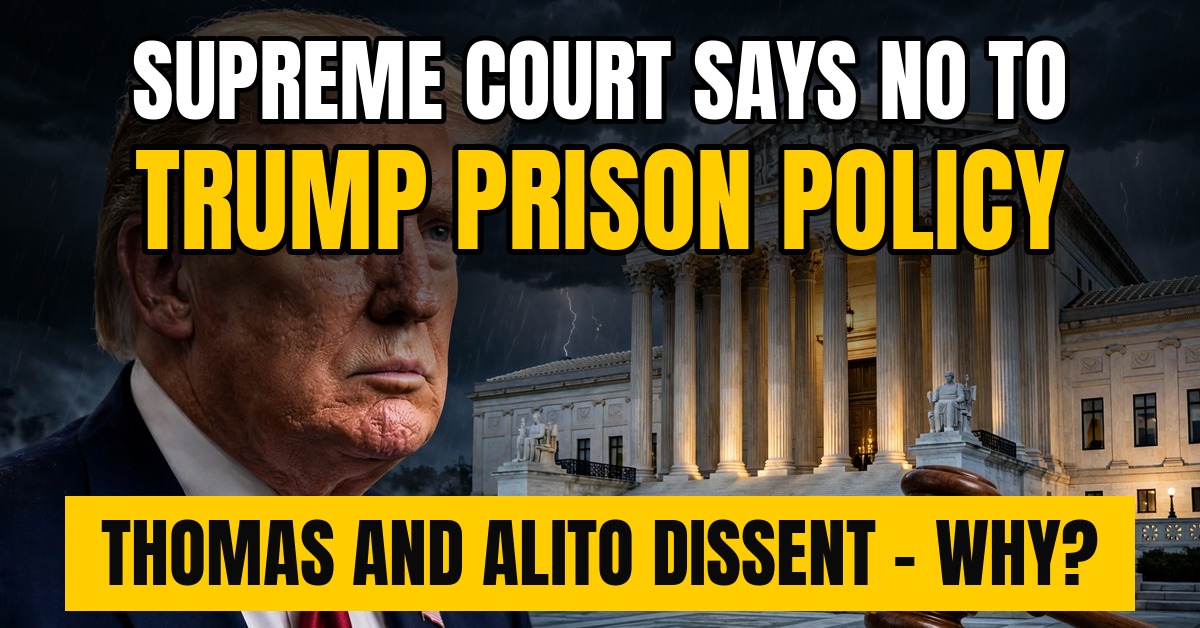
The supreme court transgender inmate policy fight just handed President Donald Trump something he's rarely gotten from the nation's highest court: a straight-up no. On October 21, the justices declined to let his administration enforce a sweeping rule that would have stripped gender-affirming care from transgender people in federal prisons while the underlying lawsuit plays out.
The order was brief and carried no explanation — standard for emergency requests. But the lineup told its own story. Justices Clarence Thomas and Samuel Alito publicly dissented. The rest of the court, conservatives included, didn't bite.
For Trump, who has compiled an unusually strong record on the court's emergency docket this term, the supreme court transgender inmate policy denial stings. For the roughly 2,000 transgender people in federal facilities and halfway houses, the care they've been receiving stays in place — for now.
How the Supreme Court transgender inmate policy fight reached the justices
This didn't start in October. On day one of his second term, Trump signed an executive order declaring the federal government would recognize only "two sexes, male and female," and that "these sexes are not changeable." The Bureau of Prisons followed with memos cutting off federal funds for hormone therapy and social accommodations for inmates with gender dysphoria.
Pushback came fast. In March 2025, two transgender men and one transgender woman held in facilities in New Jersey, Minnesota, and Florida filed a class action — Kingdom v. Trump in the lower courts — on behalf of roughly 1,000 transgender people in Bureau of Prisons custody. The ACLU, the ACLU of D.C., and the Transgender Law Center took the case. A federal judge in Washington blocked the ban that June.
The administration regrouped. In February 2026, the bureau issued a formal replacement — Program Statement 5260.01 — keeping the ban intact. On June 17, 2026, the district court blocked that too, ordering the bureau to keep providing care under its pre-executive-order rules. The government asked the D.C. Circuit to pause that injunction. It said no. Wednesday, the Supreme Court said no as well.
What the Bureau of Prisons policy actually bans
The policy goes well beyond surgery — which is exactly why the supreme court transgender inmate policy dispute drew such attention. Transgender inmates could no longer receive surgical procedures or hormonal treatments, and they'd also lose what the bureau calls "social accommodations": makeup, wigs, chest binders, breast padding, gender-appropriate clothing, and hair-removal devices.
Psychiatric services would still be offered. But the bureau's own numbers show the real stakes: it was providing hormone therapy to more than 600 inmates in 2025, and the plan was to taper those prescriptions. A few narrow exceptions — people who'd already had surgery or faced severe withdrawal effects — might have kept hormones temporarily.
The Justice Department said the changes "reflect the latest scientific information" about gender dysphoria treatments and are needed "to maintain institutional security." Its stated concerns: that treated inmates could become targets for attacks, that the care could breed resentment among other prisoners, and that continuing it would undermine the bureau's "reasonable practice of refusing to reward threats of self-harm."
A case built on three decades of prison medicine
Here's the part the plaintiffs keep hammering: this isn't new territory. The federal prison system has treated gender dysphoria with hormones since at least 1992, according to the lawsuit. More than three decades of practice — upended by one policy.
The ACLU's argument — the constitutional core of the supreme court transgender inmate policy case — is that withholding established medical care from people the government already has in custody violates basic constitutional rights. "The denial of medically necessary health care, including gender-affirming health care, to people in prison is a violation of their fundamental constitutional rights," said Li Nowlin-Sohl, senior staff attorney with the ACLU's LGBTQ & HIV Project, calling Wednesday's ruling critical for incarcerated transgender people.
Aditi Shah, a staff attorney at the ACLU of D.C., added: "This ruling will prevent serious and irreparable harm to plaintiffs and the class while we continue to challenge the government's unlawful efforts to deny medically necessary healthcare for political reasons." The Bureau of Prisons declined to comment on the decision.
Why this loss stands out for Trump
Let's be honest — the court's conservative supermajority has been a friendly place for this administration. Trump has won the overwhelming majority of his emergency requests since returning to office, on immigration, personnel moves, and more.
So a denial raises eyebrows. But the supreme court transgender inmate policy ruling is not a decision on the merits — the court hasn't decided whether the policy is legal. It only decided the government hadn't made its case for enforcing the rule before the courts finish examining it.
What Wednesday's order does is lock in the status quo: the June injunction stands, and the bureau must keep providing care under its pre-2025 rules while the appeal proceeds.
What happens next in the legal battle
The case continues in the D.C. Circuit, where the appeal of the preliminary injunction is pending. If the supreme court transgender inmate policy fight returns on the merits, expect full briefs and oral argument — a different animal from Wednesday's quick emergency ruling.
Note this case is separate from other litigation over the administration's effort to move transgender women into men's prisons. The prison-policy wars are being fought on multiple fronts, and this order settles none of them permanently.
But for the inmates who put their names on a class action to keep their medication, the takeaway is immediate and practical. Their treatment continues. Their legal team calls that a constitutional floor, not a favor. And for one Wednesday in October, a majority of the justices agreed.
Sources and Resources
- Reuters — Supreme Court won't allow Trump administration restrictions on transgender inmates
- USA Today — Supreme Court won't let Trump enforce transgender inmate policy for now
- Transgender Law Center — Supreme Court denies Trump administration request to withhold health care
- The White House — official executive orders and administration policy
FAQs
Wait — does this mean Trump lost the whole case?
No. The court only rejected the emergency request to enforce the policy right now, before the lawsuit finishes. The appeal is still pending in the D.C. Circuit, and the legality question at the heart of the supreme court transgender inmate policy dispute could come back to the justices later on full briefing.
Which justices dissented?
Clarence Thomas and Samuel Alito publicly noted their dissent. The order gave no explanation — standard for emergency applications — and neither justice attached a written opinion, so there's no public reasoning to quote yet.
How many transgender people are in federal prison?
More than 2,000, per a 2025 government figure cited in coverage. The class action was filed on behalf of roughly 1,000 of them, and the Bureau of Prisons was providing hormone therapy to more than 600 inmates last year.
Does the policy ban more than just surgery?
Yes. Beyond surgical and hormonal treatments, it bars "social accommodations" like makeup, wigs, chest binders, breast padding, and hair-removal devices. Psychiatric services would still be offered, but advocates say that's no substitute for the medical care.
Could the Supreme Court still side with Trump eventually?
Absolutely. Emergency rulings decide only whether the status quo holds during an appeal. A full merits ruling in the supreme court transgender inmate policy case — with briefs and argument — is a different matter, and Wednesday's brief order signals nothing about how the justices would vote then.
Conclusion
Wednesday's decision is a holding pattern, not a verdict — but a meaningful one. It preserves three decades of federal prison medical practice, keeps hormones flowing to hundreds of inmates, and hands an administration that has mostly heard "yes" from this court a firm "not yet." The real fight over the policy's legality is still ahead. For now, the injunction stands, the care continues, and the supreme court transgender inmate policy saga gets at least one more chapter.
For ongoing coverage of the courts and the White House, see our Politics desk — the supreme court transgender inmate policy fight is one of several clashes between the Trump administration and the judiciary we're tracking, and the supreme court transgender inmate policy story will develop as the D.C. Circuit appeal proceeds.
The supreme court transgender inmate policy dispute is far from settled, and the next chapter of the supreme court transgender inmate policy litigation will play out in the D.C. Circuit.