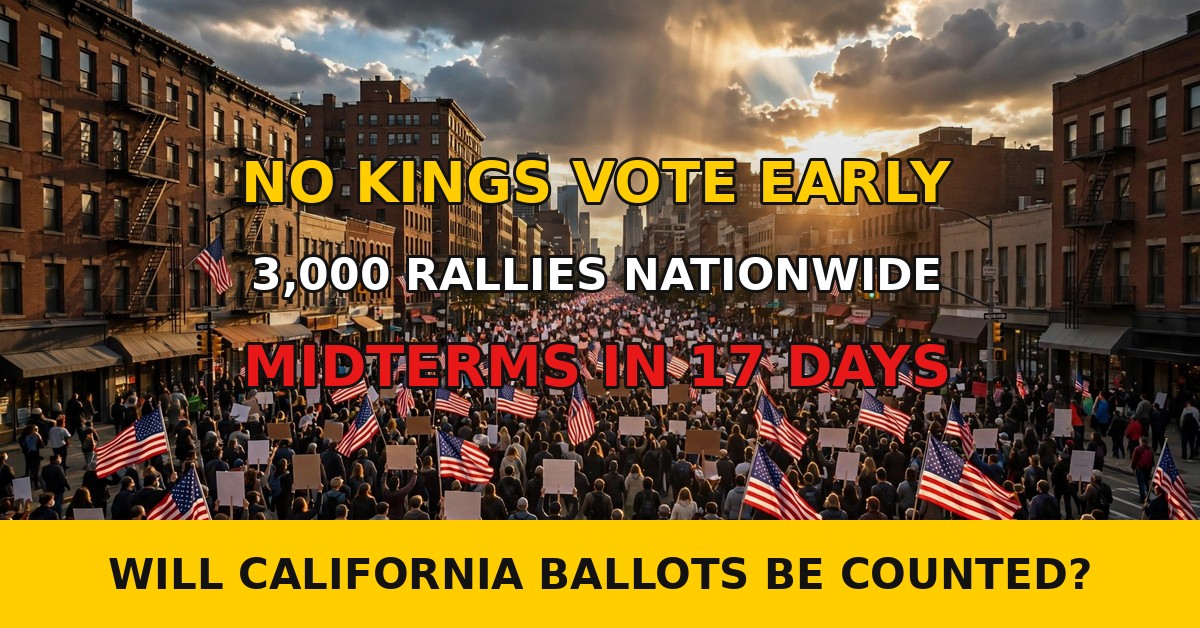
On Saturday, Oct. 17, Americans in cities and small towns across the country will gather for what organizers bill as the largest election-protection and early-vote activation in U.S. history. The fourth wave of the No Kings Vote Early movement is expected to include nearly 3,000 events nationwide — a push to turn street protests into actual ballots with just over two weeks left before the Nov. 3 midterm elections.
It’s a shift in strategy. Earlier ‘No Kings’ mobilizations — in June and October 2025, then again in March 2026 — were built as street demonstrations against what organizers call authoritarian moves by President Donald Trump’s administration. This time, rallies, marches, block parties, walks to the polls and voter festivals are paired with a practical goal: get eligible voters to make a plan, vote early, and know their options before Election Day.
And the timing couldn’t be more charged. The Justice Department is asking a federal court to stop California from counting vote-by-mail ballots from people it says may be noncitizens — a fight that has set Gov. Gavin Newsom and the Trump administration on a collision course in the middle of early voting.
What No Kings Vote Early looks like on the ground
The events run the full range of grassroots organizing. In Arizona, a dozen-plus gatherings are listed for the Phoenix metro area alone — from Midtown Phoenix and Glendale to Mesa, Chandler and Scottsdale — most of them short morning rallies and visibility events on major corridors. Jacksonville, Florida, hosts two: a rally along Race Track Road in St. Johns County in the morning and a march and rally outside the Duval County Courthouse in the afternoon.
Texas will see events in Dallas, Houston, Austin, El Paso and Midland, plus smaller towns — two days before early voting begins there on Monday, Oct. 19. In New Jersey, gatherings are scheduled in Newark, Teaneck, Montclair, Closter, Hawthorne, Wanaque, South Orange and Mountainside. In Sarasota, Florida, volunteers will gather at the Supervisor of Elections Office on Washington Boulevard. Kentucky’s events include a voter-information rally on Frankfort Avenue in St. Matthews, timed against a Trump midterm campaign rally happening the same day in Northern Kentucky.
Organizers on the movement’s website call Saturday “a day of nonpartisan voter participation, being in community with each other, and making sure every eligible voter has a plan, knows their options, and is ready to make their voice count.”
That nonpartisan framing matters. Local organizers in Louisville, for instance, say their ‘No Kings — Vote Early’ rally is meant to encourage people to exercise the right to vote — whether they vote early or on Election Day. First-aid workers and peacekeepers will be on hand at some events. But there’s no pretending the movement is politically neutral: it grew out of opposition to Trump’s policies, including immigration enforcement and executive actions, and Saturday’s events double as one more show of that opposition.
The California fight hanging over the No Kings Vote Early weekend
Hovering over the whole mobilization is a legal brawl with the potential to touch millions of ballots. On Thursday, Oct. 15, the Justice Department sued California after state officials refused a 48-hour ultimatum to act on a federal list of more than 20,000 people the government says are likely noncitizens registered to vote in the state.
Here’s the sequence: acting Deputy Attorney General Trent McCotter sent letters — the names delivered on a password-protected thumb drive — to Secretary of State Shirley Weber and Los Angeles County Registrar-Recorder Dean Logan. The letters demanded that California review the list, “segregate — not cancel —” any ballots already returned by people on it whose citizenship can’t be verified immediately, and stop counting ballots pending verification.
The DOJ’s lawsuit, filed in federal court in Los Angeles, asks a judge to bar California from counting vote-by-mail ballots from those flagged voters until their citizenship is determined. The department says Homeland Security Investigations identified the roughly 20,000 names and that mailing ballots to them undermines federal enforcement. Notably, that figure is a steep drop from the administration’s July claim of more than 190,000 alleged noncitizens on California’s rolls.
“California election officials were given an opportunity to remove noncitizens from their voter rolls and to sequester ballots returned from suspected ineligible voters. They refused,” First Assistant U.S. Attorney Bill Essayli said in the DOJ’s statement. “We are taking California to federal court to demand that the votes of American citizens not be diluted by noncitizens.”
Newsom, Weber and Bonta fire back
California’s leadership didn’t mince words. “This is a sad, desperate attempt by Trump to use his politicized Justice Department to try to suppress California voters just three weeks before Election Day,” Newsom said in a statement. “The courts have made clear that the federal government has no role in how a state carries out its election process.”
Secretary of State Shirley Weber rejected the demand, saying her office will not restrict thousands of voters based on information and methods the federal government hasn’t disclosed. Attorney General Rob Bonta pointed out that mail ballots are already in voters’ hands and that “every count, recount, hand count, lawsuit, and audit has found that there’s no widespread voter fraud in the U.S.”
Senator Adam Schiff called the move “another dangerous attempt to destabilize our safe and secure elections,” saying California would defend its constitutional rights. The lawsuit now becomes one more test of how far the federal government can reach into state-run elections — and a near-certain conversation topic at Saturday’s No Kings Vote Early gatherings in California, where more than 300 events are planned.
Early voting calendars worth knowing
The No Kings Vote Early message lands differently depending on where you live, because early voting rules are set state by state. In Texas, early voting starts Oct. 19 and runs through Oct. 30. Florida’s early voting begins Oct. 20 in some counties, with the mandatory statewide period starting Oct. 24; the deadline to request a mail ballot there is Oct. 22 at 5 p.m. New Jersey voters can cast ballots in person starting Oct. 24 through Nov. 1.
Organizers say the point of Saturday isn’t just attendance — it’s conversion. A rallygoer who leaves with a voting plan, knows their polling place, and has checked their registration is the real metric. Election-protection efforts — volunteers watching for voter intimidation and helping people who run into trouble at the polls — are part of the pitch too.
Whether all of that translates into higher turnout is the open question. Past ‘No Kings’ waves drew big crowds. This one asks something harder: not just to show up, but to vote.
Sources and Resources
- USA Today — DOJ sues California in clash over noncitizen voter allegations
- USA Today — DOJ demands California review voters’ citizenship or withhold ballots
- Democracy Docket — Trump administration sues California in bid to squash ballots
- Arizona Republic — No Kings protests return: metro Phoenix locations
- North Jersey — No Kings rallies in NJ shift from protest to get-out-the-vote
- World Reach Daily — US news and analysis
FAQs
What is “No Kings: Vote Early”?
It’s the fourth nationwide ‘No Kings’ mobilization, happening Saturday, Oct. 17, 2026. Unlike the earlier waves in 2025 and March 2026, which were mainly street protests against the Trump administration, this one pairs rallies with a practical push: early-vote plans, voter festivals, walks to the polls, canvassing and election-protection efforts.
How many No Kings Vote Early events are happening?
Organizers say nearly 3,000 events are planned across the country on Oct. 17, which they call the biggest election-protection and early-vote activation in U.S. history. More than 300 are expected in California alone, and the organizers’ interactive map keeps adding new locations.
When do early voting and Election Day fall in 2026?
Election Day is Tuesday, Nov. 3 — about two weeks after the Oct. 17 events. Early voting dates vary by state: Texas starts Oct. 19, Florida counties begin Oct. 20–24, and New Jersey’s in-person early voting runs Oct. 24 through Nov. 1. Your state’s election website has the exact dates and polling locations.
Why is the DOJ suing California over ballots?
The Justice Department says federal investigators flagged more than 20,000 likely noncitizens registered to vote in California who were automatically mailed ballots, and it wants a court to stop the state from counting those ballots until citizenship is verified. California officials — Newsom, Secretary of State Weber and AG Bonta — call the claims unverified and the lawsuit an attempt to suppress voters weeks before the election.
Do I need to attend a rally to vote early?
No. Saturday’s events are optional — the point is the plan. Check your registration status on your state or county election site, look up your early-voting window and locations, and decide whether to vote by mail, vote early in person, or vote on Nov. 3. That’s the whole message.
Conclusion
Whether October 17 becomes a footnote or a turning point will be decided at the polls, early and on Nov. 3. That’s the whole promise of No Kings Vote Early: signs are easy, ballots are what count.