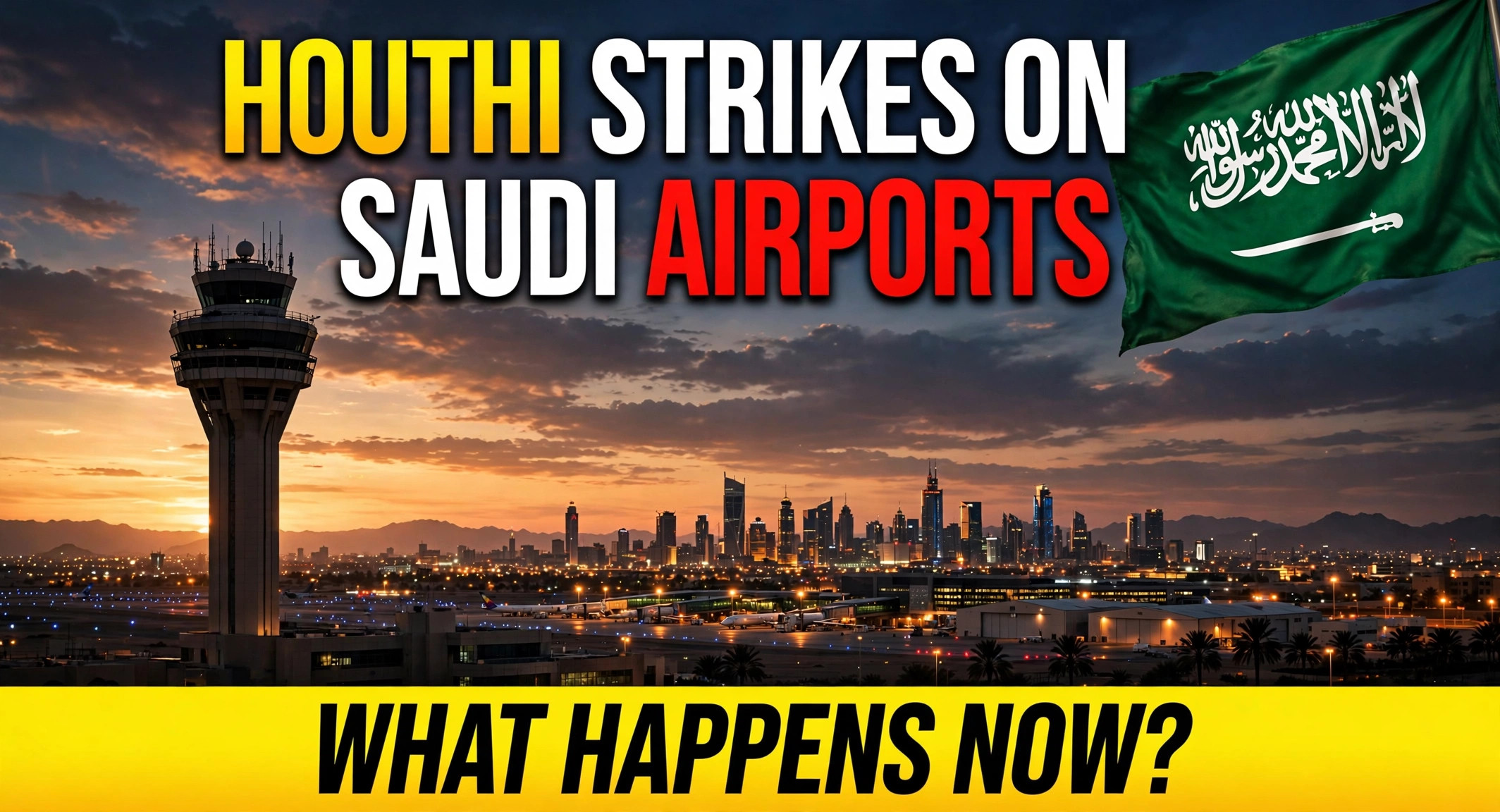

The Houthi attacks Saudi airports this week killed three people and wounded 36 others in two missile and drone strikes — one in the capital Riyadh, one in the southern city of Abha. Saudi Arabia answered with dozens of airstrikes inside Yemen, and by Thursday afternoon, hundreds of flights out of Riyadh were cancelled or delayed. Follow World Reach Daily for continuing coverage.
It’s the sharpest escalation yet in the renewed conflict between the Iran-backed Houthi movement and Saudi Arabia, and it landed squarely on civilians waiting at departure gates.
Houthi Attacks Saudi Airports Over Two Days
The strikes came on October 6 and 7, hitting King Khalid International Airport in Riyadh and Abha International Airport in the southwest, according to Saudi Arabia’s General Authority of Civil Aviation (GACA).
Abha was hit first. Two women — residents of Moroccan and Algerian nationality — were killed, and 28 people were wounded, with injuries ranging from minor to severe. A day later, King Khalid International Airport was struck: a Sudanese resident was killed and eight others injured.
Saudi authorities didn’t name a culprit in their official statement. The Houthis did it for them. Military spokesperson Yahya Saree claimed responsibility, saying Houthi forces had fired ballistic missiles and launched drones at both airports. He called the strikes retaliation for what he described as Saudi aggression — “60 airstrikes and missile attacks in the past 24 hours.”
Emergency teams were deployed immediately. GACA said it was working with other agencies to assess damage, verify facility safety, and protect passengers across the kingdom’s aviation system.
The Human Toll
The human cost of the Houthi attacks Saudi airports was written in departure lounges: two women of Moroccan and Algerian nationality at Abha, a Sudanese resident at Riyadh. The wounded included five Saudi citizens, two Egyptian residents, and one resident each from Pakistan, Bangladesh and the Philippines — all 36 transported to hospitals, injuries ranging from minor to critical.
The Houthis have hit Saudi infrastructure before — airports, oil refineries, pipelines — but striking a capital-city airport during travel hours crossed a line that drew swift regional condemnation.
Flight Chaos Grips Riyadh
By Thursday, the fallout had spread far beyond the two airports: Flightradar24 showed 153 cancelled departures from King Khalid International Airport — 39 percent of scheduled services — with 111 more flights delayed. By 4:40 p.m. Saudi time, cancellations had climbed to 162 and were still rising.
Cancelled routes included Saudia services to Dubai, Turkish Airlines to Istanbul, Qatar Airways to Doha, and Oman Air to Muscat, plus domestic flights to Jeddah and Dammam.
The flight chaos followed the Houthi attacks Saudi airports with another missile claim Thursday — Saree said the strike disrupted air traffic and warned international airlines about Saudi airspace. The Saudi-led coalition said it intercepted and destroyed missiles fired toward Riyadh and toward Khamis Mushait in the southwest — claims that couldn’t be independently verified.
Saudi Arabia Strikes Back — Hard
The coalition’s response to the Houthi attacks Saudi airports came fast. Spokesperson Maj. Gen. Turki al-Malki said the attacks “will not go unpunished,” and the coalition announced strikes against 82 Houthi military targets across the Yemeni governorates of Saada, Al Hudaydah, Al Jawf and Marib — including 11 mountain-based ballistic missile storage sites, command centers, weapons depots and gathering locations.
This is part of a much bigger fight. Yemeni government forces launched a new offensive this week under Operation “Dawn of Yemen,” aiming to retake Red Sea coast territory the Houthis seized a month ago, including the Bab el-Mandeb Strait — a chokepoint for about 12 percent of global trade. Coalition forces said they recaptured several key areas around the strait on Monday.
The stakes keep widening: Turkey is sending defensive and technical support under a new alliance pledge, and Syria is reportedly considering sending troops to Yemen, U.S. officials told Axios.
The World Reacts
The Houthi attacks Saudi airports drew swift international condemnation. On Thursday, India’s Ministry of External Affairs called the targeting of civilian infrastructure “completely unacceptable,” expressing condolences to the victims’ families and solidarity with Saudi Arabia. The UAE called the strikes a “flagrant violation” of Saudi sovereignty, and the GCC’s secretary-general, Jassim Mohammed Al-Budaiwi, called them “systematic crimes.”
Inside Yemen, the International Organization for Migration said displacement since the latest round of fighting began has topped 200,000. “People are running for their lives and finding nowhere safe to go,” said IOM Director General Amy Pope, who called for more funding for food and shelter.
Twelve years into Yemen’s war, the Houthi attacks Saudi airports mark a new front spilling across borders — into departure lounges, flight schedules, and the homes of people who never signed up for it.
Sources and Resources
Tribune (Pakistan): Pakistani among 36 injured, three killed in Houthi attacks on Saudi airports
Al Bawaba: Two killed, 28 injured in Houthi strike on Abha airport
Gulf Business: More than 150 Riyadh airport flights cancelled following attacks
Republic World: India condemns Houthi attacks on Saudi airports
Just Security: Early Edition, October 8, 2026
Frequently Asked Questions
Who are the Houthis, and why are they hitting Saudi airports?
The Houthis are an Iran-aligned rebel movement that seized Yemen’s capital in 2014 and now controls much of the country’s north, fighting a Saudi-led coalition ever since. Spokesman Yahya Saree called the Houthi attacks Saudi airports retaliation for Saudi airstrikes on Yemen. The Houthis deny being an Iranian proxy, but the coalition accuses Iran of arming, training and funding them.
Is it safe to fly to Riyadh right now?
Check with your airline first. After the Houthi attacks Saudi airports, 162 flights were cancelled and 111 delayed at King Khalid International Airport as of Thursday, with disruption still growing — and the Houthis have warned airlines about Saudi airspace.
Did Saudi defenses actually stop any missiles?
The Saudi-led coalition says it intercepted and destroyed ballistic missiles fired toward Riyadh and Khamis Mushait on Thursday, plus one north of Riyadh earlier in the week, and destroyed a launch platform in Sanaa. These claims couldn’t be independently verified.
How is this connected to the bigger US-Iran war?
The Houthi attacks Saudi airports are part of wider spillover from the U.S.-Iran conflict, analysts say. With the Strait of Hormuz disrupted, the Bab el-Mandeb Strait has become even more important for energy shipments — and the Houthis are fighting for control of it. The Pentagon recently told U.S. Central Command to prepare for resuming major combat operations in Iran, and Syria is reportedly considering joining the anti-Houthi fight.
Are the airports open again?
Riyadh’s airport stayed operational but heavily disrupted, with roughly two-thirds of departures cancelled or delayed at the peak. Both attacks caused material damage, and Saudi authorities are still assessing the extent — no timeline for full recovery has been announced.
Conclusion
The Houthi attacks Saudi airports this week killed three people, injured 36, and paralyzed one of the Middle East’s busiest airports. Saudi Arabia’s retaliation against 82 Houthi targets shows the kingdom won’t absorb civilian casualties quietly, while cancelled flights and airline warnings signal spreading fallout. With new players getting drawn in and displacement topping 200,000, civilians — at airports and in Yemeni villages alike — are paying the highest price.