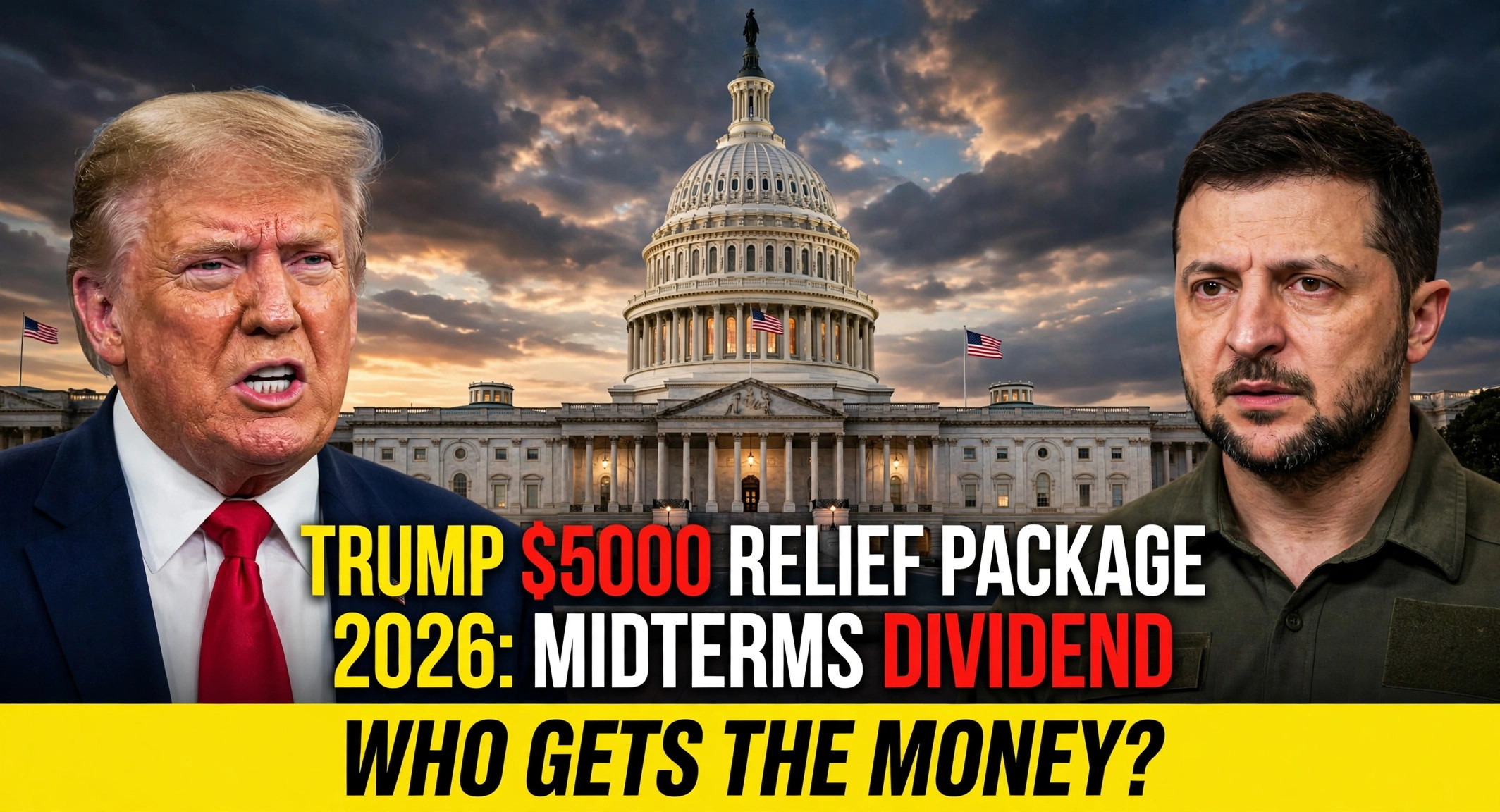
The 2026 US Midterms and Trump’s $5,000 Relief Pitch: What You Need to Know
The upcoming November 2026 midterm elections are shaping up to be anything but business as usual. Midterms almost always act as a national temperature check on whoever sits in the Oval Office. For President Donald Trump, the objective heading into November is crystal clear: keep and expand Republican majorities in the House and Senate. To get voters to the polls and tackle persistent economic worries head-on, his administration has rolled out a massive campaign proposal. They are floating a sweeping new economic relief package built to put cash straight into the pockets of the American public.
Also read:
US Tech Earnings and the Alphabet Gemini 3.5 Pro Lawsuit Explained
At the very heart of this playbook sits the “$5,000 Trump Dividend.” It’s a proposed direct payment to every adult citizen in the country, and it has absolutely dominated recent political chatter. This breakdown unpacks the nuts and bolts of the proposed relief package, the economic logic driving it, the massive legislative roadblocks it faces, and exactly how it’s reshaping the 2026 midterm landscape.
Breaking Down the “Trump Dividend”
The idea officially took center stage during the Republican Midterm Convention in Dallas, Texas, back in September 2026. President Trump laid out a bold guarantee to the electorate: if voters hand the Republican Party control of both chambers of Congress, his administration will push through a $5,000 dividend check for every adult American citizen.
It’s one of the largest direct-payment promises we’ve seen in modern campaign history. The core concept borrows heavily from the corporate world, where successful companies hand out surplus profits to their shareholders. The administration is pitching the American public as the ultimate shareholders of the country. If the nation’s economic policies—particularly revenues pulled in from aggressive international tariffs—are generating wealth, the argument goes that citizens should see that money directly.
The Economic Argument: Why $5,000?
Selling a trillion-dollar idea requires a strong pitch, and supporters are leaning hard into a few key arguments to justify the massive payout.
First, they argue for a direct return of capital. Instead of watching government revenue vanish into sprawling federal agencies and bureaucratic red tape, supporters believe handing cash straight back to the people is the absolute fastest way to juice local economies. People spend money at local diners, mechanics, and grocery stores, keeping the cash moving.
Then there’s the daily cost of living. Macroeconomic indicators look great on paper, but they don’t always translate to the kitchen table. Plenty of working-class families are still sweating over high checkout totals at the grocery store, creeping healthcare premiums, and unpredictable gas prices. A sudden $5,000 deposit offers immediate breathing room for households feeling squeezed by everyday expenses.
Finally, campaign surrogates consistently point to international trade tariffs as the engine making this whole plan possible. They argue that the billions pouring into the Treasury from these tariffs should be repurposed as a direct windfall for Americans. Prominent figures, like Ohio Senator Bernie Moreno, have already promised to hit the ground running, pledging to draft the necessary legislation the second the November votes are tallied.
The $1.2 Trillion Elephant in the Room
As appealing as a $5,000 check sounds to the average voter, the underlying math has sparked serious alarm bells for economists, fiscal watchdogs, and political rivals. Sending $5,000 to an estimated 240 million adults comes with an eye-watering price tag of roughly $1.2 trillion.
Dropping that kind of money into the economy right now carries significant risks. In August 2026, the US national debt officially crossed the $40 trillion threshold for the very first time. Critics point out that financing a trillion-dollar dividend would inevitably require the government to borrow even more money, making an already glaring fiscal deficit much worse.
There are also massive inflation risks to consider. Financial experts are flashing warning signs that dumping over a trillion dollars in liquid cash into the consumer market could kick off a brutal inflationary spike. The fear is that we’d see an economic “sugar high.” Prices would artificially inflate to soak up all that new cash, potentially leading to a sharp recessionary crash once the money runs out.
With the federal government already shelling out more cash just to cover the interest on its existing debt than it spends on major programs like national defense or Medicare, conservative fiscal hawks are openly questioning how the country can sustain this kind of massive relief package.
Political Fallout and Legal Gray Areas
Tying a massive cash payout directly to an election outcome has predictably set off a firestorm in Washington.
A fierce legal debate has erupted over whether the proposal crosses the line into electoral bribery. Legal scholars and opposition lawmakers are pointing directly to federal election laws—specifically 52 U.S.C. § 10307—which strictly ban offering financial payouts in exchange for votes. Politicians promise tax cuts and economic booms all the time; that’s just campaigning. But critics argue that explicitly dangling a $5,000 check on the specific condition that one party wins the election crosses a serious ethical and legal boundary.
The proposal has also exposed a fascinating rift within the Republican Party itself. Populist members are fully on board, but the fiscal conservatives are heavily skeptical. Texas Representative Chip Roy has publicly demanded to see the math, asking exactly how the government plans to pay for a mandate stretching well past a trillion dollars. Over in the Senate, figures like John Thune have kept things diplomatic, saying they’ll review the proposal while quietly doubting it could actually scrounge up the votes. Others, including JD Vance, have floated the idea that if this bill actually moves forward, it needs strict means-testing. In their view, the money should only go to families who genuinely need it, rather than handing $5,000 checks to millionaires.
The Reality Check: Can Congress Actually Pass This?
Promising the money on the campaign trail is easy; getting it through Congress is a completely different beast.
Before anyone sees a dime, the Republican Party actually has to win those majorities in November. But even a clean sweep is just step one. The US Constitution gives the “power of the purse” entirely to Congress. A president can’t just sign an executive order and force the Treasury to print a trillion dollars in dividend checks.
A formal bill has to be written, survive the grueling committee process, scrape together a majority in the House, and figure out how to beat a 60-vote filibuster in the Senate. The alternative is jamming it through the notoriously complicated budget reconciliation process. Considering how many elected officials are deeply worried about the national debt, passing an unfunded mandate of this magnitude is going to be an absolute dogfight on Capitol Hill.
Ultimately, the Trump Dividend highlights exactly what is on voters’ minds this cycle: domestic affordability and the cost of living. By putting a massive, easy-to-understand relief package on the table, the administration is trying to turn the midterm elections into a direct vote on personal bank accounts. Whether that play successfully drives massive voter turnout or ends up scaring off voters worried about government spending and runaway inflation is the question that will define November.
Frequently Asked Questions (FAQs)
What exactly is the 2026 Trump Relief Package? President Donald Trump has pitched a $5,000 direct payment, heavily branded as the “Trump Dividend,” to be sent out to every adult American citizen.
What has to happen for the checks to go out? The campaign promise is heavily conditional. The administration stated the checks will be issued only if the Republican Party secures control of both the House of Representatives and the Senate in the November 2026 midterm elections.
What is the actual cost of this plan? Running the numbers, financial analysts project that distributing $5,000 to roughly 240 million American adults will cost the federal government somewhere between $1 trillion and $1.2 trillion.
Can the President just issue the checks himself if his party wins? No. The Constitution doesn’t allow the President to unilaterally spend federal money. Congress holds the power of the purse and would have to draft, vote on, and pass a massive spending bill to authorize the payments.
Why are some politicians so against it? Critics are hitting the proposal from two sides. Economically, they worry that spending $1.2 trillion will explode the already historic $40 trillion national debt and kickstart a new wave of inflation. Legally, opponents argue that promising direct cash for an election win flirts dangerously with federal election bribery laws.
Would wealthy people get the check too? Under the original pitch, yes—it was framed as a universal payment to all adults. However, pushback from conservative lawmakers has sparked talks of means-testing. If drafted into a real bill, high-income earners might be entirely disqualified to lower the total cost.
PBS NewsHour
Link: PBS NewsHour Report