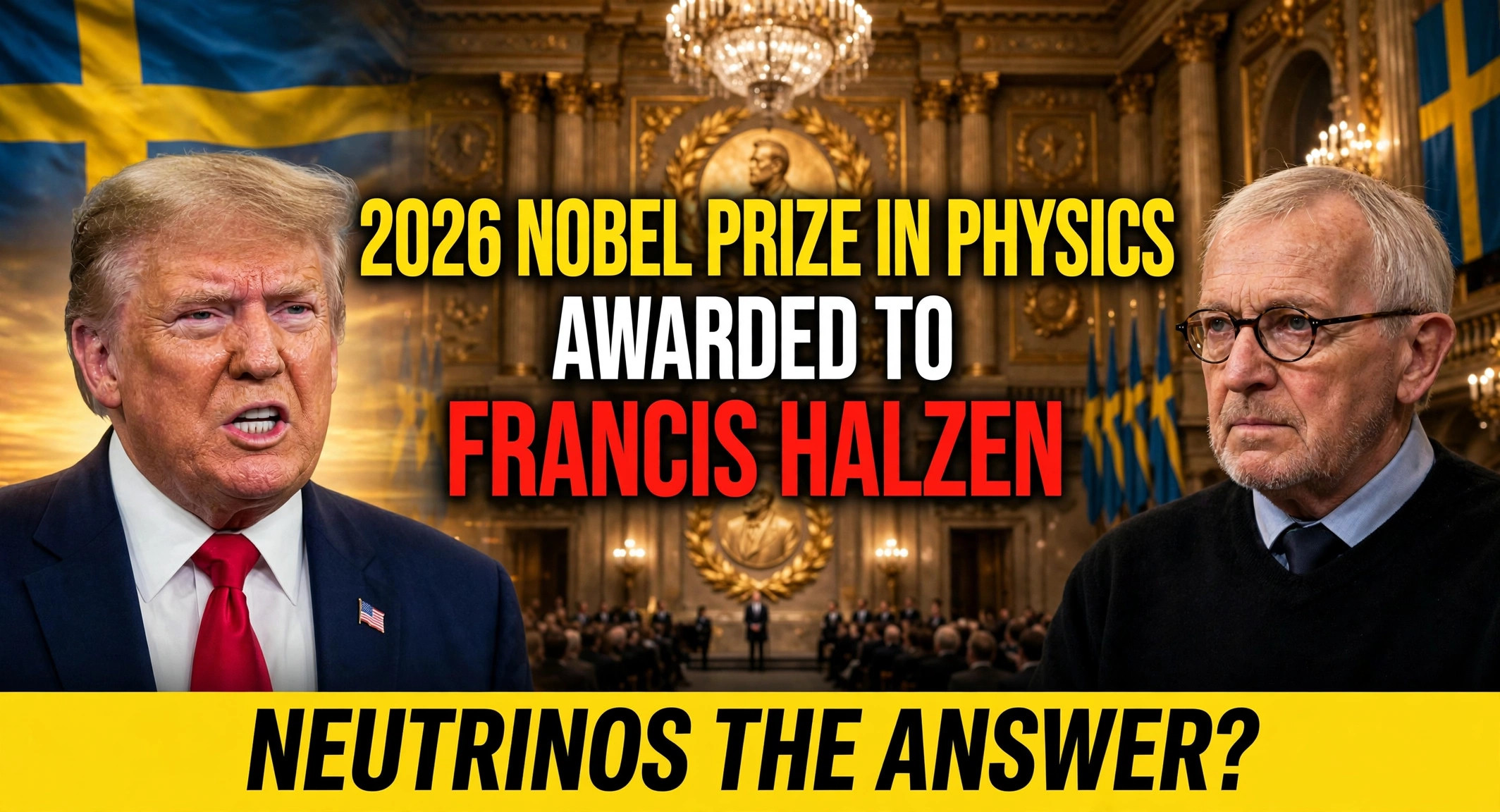
The 2026 Nobel Prize Physics award has gone to Francis Halzen, the Belgian astrophysicist whose decades-long campaign to catch the universe’s most elusive particles opened an entirely new window on the cosmos.
The Royal Swedish Academy of Sciences announced the prize in Stockholm on Tuesday, October 6, honoring Halzen “for decisive contributions to the IceCube Neutrino Observatory and the discovery of high-energy neutrinos of astrophysical origin.” The 82-year-old professor at the University of Wisconsin–Madison learned of the honor by telephone from Italy, calling it “a great surprise” and “a great pleasure.” He will receive the prize, worth 12 million Swedish crowns (about $1.2 million), at the Nobel ceremony in Stockholm on December 10.
A Dream First Sketched in 1988: The Road to the 2026 Nobel Prize Physics
Halzen’s journey to Stockholm began nearly four decades ago. In 1988, he first proposed a bold and, to many, implausible idea: use the clear, ancient ice at the South Pole as a detector for neutrinos — nearly massless, chargeless particles that stream across the universe, passing through stars, planets, and even our own bodies without leaving a trace.
He admitted after the announcement that even he was not convinced it would work, calling the project an adventure where success was not guaranteed — yet it led, nearly four decades later, to the 2026 Nobel Prize Physics.
His first attempt, a smaller detector called AMANDA, was completed in 2000 but proved too small for the job. Halzen and an international team then expanded the concept into IceCube, completed at the end of 2010: a cubic kilometer of Antarctic ice threaded with thousands of light sensors. Very rarely, a neutrino collides with an atomic nucleus in the ice, producing charged particles that emit a faint flash of pale blue light, which the sensors record — letting scientists trace each neutrino back to its origin in the sky. Committee chair Mark Pearce praised Halzen’s tenacity and vision, saying the instrument paved the way for a new kind of astronomy — and, ultimately, for the 2026 Nobel Prize Physics.
The Ghost Particles of the Cosmos
Neutrinos are often called “ghost particles” because they interact with matter so weakly. They have almost no mass and no electric charge, and they can travel through the most extreme environments imaginable without changing. While enormous numbers of low-energy neutrinos are produced by our own sun, IceCube was built to hunt far rarer quarry: high-energy neutrinos born in the most violent processes in the distant universe, such as exploding stars and blazars — distant galaxies powered by supermassive black holes. Detecting them was the achievement honored by the 2026 Nobel Prize Physics.
The breakthrough came in 2017–2018, when IceCube traced a high-energy neutrino to the blazar TXS 0506+056 — among the first times a particle from outside the solar system was linked to a specific cosmic source. The 2026 Nobel Prize Physics citation singled out this milestone as the decisive discovery. It proved the concept: neutrinos can serve as messengers from cosmic particle accelerators that light-based telescopes can never fully reveal. The observatory keeps collecting data the committee says could still reveal unknown phenomena.
Why the 2026 Nobel Prize Physics Changes Astronomy
Traditional astronomy is built on light — visible, radio, X-ray, and gamma-ray observations. But light can be absorbed or bent on its long journey across the universe. Neutrinos, traveling in straight lines from their sources without interference, carry pristine information about the distant galaxies and stellar explosions that produced them.
Committee member Eva Olsson said the particles transmit information that helps scientists better understand distant galaxies and exploding stars. Halzen himself described neutrino astronomy — now crowned by the 2026 Nobel Prize Physics — as a genuinely new branch of science, one that complements everything telescopes can already see.
What Comes Next for IceCube
With the 2026 Nobel Prize Physics behind it, the observatory remains active and is still growing. IceCube sends out real-time alerts to observatories around the world whenever it detects a neutrino likely to have an astrophysical origin, enabling follow-up observations of the sky region it came from. Plans are underway for an upgrade to extend the detector’s reach even further into the highest energies.
The 2026 Nobel Prize Physics award was the second of this year’s Nobel announcements, following Monday’s medicine prize for optogenetics. Halzen, reached in Italy, joked that he was working on a funding proposal and hoped the prize would help get it approved — a fitting coda for a scientist who spent decades convincing skeptics that a telescope made of ice could work.
Sources and Resources
- NobelPrize.org – Official Nobel Prize site with the physics prize announcement, press release, and background on Halzen’s work
- IceCube Neutrino Observatory – Official site of the South Pole detector, run by the University of Wisconsin–Madison, with news on the Nobel award and real-time alerts
Frequently Asked Questions
Who won the 2026 Nobel Prize in Physics?
Belgian physicist Francis Halzen, 82, a professor at the University of Wisconsin–Madison and principal investigator of the IceCube Neutrino Observatory. He won “for decisive contributions to the IceCube Neutrino Observatory and the discovery of high-energy neutrinos of astrophysical origin.”
What is the IceCube Neutrino Observatory?
IceCube is a cubic-kilometer neutrino detector buried in the Antarctic ice at the South Pole. Thousands of light sensors frozen into the ice record faint flashes produced when rare high-energy neutrinos collide with atomic nuclei, letting scientists trace the particles back to their cosmic sources.
What are cosmic neutrinos, and why do they matter?
Neutrinos are nearly massless, electrically neutral particles that pass through almost everything. High-energy neutrinos from deep space originate in violent cosmic events like exploding stars and active galaxies. Because they travel unimpeded across the universe, they carry information about regions that telescopes using light cannot fully observe — opening a new kind of astronomy.
When and where will the prize be awarded?
The Nobel medals will be presented by Sweden’s King Carl XVI Gustaf at the Nobel ceremony in Stockholm on December 10, the anniversary of Alfred Nobel’s death, followed by the traditional banquet at Stockholm City Hall. The physics prize is worth 12 million Swedish crowns, roughly $1.2 million.
Also on World Reach Daily: Tropical Storm Isaias takes aim at the Gulf Coast.