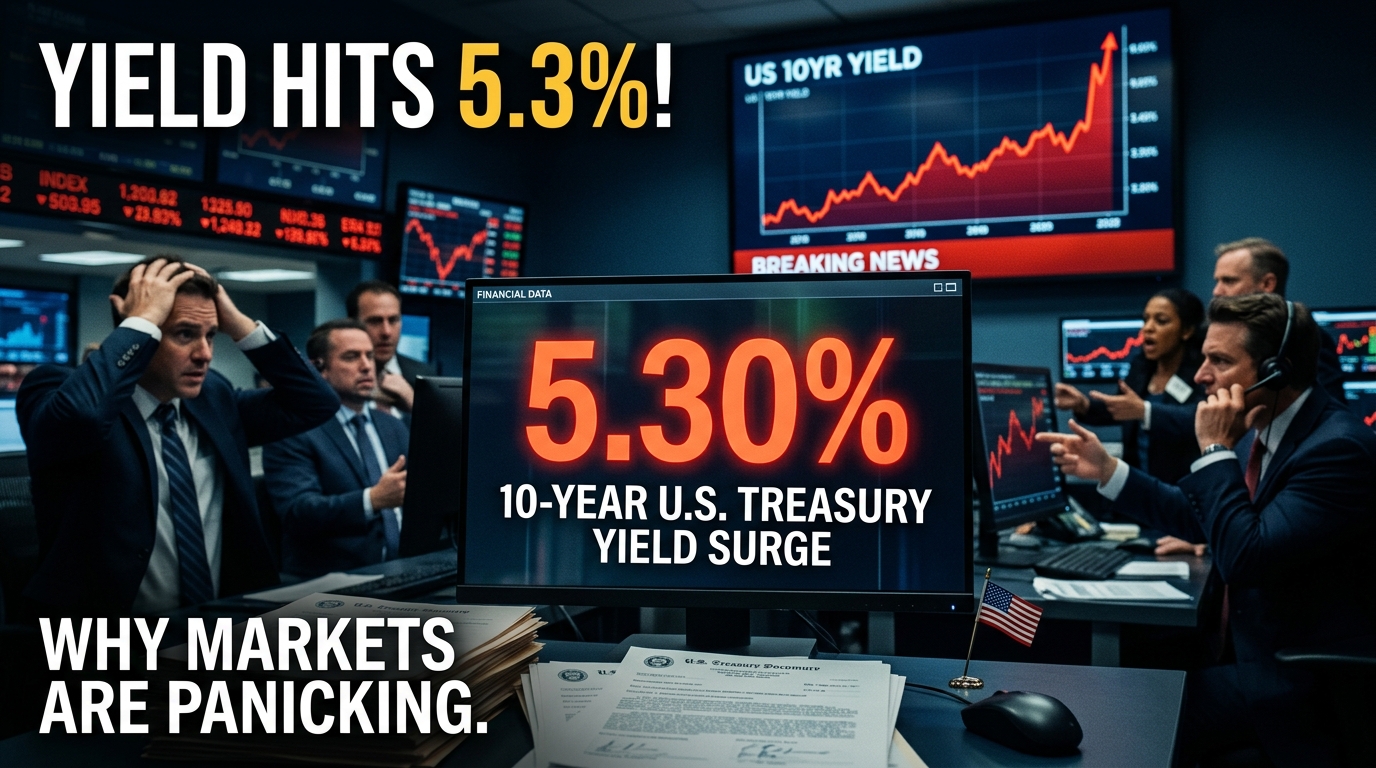
US 10-Year Treasury Yield Surges: Why the Bond Market is Freaking Out
Unless you work on Wall Street, you probably rarely check bond yields when you wake up. Most of us keep tabs on home prices, stock tickers, or how much a gallon of gas costs, completely ignoring the government debt market. But right now, something massive is happening behind the scenes in global finance. The U.S. 10-year Treasury yield recently pushed past 5.3%, hitting levels we haven’t seen in over two decades.
If you are wondering why Wall Street seems so on edge, or why getting a mortgage feels entirely out of reach lately, this climbing number is your culprit. For the better part of a decade, we lived in an era of ultra-cheap money. Borrowing was practically free, and central banks rushed in to cushion every economic bump. Today, that playbook is completely shredded. A perfect storm of shifting Federal Reserve expectations, stubborn inflation, and a surprisingly bulletproof U.S. economy has completely flipped the script.
Also read:
The Trump Foreign Aid Diversion & DHS Ad Controversy Explained
1. What Is the 10-Year Treasury Yield?
Think of a U.S. Treasury note as a very secure IOU from the federal government. When you buy a 10-year Treasury, you are lending money to the government for exactly a decade. In exchange, they agree to pay you a fixed interest rate every year until the time is up, at which point you get your original money back.
The Inverse Relationship: Prices vs. Yields
There is one golden rule you need to remember about how this market works: prices and yields always move in opposite directions.
When everyone panics and wants to buy safe government bonds, the price goes up. Because you are paying a premium to buy that bond, the effective interest rate you earn—the yield—goes down. Conversely, when investors decide they want to sell off their bonds to buy riskier things like stocks, the bond price crashes. To convince buyers to step in and purchase those unwanted bonds, the government has to offer a much sweeter deal. The yield goes up.
Why the 10-Year Benchmark Matters
Because the U.S. government practically never defaults on its debt, the 10-year yield is treated as the baseline risk-free rate for the entire planet. Every other loan on earth—from your local credit union’s auto loan to a massive corporate debt package—is priced based on this single number. If the U.S. government has to pay over 5% just to borrow money, regular people and businesses are guaranteed to pay significantly more.
2. Key Catalysts Driving Yields to Multi-Decade Highs
Catalyst A: Shifting Federal Reserve Expectations
A year ago, traders were convinced that the Fed would hike interest rates, cool off inflation, and then quickly pivot back to cutting rates. That was the dream scenario, often called a “soft landing.” The reality has been much messier. Top-line inflation isn’t at the terrifying peaks we saw a while back, but it is proving incredibly sticky. Costs for auto insurance, healthcare, housing, and general services have refused to fall back down to the Fed’s comfortable 2% target.
Because inflation eats away at the value of a fixed payout, bondholders are terrified of it. Imagine locking your money up for ten years at a 4% yield. If inflation runs at 3.5% the whole time, you are barely making any real money. To protect themselves from this exact scenario, investors are demanding higher yields up front.
Catalyst B: Surprising Economic Resilience
Normally, when the Federal Reserve jacks up interest rates this fast, the economy slams on the brakes. Businesses stop hiring, people stop spending, and a recession kicks in. During a recession, fearful investors pull their money out of the stock market and buy up safe government bonds, pushing yields right back down.
But the U.S. economy stubbornly refused to follow that traditional script. Job growth has stayed solid, unemployment remains historically low, and overall consumer spending has held up. People are still traveling, dining out, and buying goods. In the twisted logic of the bond market, this good economic news is actually terrible news for bond yields. Since the economy is doing just fine on its own, the Federal Reserve has zero reason to step in and cut interest rates to save the day. Investors realize a rescue mission isn’t coming anytime soon, so they continue to sell off long-term bonds, pushing the 10-year yield even higher.
Catalyst C: Federal Deficits and Supply Oversupply
Compounding this is the sheer math of supply and demand. The U.S. government is running massive fiscal deficits, meaning it has to borrow trillions of dollars to keep the lights on. To fund all this spending, the Treasury Department is flooding the market with a tsunami of new bonds.
At the exact same time the supply is ballooning, the usual guaranteed buyers are backing away. The Federal Reserve is busy shrinking its own massive portfolio of bonds, and foreign governments have slowed their purchases. If you flood the market with new supply and pull away the biggest buyers, prices fall and yields rise.
3. The Main Street Impact: How Surging Yields Touch Your Wallet
You might not own a single government bond, but this 10-year yield spike is directly impacting your bank account. The ripple effects through the economy are entirely unavoidable.
The Housing Market Freeze: Mortgage lenders tie 30-year fixed rates directly to the 10-year Treasury. When the 10-year yield hovers above 5%, mortgage rates easily push past 7.5% or 8%. New buyers simply cannot afford the monthly payments on an average home, and current homeowners refuse to sell because they don’t want to abandon the 3% mortgage rate they locked in years ago. The result is a frozen market with terrible affordability and scarce inventory.
Crushing Consumer Credit: As the baseline borrowing rate rises, credit card companies and auto lenders hike their annual percentage rates to match. Carrying a balance right now is more punishing than it has been in decades, quietly draining disposable income from middle-class households.
Corporate Cutbacks: Companies rely heavily on the bond market and bank debt to build new factories, buy software, and hire workers. When their borrowing costs double, their profit margins shrink rapidly. To survive, many businesses will eventually have to pause hiring, scale back on ambitious expansion plans, or pass those higher operational costs directly down to consumers.
A Reality Check for Stocks: High bond yields act like gravity on the stock market. Why risk hard-earned money on a volatile tech stock if you can get a guaranteed 5% return directly from the U.S. government? This dynamic drains capital away from equities, putting heavy pressure on stock prices—especially for high-growth companies.
4. Conclusion: Navigating the New Normal
We are witnessing a profound awakening to a world of persistent inflation, endless government debt issuance, and a resilient economy that doesn’t need central bank life support. Taking on new, high-interest debt is incredibly risky right now, and carrying rolling credit card balances is a wealth killer. Until we see a massive break in the inflation data or a severe crack in employment numbers, these elevated borrowing costs are likely here to stay.
5. Frequently Asked Questions (FAQs)
Q1: Why should I care about the 10-year Treasury yield if I don’t invest in bonds?
It dictates the cost of money for everything else in your financial life. The 10-year yield serves as the foundation for 30-year mortgage rates, private auto loans, and corporate borrowing. When the Treasury yield goes up, your personal cost of living usually goes up right alongside it.
Q2: Is a high bond yield good or bad for the stock market?
Generally, it is a significant headwind for stocks. When yields are high, investors can earn a great, guaranteed return without taking on stock market risk. This makes stocks look much less attractive by comparison, which often leads to sell-offs, particularly in the tech sector.
Q3: What specific event would cause the 10-year yield to finally go down?
A sharp economic recession or a massive drop in inflation. If the economy tanks and unemployment spikes, the Federal Reserve will cut interest rates to stimulate growth. Investors will panic and rush back into government bonds for safety, driving bond prices up and pushing yields back down.
Q4: How does inflation ruin bond prices?
Bonds pay out a fixed amount of money every year. If inflation is high, the real-world purchasing power of that fixed payout drops over time. Investors sell off their bonds when they fear inflation is out of control, driving bond prices down and yields up until the return is high enough to outpace the inflation rate.
Q5: What is the “term premium” everyone keeps mentioning?
It is the extra financial compensation you demand for locking your money up for a long time. Given the deep uncertainty around future inflation, shifting interest rates, and how much debt the U.S. government is issuing, investors are currently demanding a higher term premium to hold a 10-year bond compared to a short-term 3-month bill.
6. Official News Links & Trusted Sources
Trading Economics: US 10 Year Treasury Note Yield – Quote – Chart Provides real-time data and historical charts tracking the U.S. 10-year Treasury yield, which recently topped 5.3% to hit its highest level since early 2002 amid persistent inflationary pressures and resilient economic data.
Reuters via Investing.com: 10 year US Treasury yield hits highest since 2002 Recent financial coverage detailing how the global benchmark posted its biggest quarterly rise this century, surpassing its 2007 peak as a brutal bonds selloff gathered pace.
Hindustan Times: US 10-year Treasury yield hits 5.34%, highest since 2002: Why are yields rising? Expert analysis breaking down the primary catalysts behind the surging yields, including high inflation, massive government borrowing deficits, and the artificial intelligence boom driving up capital demand globally.
Seoul Economic Daily: 10-Year Treasury Yield Hits 24-Year High as Fed Bets Swing Reporting on how solid U.S. growth and concerns over prolonged geopolitical conflicts in the Middle East have driven the benchmark yield up to 5.306%, raising the likelihood of further Federal Reserve rate increases.
El País (English): The yield on the US 10-year Treasury reached its highest level in two decades