The Global AI Market Growth (2026-2035): Size, Trends, and Future Projections
The artificial intelligence (AI) landscape has transitioned from an experimental technological frontier to the core engine driving the modern global economy. With massive enterprise adoption, exponential increases in cloud computing capabilities, and breakthroughs in generative AI, the market is expanding at a staggering pace. For businesses, investors, and technologists, understanding the trajectory of AI market growth is no longer optional—it is a foundational requirement for strategic planning over the next decade.
Also read:
MLB Wild Card Series: Format, Rules, History & Playoff Guide
Below is a comprehensive analysis of the artificial intelligence market, including current valuations, segment breakdowns, regional dominance, and the major headwinds and tailwinds shaping the industry’s future.
The Numbers: Global AI Market Size and Forecast
While different market research firms utilize varying methodologies, there is a unanimous consensus: the AI market is experiencing hyper-growth.
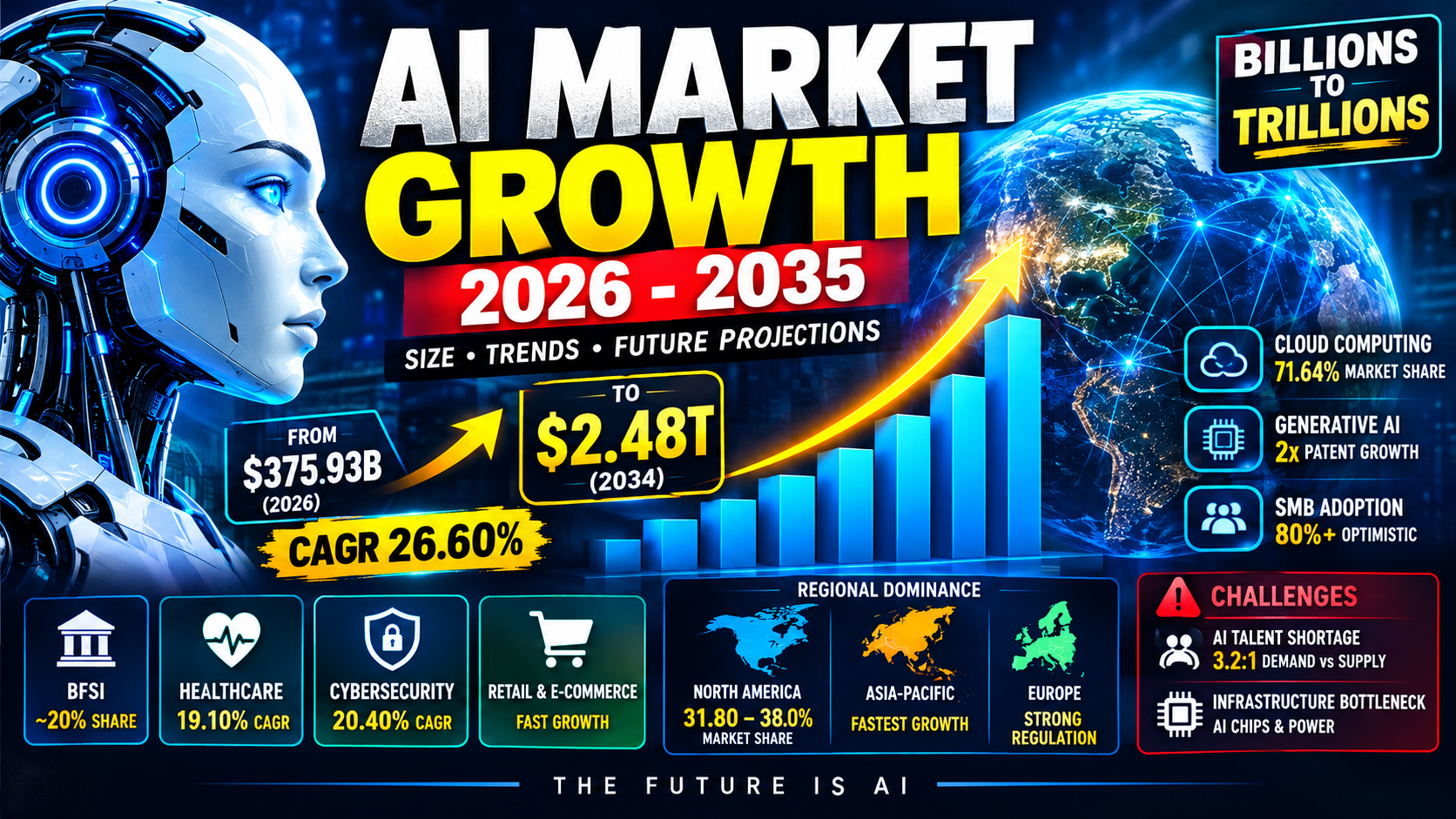
According to Fortune Business Insights, the global artificial intelligence market was valued at USD 294.16 billion in 2025 and is projected to grow from USD 375.93 billion in 2026 to an astounding USD 2,480.05 billion by 2034. This represents a Compound Annual Growth Rate (CAGR) of 26.60% during the forecast period.
Other industry analysts paint an even more aggressive picture. Grand View Research estimated the 2025 market size at USD 390.9 billion, projecting it to scale to USD 3,497.3 billion by 2033 at a CAGR of 30.6%. Precedence Research extends its forecast to 2035, predicting the market will expand from USD 757.58 billion in 2025 to over USD 4,216.29 billion by 2035.
Regardless of the exact baseline, the data indicates that AI is growing 8 to 10 times faster than traditional software markets, heavily propelled by the enterprise rush to implement machine learning, computer vision, and natural language processing capabilities.
To visualize this extraordinary trajectory, consider the projected growth curve over the next decade:
Key Drivers Fueling the Artificial Intelligence Boom
Several interconnected factors are accelerating the adoption and monetization of artificial intelligence platforms globally.
Cloud Infrastructure Investments: The cloud segment overwhelmingly dominates the AI market, accounting for approximately 71.64% of the market share in 2025. Hyperscalers like AWS, Microsoft Azure, and Google Cloud collectively account for 65% of the infrastructure market. In 2024, major tech giants (Amazon, Microsoft, Google, and Meta) invested a combined USD 248 billion in capital expenditure, primarily to support AI-focused data centers, with spending crossing USD 300 billion in 2025.
The Rise of Generative AI: Generative AI has moved from a novelty to a critical enterprise tool. According to the World Intellectual Property Organization (WIPO), large language models became the largest generative AI patent category in 2025, with GenAI inventions doubling from 18,862 in 2024 to 37,808 in 2025. This subset of AI is driving massive investments in natural language processing across legal, customer support, and software development sectors.
Small and Medium Business (SMB) Adoption: AI is no longer restricted to Fortune 500 companies. Surveys indicate that nearly 80% of U.S.-based small business owners are actively deploying or optimistic about AI tools for marketing, sales, and operational efficiency.
Industry Breakdown: Which Sectors Are Adopting AI Fastest?
The integration of artificial intelligence is not uniform across all sectors. Certain industries have distinct data pipelines and quantifiable ROI metrics that make AI implementation highly lucrative.
BFSI (Banking, Financial Services, and Insurance): The BFSI sector remains the leading end-user, holding roughly a 19% to 20% market share globally. Financial institutions are deploying machine learning and AI for real-time fraud detection, algorithmic trading, credit scoring, automated compliance, and dynamic risk management.
Healthcare and Life Sciences: Healthcare is expected to grow at an aggressive CAGR of 19.10% over the coming decade. AI applications are revolutionizing medical imaging diagnostics, accelerating drug discovery, and streamlining patient record management.
Cybersecurity: As cyber threats become more sophisticated, automated defense mechanisms are essential. The cybersecurity function segment is projected to grow at a CAGR of 20.40%, heavily utilizing AI for anomaly detection and rapid threat response.
Retail and E-commerce: Deep learning algorithms are fundamentally altering how retailers manage inventory, forecast demand, and execute hyper-personalized marketing campaigns.
Regional Analysis: North America, Asia-Pacific, and Europe
Geographic concentration plays a major role in the AI economy, driven by regional talent pools, venture capital availability, and government policies.
North America: The Current Leader
North America dominates the global AI ecosystem, capturing between 31.80% and 38.0% of the market share in 2025, generating upwards of USD 93.5 billion in revenue. The United States houses the vast majority of well-funded AI startups. According to the 2022 AI index report, out of 1,392 globally funded AI companies receiving over USD 1.5 million, the U.S. accounted for 542. Continued public-private collaboration and a massive concentration of capital in hubs like Silicon Valley ensure North America will maintain a leading position.
Asia-Pacific: The Fastest Growing Market
While North America holds the largest current market share, the Asia-Pacific region is the fastest-growing territory. The market in China alone is estimated to hit USD 37.16 billion in 2026, driven by aggressive domestic tech investments and government backing. India (USD 18.08 billion) and Japan (USD 20.9 billion) follow closely, with major initiatives aimed at advancing sovereign AI capabilities and building resilient semiconductor supply chains.
Europe: Scaling with Regulation
Europe accounted for approximately USD 65.48 billion in 2025 and is projected to reach USD 81.97 billion in 2026. The U.K. market is estimated to reach USD 19.38 billion in 2026, leading Germany (USD 14.96 billion) and France (USD 12.12 billion). The European market is uniquely shaped by stringent regulatory frameworks, such as the EU AI Act and GDPR, which restrict automated individual decision-making and emphasize explainable AI.
Challenges and Roadblocks Ahead
Despite the explosive growth, the artificial intelligence market faces significant structural and macroeconomic hurdles.
The most pressing constraint is the global AI talent supply deficit. As of 2026, global demand for AI professionals exceeded qualified supply by a 3.2:1 ratio. There are over 1.6 million open positions globally competing for a pool of just 518,000 qualified candidates. This talent shortage directly threatens the timeline for AI development, implementation, and enterprise scalability.
Additionally, the immense computing power required to train large language models has triggered an infrastructure bottleneck. The reliance on specialized AI Chips and GPUs has strained global supply chains. Facilities are now being designed to house upwards of 100,000 cutting-edge AI chips—four times the capacity of earlier AI factories—requiring unprecedented levels of electricity and cooling infrastructure.
Conclusion
The artificial intelligence market is currently in a phase of historic acceleration. Valued at over USD 375 billion in 2026, the industry is on a clear trajectory to cross the multi-trillion-dollar threshold within the next decade. Driven by the ubiquity of cloud computing, the disruptive power of generative AI, and deep integrations across finance, healthcare, and retail, AI is reshaping the global technological landscape. While challenges such as a severe talent shortage and infrastructure constraints loom, the capital influx from major tech hyperscalers ensures that the AI market will remain the most critical growth vector in the modern digital economy.
FAQs
What is the projected size of the global AI market by 2034/2035?
Depending on the forecasting firm, the market is projected to reach between USD 2,480.05 billion (Fortune Business Insights) and USD 4,216.29 billion (Precedence Research) by 2034-2035.
Which region currently holds the largest AI market share?
North America dominates the market, capturing approximately 31.80% to 38.0% of global revenue in 2025, heavily driven by massive investments in the United States.
Which industry is the largest adopter of AI technology?
The BFSI (Banking, Financial Services, and Insurance) sector is the leading adopter, utilizing AI for fraud detection, risk management, and algorithmic trading, holding roughly a 19% to 20% market share.
What is the main challenge facing the AI industry’s growth?
The primary bottleneck is a severe lack of skilled professionals. In 2026, there was a 3.2:1 ratio of demand to supply for qualified AI talent, limiting implementation and scalability.
How much of the AI market does cloud computing represent?
The cloud segment is the dominant deployment method, accounting for approximately 71.64% of the total AI market share.
Official News Links & Trusted Sources
Fortune Business Insights: Artificial Intelligence Market Global Report 2034
Market.us: Artificial Intelligence (AI) Market Size, Share | CAGR of 30.6%
Grand View Research: Artificial Intelligence Market Size & Share Report, 2026-2033
Precedence Research: Artificial Intelligence (AI) Market Size and Forecast 2026 to 2035
Visionary Marketing: AI Market Size & Growth Statistics (2026)