
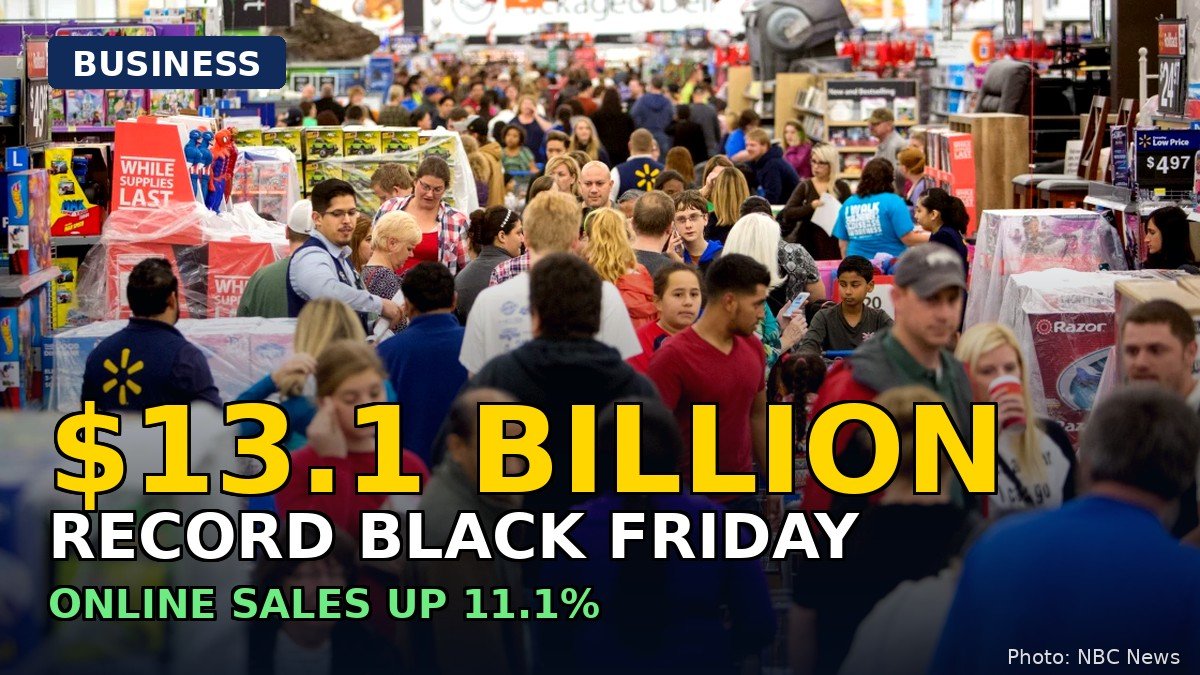
Black Friday online sales hit a record $13.1 billion in the United States this year, rising 11.1% on last year as shoppers splurged on electronics, gaming and toys — and beat even Adobe’s own forecast for the biggest shopping day of the year. The number, from Adobe Analytics data published on Saturday, suggests American consumers are still willing to spend when the deals are right, even while inflation and high petrol prices squeeze household budgets.
The figure edged past Adobe’s initial forecast of around $12.9 billion for the day. Retailers pushed hard with discounts on apparel and appliances in an effort to win over shoppers who have grown careful about every dollar — and, for one day at least, the strategy worked.
Black Friday Online Sales: What Shoppers Actually Bought
Gaming and electronics were the standout categories of the day, according to the Adobe report, but the spending was broader than gadgets alone. Consumers also used the deals to stock up on essentials — household cleaning products, pet care items and personal hygiene products — the kind of everyday purchases that say as much about household budgets as any television or games console does.
That mix tells the story of this year’s Black Friday. Shoppers were not just treating themselves; they were using the biggest discount day of the year to buy things they need anyway, at prices they may not see again until next year. It is the behaviour of a consumer who is still spending, but spending with a plan.
The pace of the day was extraordinary. Spending peaked at $14 million a minute between 10 a.m. and 2 p.m. Eastern Time — the four-hour window when most of America was awake, online and hunting for deals at the same time. It is the kind of number that explains why retailers now treat Black Friday less as a single day and more as a carefully engineered peak in a weeks-long campaign.
Why Shoppers Spent More Despite Inflation
The record comes against a difficult backdrop. Americans have been weighed down by inflation and high gas prices, and this year’s holiday shopping season was widely expected to be marked by consumers looking for ways to stretch their holiday budgets — relying on deals and using artificial intelligence tools to carefully compare prices before buying.
That is exactly what happened, and it is why the record is more interesting than the headline number alone. Shoppers did not abandon caution; they weaponised it. They compared prices across retailers, waited for the deepest discounts and then spent — heavily — when the value was clear. The retailers that won Black Friday were the ones that made the value obvious.
It is a pattern the market has been watching all week. Just days earlier, the S&P 500 posted its best week since April 2025 as tech stocks rebounded: S&P 500 Posts Best Week Since April 2025 as Tech Stocks Rebound. Strong consumer spending is one of the things that rally was pricing in — and Black Friday delivered the evidence.
The caution was visible before the day itself. In the run-up to Black Friday, shoppers were already signalling they would be selective, hunting for value rather than buying on impulse: Cautious Shoppers Gear Up for Black Friday as Inflation Woes Bite. The record total shows that selectivity did not mean staying away — it meant spending smarter.
Buy Now, Pay Later and the AI Price Check
Two habits defined this year’s Black Friday. The first is buy now, pay later. Shoppers are increasingly relying on the option to spread the cost of their purchases, and Adobe expects it to contribute $1.09 billion in online spending on Cyber Monday alone — up 5.3% on a year ago. For big-ticket electronics and gaming purchases, splitting the payment has become part of how many households make the maths work.
The second is AI-assisted shopping. Consumers are using artificial intelligence tools to compare prices across retailers in seconds, checking whether a “deal” is genuinely cheaper or just dressed up to look like one. Retailers can no longer rely on a red sale sticker to do the persuading — the price has to survive a comparison.
What Cyber Monday Could Bring
If Black Friday is the record, Cyber Monday is expected to break it. Adobe expects Cyber Monday spending to reach a record $15.1 billion, which would make it the biggest online shopping day in US history. The buy now, pay later figure of $1.09 billion is part of that total, and the same forces — deep discounts, careful comparison, and a willingness to spend when the value is real — will decide whether it lands.
For retailers, the two days together are the real test of the holiday season. Black Friday proved the demand is there. Cyber Monday will show whether it was a one-day surge or the start of a strong season.
What the Record Means for Retailers
The $13.1 billion figure matters beyond a single day of sales. It is the clearest signal yet of how the American consumer is behaving in late 2026: still spending, still drawn to big-ticket electronics and gaming, but disciplined — buying essentials on discount, comparing prices with AI tools, and spreading payments where it helps.
Retailers that read that signal correctly will shape the rest of their holiday season around it: sharper discounts on the categories people actually want, honest pricing that survives comparison, and flexible payment options at checkout. Those that do not will be left wondering why the record-breaking day passed them by.
The story was first reported by Reuters. Read the full source report here: Black Friday online shopping rises to $13.1 billion in the US, Adobe Analytics data shows.