
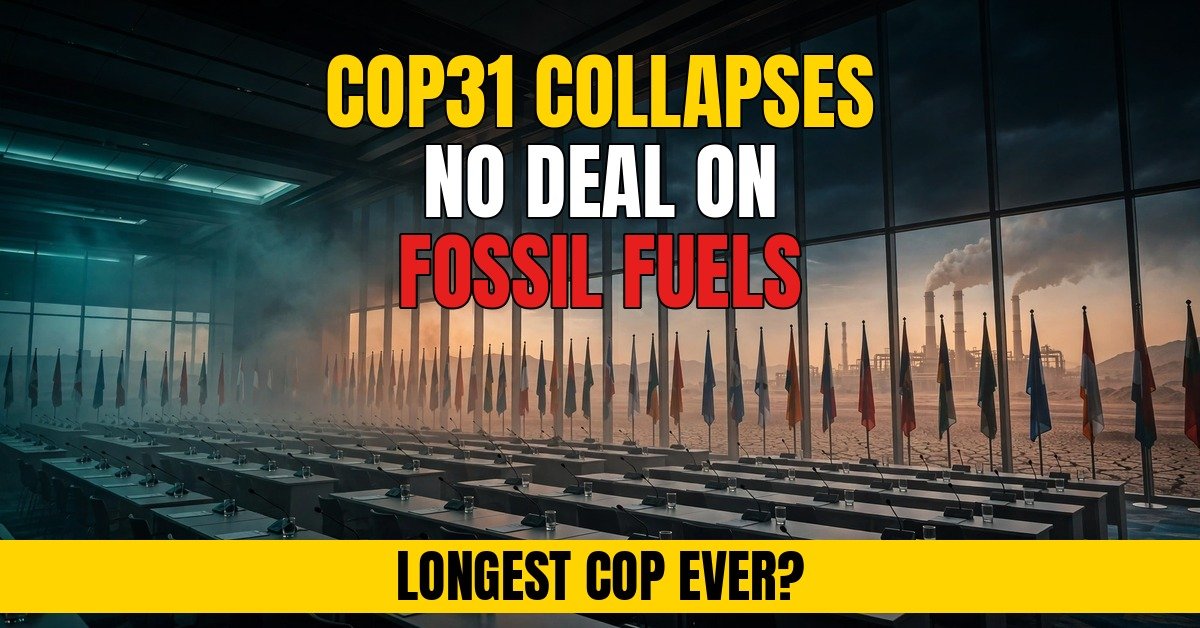
The COP31 climate summit collapse stunned Antalya on Sunday, 22 November 2026. After more than two weeks of talks, delegates from more than 190 countries left without an overarching deal, and the conference chair admitted there was simply no consensus to approve one.
It was the longest COP in history. It was also the first time a major climate summit had broken down so completely since Copenhagen in 2009. For people already living with floods, heat and drought, the result felt less like a diplomatic delay and more like a door closing.
What broke the talks was not a technical detail. It was the cause of the crisis itself: fossil fuels. Delegates could not agree to say, in the final text, that the world must move away from coal, oil and gas. That failure, after days of overtime, is why Antalya ended with no pact at all.
How the COP31 climate summit collapse unfolded
The COP31 climate summit collapse did not happen in a single vote. It built up over a fortnight of arguments in Antalya, Turkey, then spilled into a weekend of overtime sessions that ran long past the planned close. By Sunday, the final meeting meant to approve the so-called Antalya Pact had become a reckoning instead.
COP31 president Murat Kurum told the closing plenary that support was not there to gavel the pact through. “We have done our utmost,” he said, adding: “It is clear that there are parties in this hall who oppose this text. We recognize that there is no consensus on this document.” With that, the deal was dead.
The European Union, Panama, the Marshall Islands and Norway were among those that rejected the draft. Darragh O’Brien, Ireland’s climate minister, who helped lead negotiations for the EU, said the bloc would not endorse a deal “that does not even mention fossil fuels.” For the EU and many small island states, a climate agreement with no mention of fossil fuels was not a compromise. It was a retreat.
The United States was not part of that final argument. Under President Donald Trump, Washington has pulled out of international climate action, and the US did not join the more than 190 countries trying to reach consensus in Antalya.
Two words that broke the talks: fossil fuels
At the heart of the COP31 climate summit collapse were two words: fossil fuels. The first draft of the COP31 “cover decision” — the overarching agreement from the conference — was published on Monday and called for “the immediate transition away from fossil fuels in energy systems.” That language did not survive.
Every mention of fossil fuels was stripped out of each later draft, even though more than 100 countries pushed to keep it in. “You cannot solve a fossil fuel crisis by pretending we don’t need to phase out fossil fuels,” said Harjeet Singh, a veteran COP negotiator and founding director of the Satat Sampada Climate Foundation.
The retreat matters because of what happened three years earlier. At COP28 in Dubai in 2023, countries agreed to an unprecedented call to “transition away from fossil fuels.” Since then, that promise has not been repeated or built upon. Oil-producing nations have resisted any reference to the driving force of the climate crisis, and at COP31 that resistance won the day — by killing the deal outright.
Delegates also worried about the draft’s embrace of carbon capture technology, which would let fossil fuel production continue if its carbon pollution is captured before it reaches the air. Many scientists say some carbon capture will be needed, but the technology remains expensive and unproven at scale. Critics call it a distraction from cutting emissions at source. “Relying on carbon capture without phasing down fossil fuels is like trying to quit smoking without putting down the cigarettes,” said Matt Webb, associate director for global clean power diplomacy at E3G, a climate think tank.
Money was the other fault line
Finance helped drive the COP31 climate summit collapse, too. Poorer, climate-vulnerable countries have long asked for more money to adapt to disasters they did little to cause — and to recover after them. At Antalya, they felt that ask was brushed aside once again.
The draft agreement called for efforts to at least triple adaptation finance by 2035, but it gave no baseline and no specific numbers. For developing countries, a target with no starting point and no figures attached was a promise they could not bank on.
“Rich countries refused to put money on the table to help communities prepare for and recover from climate disasters, and handed polluters a free pass instead,” Singh said. “No deal is better than a deal that locks in failure.” That view — that a bad deal would have been worse than none — helps explain why so many delegations were willing to let the pact fall.
What the COP31 climate summit collapse means for 1.5C
The COP31 climate summit collapse lands at a brutal moment for the planet. A recent UN report confirmed the world will overshoot its target of limiting global warming to 1.5 degrees Celsius above pre-industrial levels. On current policies, temperatures are expected to rise to a potentially catastrophic 2.8 degrees. The planet is already at around 1.4 degrees of warming.
The effects are no longer abstract. CNN’s reporting pointed to catastrophic flooding in Nepal and deadly heat in Europe, alongside a world distracted by geopolitical turbulence — including the Iran war, which has caused the world’s largest energy supply shock. While attention drifts elsewhere, the climate crisis keeps accelerating.
That is why the reaction from experts was so sharp. “This has been the worst ever COP and its collapse needs to be a wake up call for the world,” said Mohamed Adow, director of the energy think tank Power Shift Africa. Mary Robinson, the former president of Ireland and a COP veteran, put it this way: “Recognition of the dangers of overshoot should have shaken leaders into action, instead COP31 saw a shameful lack of urgency and leadership.”
What happens next after Antalya
The COP31 climate summit collapse does not end climate talks. It raises the stakes for the next round, and it leaves a hard question hanging over every delegation that went home from Antalya: if 190-plus countries cannot agree to name fossil fuels, what can they agree on? The COP31 climate summit collapse will shape those next talks, whether leaders want it to or not.
Chris Bowen, COP31 president of negotiations, called the result very disappointing, but pointed to some progress outside the main pact, including more than 90 countries signing a pledge to ramp up the electrification of their economies. That is real, and it shows that action can move forward in smaller groups even when a full consensus fails.
Still, the core issues have not gone away. The next talks will have to return to the same two questions — how fast the world moves away from fossil fuels, and how much rich countries will pay to help vulnerable nations adapt. Antalya proved that dodging those questions does not make them disappear. It just makes the next summit harder.
Sources and Resources
Our report on the COP31 climate summit collapse is based on CNN’s reporting from Antalya on 22 November 2026, including the closing plenary, the draft texts and the reactions quoted above. Read the full CNN report here: CNN: Global climate summit collapses as countries fail to agree on moving away from fossil fuels. For more international coverage, see our World news section.
Frequently Asked Questions
So, did COP31 actually end with no deal at all?
Yes. The COP31 climate summit collapse means the main Antalya Pact was never adopted. There was no consensus among the more than 190 countries present, so the closing plenary ended without an overarching agreement — the first breakdown of its kind since Copenhagen in 2009.
Why couldn’t they just agree on fossil fuels?
Because that was the sticking point. The first draft called for an “immediate transition away from fossil fuels,” but later drafts dropped every mention of them, despite support from more than 100 countries. Oil-producing nations pushed back, and the EU and others refused to sign a deal that did not even name fossil fuels.
What does this mean for the 1.5C target?
It makes an already tough job tougher. The COP31 climate summit collapse came as a recent UN report said the world will overshoot 1.5C, and on current policies warming could reach 2.8C. The planet is already at about 1.4C, with floods in Nepal and deadly heat in Europe showing what that warming looks like in practice.
Who walked away, and who got blamed?
The EU, Panama, the Marshall Islands and Norway were among those that rejected the final draft. After the COP31 climate summit collapse, climate experts blamed a lack of leadership and pressure from fossil fuel interests, while vulnerable countries blamed rich nations for refusing to put real adaptation money on the table.
What happens now — is that it for climate talks?
No. Climate talks will continue, and smaller groups of countries are already moving ahead — more than 90 signed a pledge at COP31 to speed up electrification. But after the COP31 climate summit collapse, the big questions on fossil fuels and finance will return at the next summit, and Antalya has made them harder to dodge.
Conclusion
The COP31 climate summit collapse will be remembered as the summit that could not say the words that mattered most. After the longest COP ever, in a year of floods, heat and war-driven energy shocks, delegates left Antalya with no pact, no fossil fuel language and no firm finance numbers.
That is a failure, plain and simple. Yet the walkouts also drew a line: for the EU, small island states and more than 100 other countries, a deal that pretends fossil fuels are not the problem was not worth signing. The test now is whether that line holds after the COP31 climate summit collapse — and whether the next talks turn a collapse into a turning point, before 1.5C slips out of reach for good.