
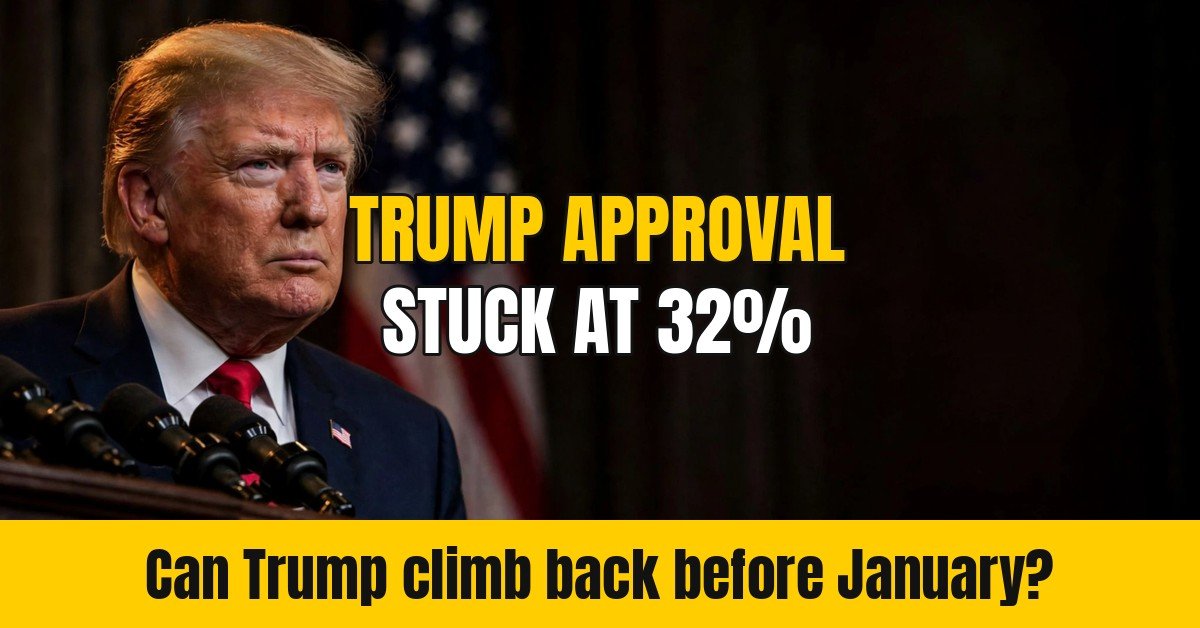
President Donald Trump’s approval rating has flatlined near the lowest point of his presidency, tied directly to kitchen-table pain in the latest Reuters/Ipsos poll. The Trump approval rating stands at 32% in the four-day poll completed on Monday, November 16 — the fourth straight survey in the same narrow band since it touched a career low of 31% in mid-October. For a president who built his brand on winning, the numbers tell a stubborn story: voters have stopped moving, and they are not moving his way.
The poll landed less than two weeks after the November 3 midterms, in which Republicans lost control of Congress, and just as Democrats prepare to take over the Senate and House in January. Trump still commands fierce loyalty inside his own party, but the survey shows a president who has lost the middle of the electorate — with no clear route back to it.
Fuel prices and the Iran war are dragging the Trump approval rating down
The thread running through the poll is the US war with Iran, and what it has done to fuel prices. The Trump approval rating has tumbled this year as the conflict pushed prices sharply higher, squeezing household budgets. Only 31% of Americans support the war — putting the president at odds with roughly seven in ten voters on the defining foreign policy question of his second term.
That gap has carried a political price. Voters punished Republicans on November 3, handing Democrats control of Congress. The war was supposed to project strength; instead it has become the backdrop to a cost-of-living crunch, and voters are blaming the White House for both. Fuel prices show up every week at the pump, and they have now shown up in the president’s numbers four polls in a row.
The steadiness is itself a signal. A one-off dip can be written off as noise; four straight polls at 31% or 32% look like a settled verdict. The survey, conducted online among 1,521 US adults, carries a margin of error of about 3 points, so the true figure sits in the high 20s or mid 30s. Either way, it is a long way from the kind of standing that lets a president set the agenda.
Democrats take Congress — but their own leaders are struggling
The party about to take power is not riding a wave of affection either. The same poll found Democratic voters divided over their own leadership, with Senate leader Chuck Schumer viewed more unfavorably than favorably in his own party: 34% favorable, 43% unfavorable, and 22% who had never heard of him.
Schumer now faces a leadership challenge from fellow Democratic Senator Chris Van Hollen of Maryland. Back in February, 38% of Democrats viewed Schumer favorably and 37% unfavorably — a net positive that has since flipped. Van Hollen has been more forceful in criticizing Israel’s war in Gaza, arguing that blocks on some weapons sales to Israel might be needed; Schumer has also criticized the attacks but has voted against limits on weapons sales to the US ally.
That Gaza divide has cut deep. Israel’s war in Gaza, which followed deadly attacks in 2023 by Palestinian militants on Israeli civilians, has sharply divided Democrats and eroded longstanding support for Israel in the party. The divide will still be there in January when the new Democratic majority takes its seats. House leader Hakeem Jeffries fares better: 40% of Democrats look on him favorably and 29% unfavorably, with 29% saying they do not know the name — making him the steadier of the two leaders heading into the new Congress.
Republicans stay loyal — 75% still back Trump
Inside his own party, the numbers tell a different story. Republicans are far more united, with 75% saying they like Trump and 77% the same of Vice President JD Vance. That loyalty is the president’s firewall: even at 32% nationally, Trump remains the undisputed center of the Republican Party, and no serious rival has dared to challenge him.
Trump is popular enough with his base to dominate his party, and unpopular enough with everyone else to have lost Congress. With Democrats set to control both chambers in January, he will face a Congress that can block his agenda and investigate his administration — backed by a base that still supports him overwhelmingly, and a national Trump approval rating stuck near its floor.
What happens next
The question now is whether 32% is a floor or a trapdoor. If fuel prices keep climbing, the pressure on household budgets will climb with them, and the Trump approval rating will be hard to move. If the conflict eases and prices fall, Trump may find the room he has been missing since October. Four straight polls say voters are waiting to be convinced, not cheering him on.
For Democrats, the challenge is the mirror image. They won Congress by running against Trump’s record, and in January they will have to govern with leaders their own voters are unsure about. Schumer’s leadership fight will test whether the party can turn a midterm win into a working majority, or whether the Gaza divide swallows the victory first.
FAQs
What is Trump’s approval rating now?
The Trump approval rating stands at 32% in the latest Reuters/Ipsos poll, completed on Monday, November 16 — steady in four straight polls since a career low of 31% in mid-October.
Why has the Trump approval rating fallen?
The Trump approval rating fell as the US war with Iran pushed fuel prices sharply higher. Only 31% of Americans support the war, and the economic fallout cost Republicans control of Congress in the November 3 midterms.
How many Americans support the war in Iran?
Just 31%, according to the Reuters/Ipsos poll. That leaves roughly seven in ten Americans opposed to or unconvinced by the conflict.
Is Chuck Schumer facing a leadership challenge?
Yes. Senator Chris Van Hollen of Maryland is challenging Schumer for the Senate leadership. Only 34% of Democrats view Schumer favorably, against 43% unfavorably.
When do Democrats take control of Congress?
Democratic lawmakers will take control of the US Senate and House of Representatives in January, after winning the November 3, 2026 midterm elections.
Conclusion
The poll leaves both parties with the same uncomfortable fact: voters are not happy, and they have now said so four times running. The Trump approval rating is the number both sides will watch into January — for Trump, proof of how far he has fallen; for Democrats, a reminder that winning Congress is easier than keeping the voters who handed it to them.