
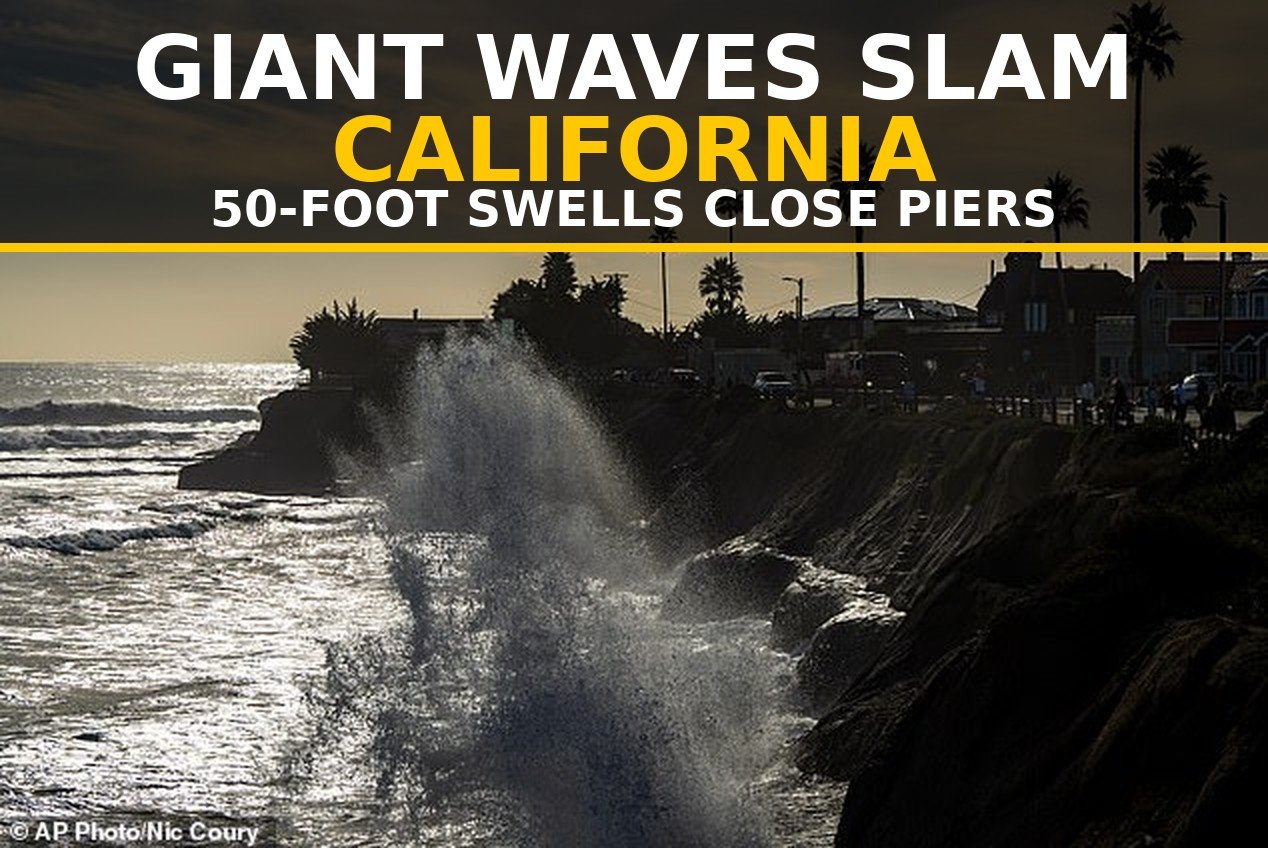
The California coast waves that slammed the shoreline over the weekend were the largest to hit the state in more than a decade, turning familiar beaches into danger zones, flooding streets, forcing piers to close and prompting evacuation warnings for hundreds of homes.
California Coast Waves Reach 50 Feet Near Mavericks
Waves above 50 feet were recorded on Saturday in San Mateo County, near the famous Mavericks surf break south of San Francisco. It was a measurement that put the weekend in rare company, and it explained why so many beaches were closed or placed under urgent warnings within hours.
Off Point Reyes, a buoy recorded a significant wave height of 31.2 feet — the average height of the largest third of waves — making it the second-highest reading in nearly 30 years. The only higher measurement came in December 2015, and it exceeded Saturday’s figure by less than a foot.
The National Weather Service warned that waves reaching 35 feet were possible on Sunday, along with dangerous rip currents and sneaker waves. Sneaker waves can arrive without warning, run much farther up the beach than the waves before them, and sweep people off their feet. Officials urged people to watch only from a safe distance: “Stay out of the water, stay off rocks and jetties, and never turn your back on the ocean.”
Pacifica Seawall Overtopped as Streets Flood
Pacifica, south of San Francisco, was among the hardest-hit communities. Powerful waves repeatedly surged over its seawall and onto Beach Boulevard, sending water, rocks, kelp and other debris across the road. Roughly every half hour, another wave — sometimes appearing twice as large as the one before it — sent onlookers running for higher ground.
Debris piled up around Pacifica’s well-known Taco Bell Cantina, a landmark that sits close to the water, while almost a foot of water covered parts of Highway 1. At Surfers Beach in Half Moon Bay, large waves broke close to shore, and in Capitola, towering swells rolled in on Saturday as crowds gathered to watch conditions many had not seen in years.
Piers Closed From Ventura to San Diego
Several Southern California piers were closed as the California coast waves moved south, including those in Ventura, Manhattan Beach, Huntington Beach and San Diego’s Pacific Beach. The closures showed how widespread the threat had become: this was not a problem for one beach or one county, but for the entire California coastline.
In Santa Cruz County, the Sheriff’s Office issued an evacuation warning for about 300 homes near Capitola, warning that large waves had the potential to reach coastal homes and properties, causing dangerous flooding and damage. Residents were told to be ready to leave at short notice.
At La Jolla Cove near San Diego, water spilled across the beach and surged up the beach staircase. Near Pacifica Pier, a mother carrying a toddler was struck by a sneaker wave and knocked down. Both managed to get back on their feet with immediate help from bystanders, but the incident showed how quickly a moment of inattention could turn serious when the surf is this powerful.
Surfers Still Rode Mavericks Despite the Warnings
Even as authorities warned people to stay away, surfers continued to take on the giant swells at the renowned Mavericks Beach near Half Moon Bay. A surfer was pictured riding one of the monstrous waves in Santa Cruz, a reminder that the same conditions that terrify officials can draw experienced big-wave riders from around the world.
Experts say repeated episodes of California coast waves like these could inflict billions of dollars in damage along California’s coast, especially when the largest waves arrive at high tide. Seawalls, roads, homes and piers that can survive an ordinary winter storm may not survive a series of record-breaking swells.
Why a Super El Niño Is Driving the Dangerous Surf
The unusually early surge in California coast waves comes during a super El Niño, which has warmed the ocean and is changing weather patterns across the Pacific. That warming is helping to steer storms and swell toward California earlier and more powerfully than many residents expected.
Researchers at the Scripps Institution of Oceanography say El Niño-driven changes in tropical weather patterns are shifting storm paths across the North Pacific. During El Niño, storms also tend to track farther south, forming closer to California and increasing the chance that their swell will hit the coast at full strength. That helps explain why this episode arrived so early in the season, before Thanksgiving.
Southern California has already faced serious coastal flooding this autumn, as reported in our coverage of Southern California coastal flooding in Laguna Beach, where a luxury resort moved guests off its first floor as pounding surf threatened the shoreline.
High Surf Advisories and More Storms Ahead
Conditions eased by Sunday afternoon, but forecasters warned that California coast waves could persist through the coming days. Ventura County beaches remained under a high surf advisory through Tuesday afternoon, with waves of 7 to 12 feet in sets. A separate high surf advisory remained in effect for Orange and San Diego counties until 4 a.m. on Wednesday.
Meanwhile, two storm systems are expected to move across Southern California this week, bringing rain and snow to the mountains. For now, the advice from forecasters remains simple: stay out of the water, stay off rocks and jetties, keep a safe distance from the surf, and never turn your back on the ocean.
Sources and Resources
Reporting for this article is based on the Internewscast story: California Coast Slammed by Biggest Waves in More Than a Decade.