
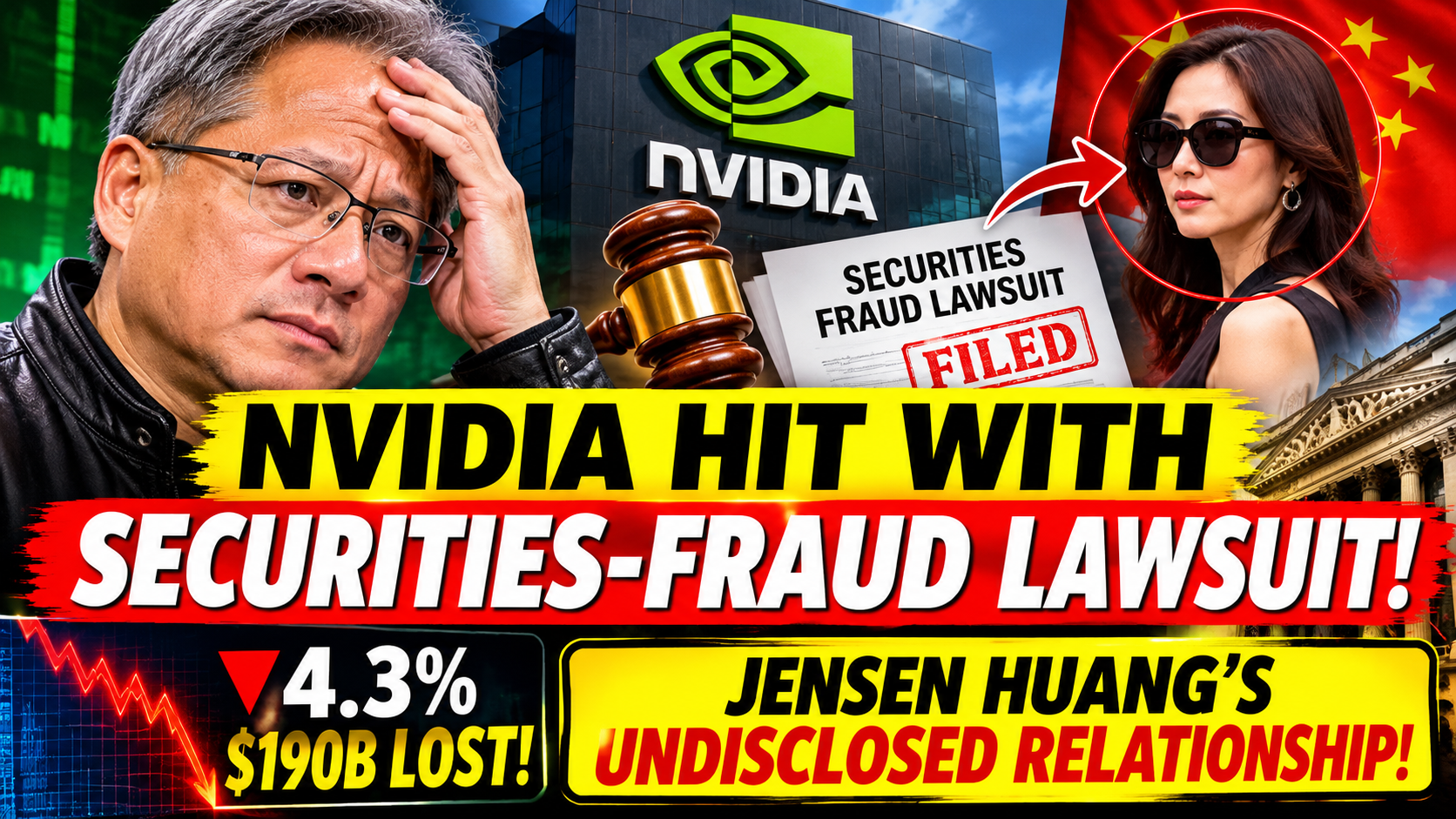
Nvidia Hit with Securities-Fraud Lawsuit Over CEO Jensen Huang’s Undisclosed Relationship
In a stunning escalation that bridges corporate governance, geopolitics, and Wall Street compliance, Nvidia securities-fraud lawsuit Jensen Huang undisclosed relationship headlines have dominated financial markets. A proposed class-action lawsuit has been filed against artificial intelligence giant Nvidia and its Chief Executive Officer, Jensen Huang, in the U.S. District Court for the Northern District of California.
The legal action accuses the company and its leadership of misleading investors by allegedly concealing information regarding Huang’s personal relationship with an individual identified by U.S. authorities as an alleged Chinese intelligence asset. The unfolding controversy has triggered sharp market sell-offs, wiped out billions in shareholder value, and sparked independent corporate and federal investigations.
Also Read:
Gas Prices Drop Below $4 a Gallon for First Time Since July
Background of the Controversy
The legal complaint stems from high-profile media reports revealing that Jensen Huang had an extramarital relationship with Alice Huang, a former executive of Singapore-based data center firm Megaspeed International who is unrelated to the CEO. According to public disclosures and journalistic investigations, U.S. intelligence and security officials concluded that the individual was operating as a foreign intelligence operative linked to Beijing, potentially attempting to gain insight into U.S. export controls and advanced semiconductor restrictions.
Megaspeed International had emerged as a major buyer of Nvidia’s high-performance microprocessors, purchasing billions of dollars worth of advanced hardware. The intersection of a personal relationship with a major corporate client executive and suspected national security complications immediately raised red flags among market regulators and shareholders.
Following the public disclosure of the relationship, Jensen Huang issued an open letter to Nvidia employees admitting to unfaithfulness and expressing deep regret to his family, while pledging full cooperation with ongoing inquiries. However, the initial corporate response and subsequent stock reaction laid the groundwork for immediate shareholder litigation.
Core Allegations in the Securities-Fraud Class Action
Filed on behalf of investors led by retail investor Mark Kistenmacher, the lawsuit targets Nvidia and CEO Jensen Huang under federal securities laws. Specifically, the complaint alleges violations of Section 10(b) of the Securities Exchange Act of 1934 and U.S. Securities and Exchange Commission (SEC) Rule 10b-5, alongside control-person liability claims under Section 20(a) against Huang.
====================================================================
NVDA SECURITIES LITIGATION CORE ALLEGATIONS & MARKET IMPACT
====================================================================
Parameter                  Detail / Metric
--------------------------------------------------------------------
Plaintiffs                 Shareholders led by Mark Kistenmacher
Jurisdiction               U.S. District Court, Northern District of CA
Primary Claims             Securities Exchange Act (Rule 10b-5)
Immediate Market Impact    Shares closed down ~4.3%; ~$190B wiped out
Corporate Response         Independent investigation launched by board
====================================================================
The plaintiffs argue that Nvidia made misleading public statements and omissions regarding its commercial ties, export compliance oversight, and the severe reputational and operational risks posed by the CEO’s undisclosed personal connections. The lawsuit asserts that investors were kept in the dark about critical vulnerabilities at the helm of the world’s most valuable chipmaker, artificially inflating stock confidence before the news broke.
Market Fallout and Immediate Financial Impact
The revelation of the security and personal controversy dealt an immediate blow to Nvidia’s market capitalization. On the trading day following the widespread media reports, Nvidia shares closed down approximately 4.3%. Given Nvidia’s immense valuation—hovering around multi-trillion-dollar thresholds as the cornerstone of the global artificial intelligence infrastructure boom—that single-day percentage drop erased roughly $190 billion in market value.
The sharp pullback underscored the extreme concentration risk inherent in companies heavily defined by a single visionary leader. Analysts noted that institutional and retail investors alike reacted not only to the personal nature of the scandal but also to potential regulatory repercussions regarding advanced chip exports to Asian markets.
Corporate, Independent, and Federal Investigations
In response to the escalating crisis, Nvidia’s board of directors acted swiftly, announcing the appointment of a leading external law firm to conduct an independent investigation into the circumstances surrounding the CEO’s relationships and corporate oversight.
Concurrently, political and regulatory scrutiny intensified. United States President Donald Trump confirmed during a White House briefing that the Federal Bureau of Investigation (FBI) is looking into the matter to assess potential national security implications, while noting that Huang expressed no prior knowledge of the individual’s alleged intelligence background. Bipartisan members of the U.S. Congress have also signaled intent to review export compliance and corporate governance standards at major technology firms.
Frequently Asked Questions (FAQs)
What triggered the securities-fraud lawsuit against Nvidia?
The lawsuit was triggered by revelations that CEO Jensen Huang maintained an undisclosed personal relationship with an individual alleged by U.S. authorities to be a foreign intelligence operative, creating potential regulatory, commercial, and national security risks that were allegedly withheld from investors.
What legal provisions are cited in the Nvidia class action?
The complaint accuses Nvidia and Jensen Huang of violating Section 10(b) of the Securities Exchange Act of 1934 and Rule 10b-5, alongside individual control-person liability claims under Section 20(a).
How did the stock market react to the scandal?
Nvidia shares dropped roughly 4.3% in a single trading session following the news, wiping out approximately $190 billion in market capitalization.
What actions has Nvidia taken in response?
Nvidia’s board of directors initiated an independent investigation led by an outside law firm, and Jensen Huang issued an open letter apologizing to his family and employees while pledging full cooperation with authorities.
Disclaimer: This article is published strictly for informational, news reporting, and analytical purposes based on public court filings, regulatory disclosures, and media reports. All corporate entities and individuals mentioned are presumed innocent or compliant with the law until proven otherwise in a court of law.