
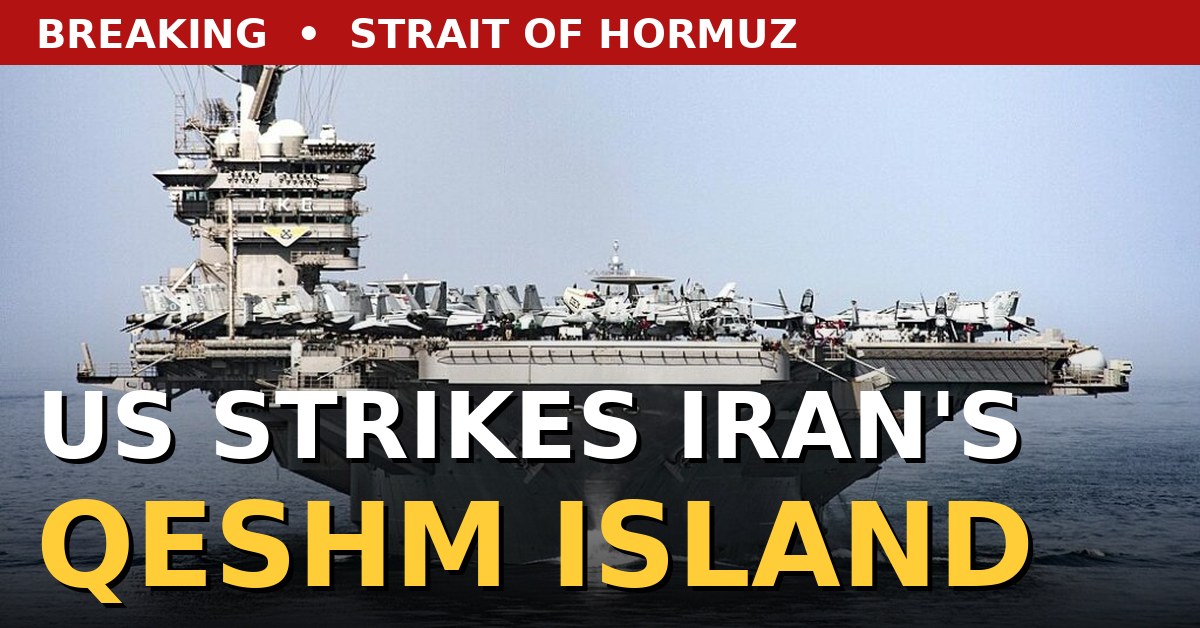
The US strikes Iran again, and Tehran has answered with a threat that is hard to miss. Iran has lifted its self-imposed 2,000-kilometre limit on ballistic missile range and promised new homegrown weapons that would, in its own words, astonish the entire world. The move came within hours of the United States launching a new task force to choke off Tehran’s weapons shipments, and just as President Donald Trump confirmed fresh American strikes on an Iranian air defence site on Qeshm Island on Friday.
It is the first time the US strikes Iran again since the midterm elections. Washington says it wants to cut the flow of weapons and money that keeps Iran’s war machine running. Tehran says it will hit back harder than before. Caught between them are Iraq, the Gulf states, and the shipping lanes of the Middle East, where one misjudged move could turn a shadow war into something far worse.
US strikes Iran again: what happened on Qeshm Island
President Trump confirmed fresh, minor strikes on an Iranian air defence site on Qeshm Island on Friday. Qeshm sits in the Strait of Hormuz, the narrow waterway that carries a huge share of the world’s oil, and an air defence site there is no small target. Hitting it sends a message about American reach, and about what Washington will do when it believes Iran’s defences are being rebuilt.
Tehran lifts its 2,000 km missile-range limit
Islamic Revolutionary Guard Corps spokesperson Brigadier General Hossein Mohebbi confirmed that Iran was abandoning its previous 2,000-kilometre, or roughly 1,240-mile, ballistic missile-range restriction after the US strikes Iran again. “That restriction has been lifted for us,” Mohebbi said, according to the Associated Press. The old limit already put the entire Arabian Peninsula, the Levant, most of Egypt, and parts of Greece and the Balkans within range. Lifting it opens up a wider map.
In March, Iran tried and failed to strike the joint US-British military base on Diego Garcia in the Indian Ocean, roughly 2,500 miles from Iran. Dropping the cap makes those ambitions official. Mohebbi also warned that Iran was developing new weapons for another clash with the United States and Israel. “There are surprises that will be unveiled and deployed on the battlefield if a third wave of confrontation with the enemy erupts. These surprises will astonish the entire world,” he said at a news conference in Tehran on Saturday, according to Iran’s state-run Islamic Republic News Agency. He added that Iran’s next blows would be even harder and would leave its enemies crippled for years to come.
Task Force Iron Gate: closing the land routes
The American answer came on 7 November, when US Central Command set up Task Force Iron Gate. The task force targets the movement of advanced Iranian weapons systems, dual-use materials, and illicit revenue across Iran’s land borders and the Caspian Sea. It is a land blockade aimed at the routes Iran uses to rebuild.
“Strengthening CENTCOM’s collaboration with US Interagency partners will further constrain Iran’s ability to finance terrorism, rebuild weapons factories, and replenish their military,” Admiral Brad Cooper, commander of US Central Command, said in a statement shared on X. The Revolutionary Guard dismissed the new initiative as “wordplay”, claiming Tehran had already made preparations to withstand extra pressure, according to Fars News Agency.
Behnam Taleblu, a senior fellow at the Foundation for Defense of Democracies, told Fox News Digital that the United States may now carry out targeted strikes against facilitators, while putting political pressure on bordering states and sanctions pressure on institutions underwriting Iran’s illicit trade. Taleblu said the pattern is clear: the US strikes Iran again to stop the rebuild before it starts.
He noted that domestic missile production was significantly constrained during the 40-Day War, so Iran will be reliant on imports to build back at scale and at speed. “This is why efforts to constrain both land and sea trade in and out of Iran are a one-two punch for the regime,” he said. Taleblu also said the Caspian Sea has “turned into a two-way sanctions-busting hub for both Iran and Russia”. Iraq, meanwhile, has closed only one border crossing with Iran so far, despite US pressure to shut most of them, and on Sunday the US Treasury pressed Baghdad to close all crossings except two.
Talks stay open, but only just
Qatar-mediated talks stay open, and that is the one thread holding this together. Neither side has walked away from the table, even as both sides prepare for the next round of fighting. If the US strikes Iran again while talks are still open, mediators will have a harder job.
But talks that stay open are not the same as talks that are moving. The gap between what Washington wants — an end to Iran’s weapons flows and a halt to its missile rebuild — and what Tehran wants — relief from pressure and room to rearm — is wide. If the talks fail, the task force, the missile cities, and the threats of astonishing strikes will be the only tools left.
Sources and Resources
Read the full source reporting behind this story: Fox News: Iran vows ‘astonishing’ strikes and lifts missile-range limit as US targets land routes. Further background is available from the Associated Press, Reuters, and the Institute for the Study of War. More from World Reach Daily.
Frequently Asked Questions
Why did the US strikes Iran again now?
The US strikes Iran again because President Trump confirmed fresh minor strikes on an Iranian air defence site on Qeshm Island on Friday, the first since the midterms, as the US launched Task Force Iron Gate to choke off Iran’s weapons shipments.
What is Task Force Iron Gate?
It is a US Central Command task force launched on 7 November that targets advanced Iranian weapons, dual-use materials, and illicit revenue across Iran’s land borders and the Caspian Sea.
What does lifting the missile-range limit change?
Iran’s old 2,000-kilometre limit already covered the Arabian Peninsula, the Levant, most of Egypt, and parts of Greece and the Balkans. Lifting it lets Tehran openly build and test missiles that reach further.
Are the US and Iran still talking?
Yes, Qatar-mediated talks stay open, even as both sides trade threats and strikes. They have not produced a deal yet, and the latest moves make a deal harder, but neither side has walked away.
Could this turn into a wider war?
It could. If the US strikes Iran again, Iran has warned of a third wave of confrontation and promised blows that would leave its enemies crippled for years. For now, the talks and the limited nature of the strikes are holding the line, but the margin for error is thin.
Conclusion
The US strikes Iran again, and Tehran’s reply could not have been clearer: the range limit is gone, new weapons are coming, and the next blows will be harder. Washington’s reply is just as clear: Task Force Iron Gate will hunt the routes Iran uses to rebuild. Between them, Qatar’s mediators are keeping a door open that both sides still need. Whether they can walk through it before the next strike will decide what happens next.