
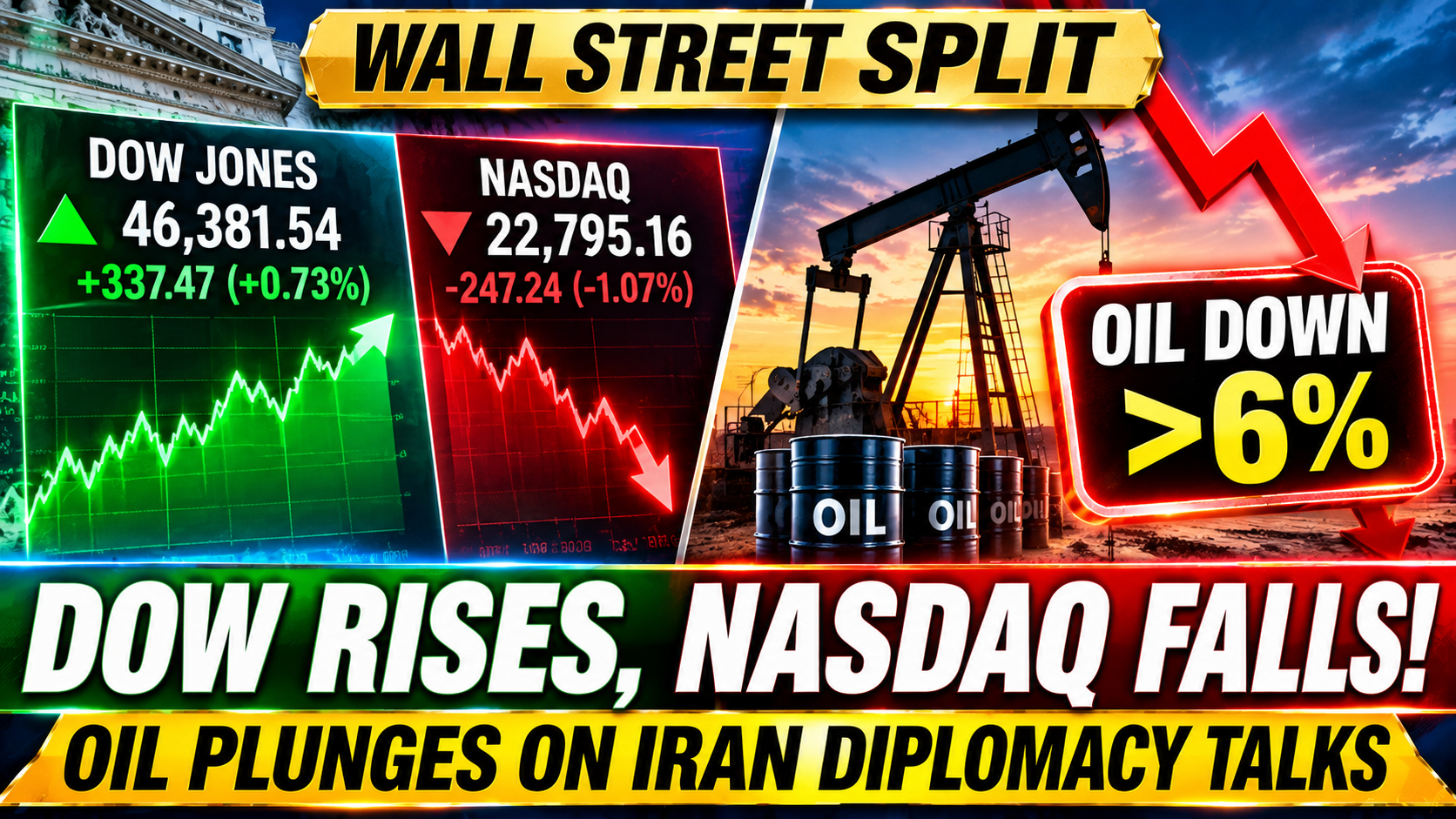
Wall Street Splits as Dow Rises and Nasdaq Falls a Third Day While Oil Plunges on Iran Diplomacy Hopes
Introduction: Divergent Trends Hit U.S. Equity and Energy Markets
Financial markets presented a stark study in contrasts as trading closed across major exchanges. Wall Street splits as Dow rises and Nasdaq falls a third day while oil plunges on Iran diplomacy hopes, reflecting sharp sector rotations and rapid recalibrations in geopolitical risk premiums.
Blue-chip industrials and cyclical equities propelled the Dow Jones Industrial Average higher, buoyed by declining energy overhead costs and strong domestic manufacturing data. Conversely, persistent valuation pressures and mega-cap semiconductor profit-taking dragged the tech-heavy Nasdaq Composite down for its third consecutive session. Concurrently, global crude oil benchmarks suffered steep single-day declines exceeding 6% as international mediation efforts between Washington and Tehran raised expectations for a diplomatic resolution to Middle East shipping disruptions.
Also Read:
Midterm Night of Historic Firsts: Bottoms, Jeffries, Pappas and Flanagan Break Barriers
The Energy Market Collapse: Diplomacy Eases Hormuz Supply Fears
The primary catalyst driving market sentiment was a sharp selloff in international energy commodities. Both Brent crude and West Texas Intermediate (WTI) futures tumbled sharply following confirmation that Qatari envoys submitted a structured de-escalation framework to senior officials in Tehran.
Middle East Risk Premium Unwinds: The prospect of a temporary maritime ceasefire across the Strait of Hormuz prompted commodity trading desks to unwind elevated geopolitical risk premiums built up during recent tanker incidents.
Impact on Energy Stocks: Lower crude prices caused a immediate drag on major energy producers. The S&P 500 Energy sector emerged as the day’s primary laggard, sharply pulling back from its October highs.
Macro Relief for Consumers: While energy shares faced pressure, broader market participants welcomed lower crude prices as a potential buffer against persistent inflation heading into key economic releases and midterm elections.
[Qatari Mediators Present Ceasefire Plan] ---> [Crude Oil Plunges Over 6%] ---> [Energy Shares Drag Down S&P Energy Sector] ---> [Dow Rises / Tech Selloff Weighs on Nasdaq]
Sector Rotation: Industrial Strengths vs. Tech Headwinds
The divergence between the Dow Jones Industrial Average and the Nasdaq Composite illustrates an ongoing rotation away from elevated artificial intelligence valuations and into traditional value sectors.
1. Industrials and Cyclicals Fuel Dow Performance
Traditional industrial, financial, and consumer discretionary shares advanced as falling energy prices provided relief for manufacturing operations and transport logistics. Solid purchasing managers’ index (PMI) data showing expansion in U.S. factory activity further bolstered investor confidence in domestic economic growth.
2. Tech De-risking Extends Nasdaq Losses
In contrast, technology heavyweights continued their downward trajectory. Investors adjusted portfolios ahead of critical quarterly earnings disclosures, trimming positions in high-multiple chipmakers and enterprise software firms. The three-day slump marks the Nasdaq’s most prolonged losing streak since early autumn.
| Financial Index / Commodity | Price Action / Percentage Change | Primary Market Catalyst |
| Dow Jones Industrial Average | Gained +0.8% (Upward Trend) | Lower energy overhead, solid industrial & manufacturing metrics |
| Nasdaq Composite | Declined -0.7% (3rd Straight Loss) | Mega-cap tech valuation pressure, elevated yields, AI de-risking |
| Brent Crude Oil | Plunged >6.0% (Tumbled) | Progress in Qatari-mediated U.S.-Iran de-escalation talks |
| S&P 500 Energy Sector | Slumped >3.5% (Major Laggard) | Unwinding of crude risk premiums; pullback in oil equities |
Macro Outlook: Earnings and Midterm Election Focus
Wall Street traders now turn their attention to a cluster of major macroeconomic events. Beyond Middle East diplomatic updates, institutional desks are preparing for upcoming Federal Reserve rate announcements, critical non-farm payroll reports, and the national midterm elections.
Market analysts emphasize that whether crude oil can maintain lower price channels will depend heavily on formal responses from Washington and Tehran regarding the seven-day ceasefire proposal. In the interim, equity markets remain sensitive to sectoral shifts as investors navigate inflation inputs and mega-cap corporate performance.
Frequently Asked Questions (FAQs)
Q1: Why did the Dow Jones rise while the Nasdaq fell for a third straight day?
A: Wall Street split as investors rotated out of high-valuation technology stocks and into traditional cyclical and industrial shares, which benefited from plunging energy costs.
Q2: What caused crude oil prices to plunge over 6%?
A: Oil prices dropped sharply after Qatari mediators presented a seven-day de-escalation roadmap to end the conflict between the U.S. and Iran, easing supply fears in the Strait of Hormuz.
Q3: Which stock market sector was the biggest laggard during trading?
A: The S&P 500 Energy sector was the biggest laggard, declining significantly as crude oil prices plummeted from recent high levels.
Q4: How did economic data impact the Dow Jones Industrial Average?
A: Solid U.S. manufacturing PMI data indicating expansion in factory activity boosted confidence in domestic economic growth, supporting blue-chip industrial stocks.
Disclaimer
Disclaimer: This financial news report synthesizes real-time market data, institutional disclosures, and commodity index metrics as of early November 2026. Financial asset valuations, oil price benchmarks, and stock index movements remain subject to ongoing macroeconomic volatility.