
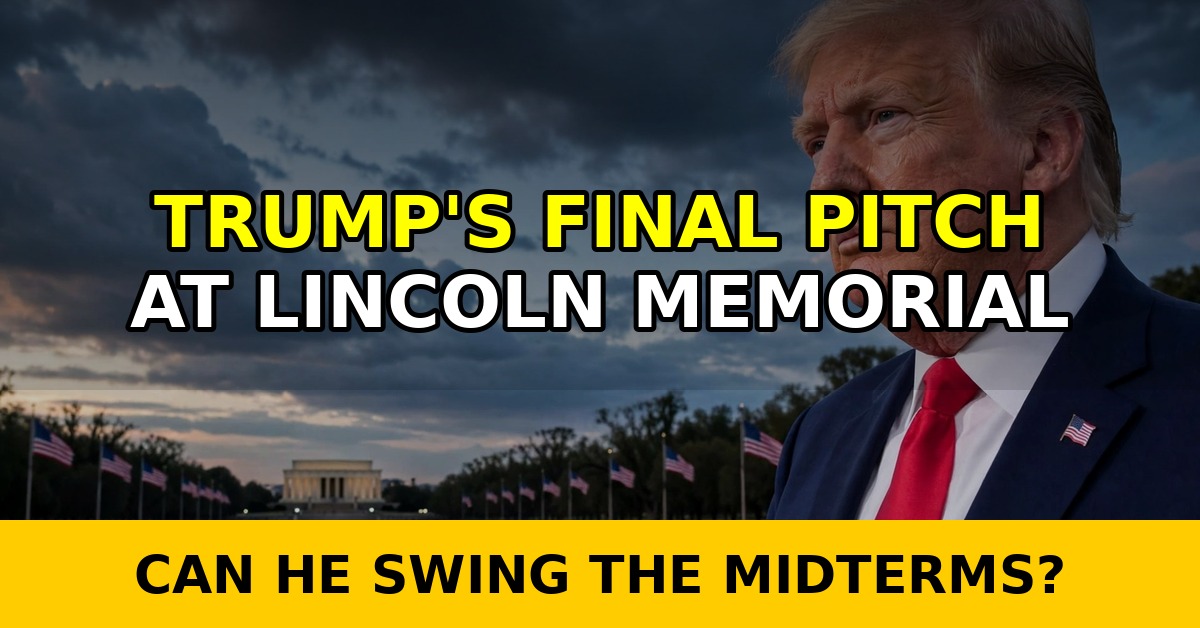
The Trump closing argument is set for one of the most recognisable backdrops in American politics. On the final day before the 2026 midterm elections, President Donald Trump will deliver the Trump closing argument at the Lincoln Memorial Reflecting Pool, while Vice President JD Vance campaigns in New York and Ohio, in a split-screen finish to a campaign that has turned on Senate control, the cost of living, and trust in the vote itself.

Trump’s team has billed the Washington event as a closing statement, not a rally for its own sake. The Reflecting Pool, with the Lincoln Memorial behind him and the Washington Monument in the distance, gives the president a stage that reads as presidential, historic, and deliberately calm, even as the race around him has been anything but. Vance, meanwhile, will do the ground-level work in two states where Republican candidates need every last vote, while the Trump closing argument sets the national message.
Why the Trump closing argument lands at the Reflecting Pool
Presidents have long used the Lincoln Memorial to claim a place in a longer American story. Abraham Lincoln’s words about a government of the people, by the people, for the people still hang over the site, and any speaker there invites comparison, for better or worse. The Trump closing argument at the Reflecting Pool, rather than an arena or an airport hangar, suggests his advisers want voters to hear a message about the country, not just about a party.
It also puts the Trump closing argument in Washington, the city voters will judge on Tuesday. Trump has spent much of his second term arguing that Washington needs a shake-up, and he has framed the midterms as a referendum on whether Congress should help him finish that work or block it. A speech at the Reflecting Pool lets him make that case with the Capitol in the frame, literally and politically.
For supporters, the Trump closing argument will feel like a bookend to a campaign that began with big promises on immigration, energy, and the economy. For critics, it will feel like a president using a national monument as a campaign prop on the eve of an election. Both reactions are part of the point. In a race this close, a closing image can travel further than a closing paragraph.
Vance takes the fight to New York and Ohio
While Trump speaks in Washington, Vance will campaign in New York and Ohio, two very different battlegrounds with a common thread: Republicans believe late momentum matters, and they believe Vance is their best closer with working-class voters and younger men who have drifted toward the party in recent cycles.
In Ohio, Vance is on home turf. He rose to national fame as the author of a memoir about Appalachian family life, then won a Senate seat there before joining Trump’s ticket. His presence in Ohio is meant to shore up turnout in the state’s industrial and rural counties, where Republican margins can decide statewide races, and to reinforce the Trump closing argument on the ground.
New York is a harder, stranger assignment. Republicans are not expected to win the state outright, but House races in the suburbs and upstate mean that even a small shift in turnout can matter. Vance’s job there is to energise volunteers, dominate local news, and give down-ballot candidates a national figure to campaign alongside in the final hours, while the Trump closing argument plays out in Washington.
What the polls say, and what they don’t
Recent polling has given Democrats hope in five Republican-held Senate states, according to a survey round-up published before election day, and you can read our related coverage in Final polls show Democrats leading in five Republican-held Senate states. That finding, if it holds, would put the Senate majority in play and turn Tuesday into a night of long counts and close calls. Polls, though, are snapshots, not results. They miss late deciders, they struggle with turnout models, and in 2026 they have faced the same questions about who actually picks up the phone.
Trump’s advisers have dismissed polls that show Democrats ahead, arguing that their internal numbers point to a stronger Republican finish, and that the Trump closing argument will move undecided voters in the final day. Democrats, in turn, say the public polls confirm what their canvassers have heard for weeks: voters are tired, bills are high, and the party in power usually pays a price in a midterm. Both sides can be right about the mood and wrong about the map, which is why the final day still matters.
As one veteran strategist put it in the run-up to the vote, midterm elections are often decided not by the voters who are loudest online, but by the voters who show up when the weather turns and the ads get nasty. That is the audience the Trump closing argument is chasing on Monday.
What voters will decide on Tuesday
At its core, this election is about control of Congress, and control of Congress is about what happens next. If Republicans hold the Senate, Trump will have a freer hand on judges, Cabinet picks, and the rest of his agenda. If Democrats take it, even by a seat or two, they gain the power to block nominations, demand hearings, and force compromises on spending and oversight.
The economy remains the issue most voters cite first. Prices have eased from their worst peaks, but groceries, rent, and health costs still bite, and many families say they do not feel better off even when the headline numbers improve. Immigration, crime, and the future of federal benefits have also featured heavily, and the final week has seen both parties try to link their opponents to the shutdown fight that left federal workers unpaid and food aid in doubt.
Turnout will be the quiet story of the night. Midterm electorates are smaller and older than presidential ones, and they reward campaigns that can get their voters to a polling place or a ballot box. That is why the closing day is split between a big speech and a pair of state visits: one to set the message, the other to move the machine, and the Trump closing argument ties both together.
Sources and Resources
Read the source report that informed this article: US Midterm Elections 2026: Democrats Lead in Senate Polls as Trump Faces a Test of Congress (Nexus Europa). Further context comes from national polling coverage and campaign reporting on the final days of the 2026 midterm race, including the Trump closing argument coverage above.
Frequently Asked Questions
Where is Trump giving his closing argument?
At the Lincoln Memorial Reflecting Pool in Washington, DC, on the final day before the midterm elections, where he will deliver the Trump closing argument.
Where is JD Vance campaigning?
In New York and Ohio, where he is backing Republican candidates and trying to lift turnout in the closing hours.
Why does the Senate matter so much this time?
Because the Senate confirms judges and senior officials, and a change of control would sharply limit what the president can push through Congress.
Do the polls showing Democrats ahead mean they will win?
Not on their own. Polls are a guide to the mood, but turnout, late deciders, and counting rules can still swing close states.
When will we know the results?
Some races will be called on election night, but close Senate contests may take days if mail ballots and tight margins slow the count.
Conclusion
The Trump closing argument at the Reflecting Pool, paired with Vance’s stops in New York and Ohio, is a final bet that message plus turnout can still move a tight election. By Tuesday night, voters will have the last word, and the image from the Reflecting Pool will either look like a fitting close or a misread of the moment. Either way, the campaign is over, and the counting begins.