
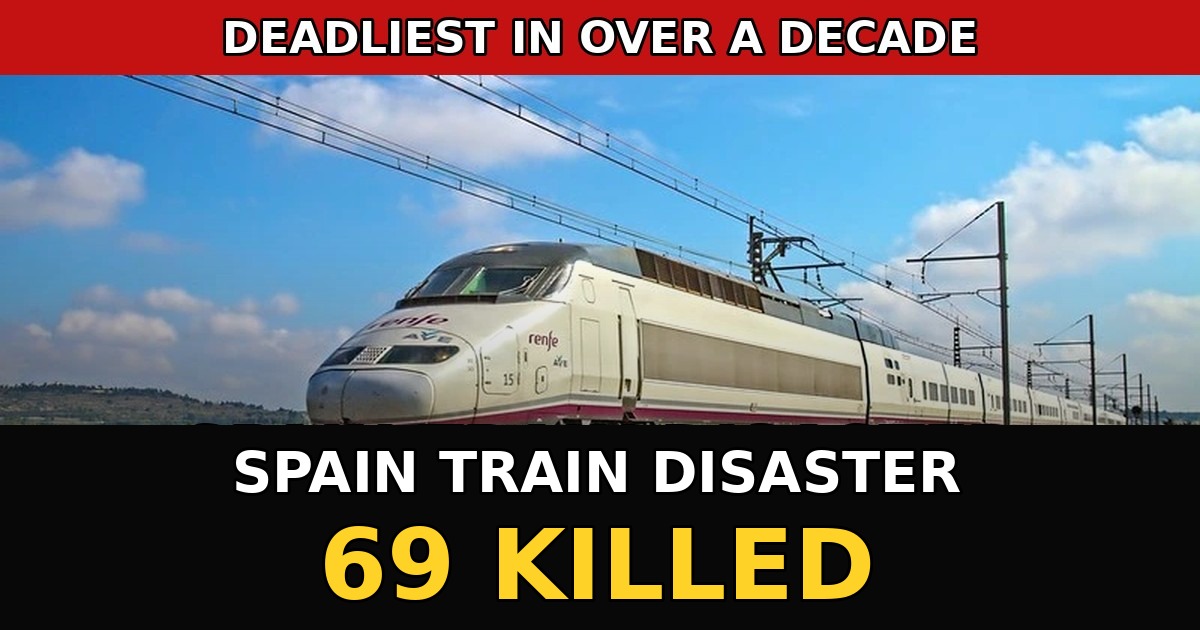
The Spain train crash has claimed another life. Officials in Castilla-La Mancha confirmed on October 29 that the death toll from the catastrophic collision between two high-speed trains near Urda, in Spain’s Toledo province, has risen to 69 — making it the deadliest rail disaster in the country’s modern history.
The revision, announced by regional president Emiliano García-Page, marks the second time the official count from the Spain train crash has been raised since the evening of October 28. Authorities had initially confirmed 68 dead; the updated figure came as dozens of injured passengers remained in hospitals across the region, and officials warned the toll could climb further.
Our initial report on the Toledo collision covered the first chaotic hours of the rescue operation. Now, as Spain observes three days of national mourning, attention has turned to the investigation: Transport Minister Óscar Puente says a computer malfunction knocked out the trains’ LZB safety system and that the Renfe service was wrongly authorised to move — a sequence of failures he described as “inexplicable.”
Spain Train Crash Toll Rises as Victim Count Updated
García-Page delivered the grim update on Thursday, October 29, confirming that the official toll had been revised upward from 68 to 69 after another victim died from injuries sustained in the crash.
The announcement from García-Page, who has been coordinating the regional response since the first emergency calls came in on the night of October 28, underscores how the casualty figures have evolved as rescue teams reached every carriage and hospitals reported back on the critically injured.
Regional health authorities painted a sobering picture of the aftermath. Fifty people remained hospitalized, while 60 of the injured had been discharged. Of the 15 patients classified as “code red,” four were showing signs of improvement — a rare glimmer of hope in an otherwise devastating toll.
But officials were blunt about the road ahead. With several of the hospitalized in critical condition, authorities cautioned that the death toll may rise further in the coming days. Victim identification efforts continued through Thursday, with emergency services and forensic teams working around the clock to account for every passenger.
LZB Safety System Failure Under Investigation in Spain Train Crash
The investigation into what caused the disaster took a dramatic turn when Transport Minister Óscar Puente revealed that a computer malfunction had knocked out the LZB train protection system — the automated safeguard designed to prevent exactly this kind of catastrophe.
According to Puente, the Renfe AVE train was wrongly authorised to move onto a section of track where it should never have been, because the disabled safety system could not intervene. The minister called the failure “inexplicable” and pledged a full technical and judicial investigation.
The two trains at the center of the tragedy — a Renfe AVE service and Iryo train 6076, both operating on the busy Madrid-to-Seville high-speed corridor — collided near Urda on the evening of October 28. There were 397 people aboard the Renfe train and 147 on the Iryo service, making the emergency response one of the largest in Spain’s recent history.
Emergency crews worked through the night to free trapped passengers from the mangled carriages, in an operation that drew firefighters, medical teams, and military emergency units from across Castilla-La Mancha and beyond.
Three Days of National Mourning Declared
Prime Minister Pedro Sánchez declared three days of national mourning, running from October 29 through October 31, as the country reeled from the scale of the loss.
Flags flew at half-mast on public buildings across Spain, official engagements were cancelled or postponed, and moments of silence were observed in cities and towns nationwide. The mourning period reflects the profound shock the crash has sent through Spanish society.
Messages of condolence poured in from leaders around the world, as Spain confronted the human cost of a disaster that struck ordinary travelers on an ordinary evening journey between two of the country’s great cities.
The Spain train crash has united the country in grief, with vigils planned in Toledo and Madrid as the nation honors the victims and supports the injured.
Second Deadly Rail Disaster This Year
The Toledo collision is Spain’s second deadly rail crash of 2026, following the January accident near Adamuz that killed 46 people. Two major rail disasters in less than a year have intensified scrutiny of the country’s rail safety systems and the oversight of its high-speed network — one of the most extensive in Europe.
With 69 confirmed dead, the Spain train crash now ranks among the worst rail disasters in Europe in recent decades.
Rail safety experts say the alleged LZB failure will be at the center of the investigation. The system is designed to automatically intervene when a train is moving unsafely; understanding how a computer malfunction could disable it entirely — and why the Renfe train was cleared to proceed regardless — will be critical to preventing a repeat.
What Happens Next
A full technical investigation is now underway, alongside a judicial probe into potential responsibility. Investigators will examine the failed computer systems, the authorisation chain that cleared the Renfe train to move, and whether warning signs were missed in the hours before the collision.
The judicial probe into the Spain train crash will run alongside the technical investigation, with both expected to take months to complete.
For the families of the 69 victims, the coming days will bring funerals and an agonising wait for answers. For the 50 still in hospital, the fight for recovery continues. And for Spain’s rail network, the disaster poses urgent questions that cannot wait: how a modern high-speed system failed so completely — and what must change to ensure it never happens again.