
Apple has finally done it. The Apple touchscreen MacBook Pro is real — the first Mac ever to respond to touch — arriving with a brand-new PROLED XDR display and a glowing rear Apple logo. MacRumors reported the announcement on October 28, 2026, and the details close out one of the longest-running arguments in computing: whether a Mac should ever let you reach out and tap the screen.
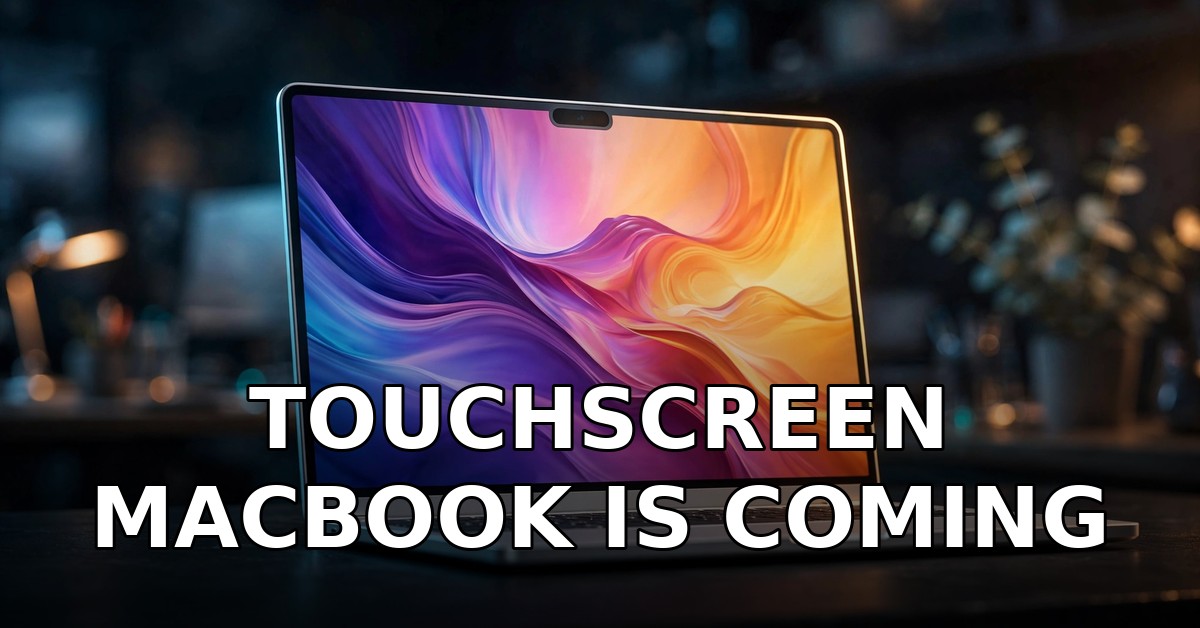
For years, the company’s answer was a flat no. Executives insisted that touch belonged on the iPad, that reaching up to poke a laptop display was ergonomically wrong, that the Mac was fine exactly as it was. Then the rumors started, then the reports hardened, and now the product is here. Two sizes. A tandem OLED panel. Pricing that starts at $2,899. Whatever comes next for the Mac, this is the moment the line changed direction.
A Historic First for the Mac Line
Let’s be clear about what Apple just did: it shipped a touchscreen Mac. Not a concept, not a patent filing, not a carefully worded maybe — a real product, on sale, with pre-orders already open. The new high-end MacBook Pro comes in 14-inch and 16-inch sizes, and both support touch gestures directly on the display.
That alone makes this one of the most consequential Mac announcements in a decade. The Mac has spent forty years as a keyboard-and-trackpad machine while the rest of the industry went touch-first. Apple watched, waited, and built the iPad into a touch-native powerhouse in the meantime. Now it has decided the two ideas can coexist on the same device — at least at the top of the lineup, where professionals and early adopters are most willing to pay for something new.
The glowing rear Apple logo is the detail that tells you how Apple feels about this machine. The illuminated logo disappeared from MacBooks years ago; bringing it back, glowing, on the first touchscreen Mac reads like a statement. This isn’t a quiet spec bump. It’s a flagship meant to be seen.
PROLED XDR: A Tandem OLED Display
The screen is the other half of the story on the Apple touchscreen MacBook Pro. Apple calls it PROLED XDR, and it’s a tandem OLED panel — two OLED layers stacked to push brightness far beyond what a single layer can manage. Peak brightness reaches up to 2,000 nits, and the contrast ratio is rated at 10,000,000:1.
Those numbers matter in practice. Deep blacks stay black because individual pixels switch fully off, while highlights can punch through in HDR content without washing out the rest of the frame. Photographers, video editors, and anyone grading footage on a laptop will feel the difference immediately.
The panel also supports ProMotion, Apple’s adaptive refresh technology, sweeping from 10Hz all the way to 120Hz. Scrolling stays glassy smooth, motion looks clean, and the display can drop to low refresh rates when nothing is moving to save battery. It’s the same philosophy Apple has applied across its best displays, now paired with touch for the first time on a Mac.
Touch Built Into the Panel — With a Hinge to Match
For the Apple touchscreen MacBook Pro, Apple says touch is built directly into the display panel itself, which means no added latency between your finger and the response on screen. That’s a meaningful engineering claim: bolt-on touch layers can introduce lag and parallax, the slight disconnect between where you tap and what the screen shows. Integrating the touch layer into the panel is how you make taps feel instant and precise.
The company also redesigned the hinge. Anyone who has ever poked at a laptop screen knows the problem — the display wobbles, bounces, and slowly drifts backward with every tap. Apple’s new hinge is designed to keep the display steady under touch, so tapping, swiping, and gesturing doesn’t turn the screen into a bobblehead. It’s the kind of unglamorous mechanical detail that decides whether a touchscreen laptop feels premium or annoying, and Apple clearly knew it had to get it right.
What touch gestures will do across macOS remains the big open question, but the hardware foundation is now in place: a fast, bright, touch-sensitive panel that doesn’t add lag and doesn’t wobble.
Apple Touchscreen MacBook Pro Pricing and Availability
Pricing for the Apple touchscreen MacBook Pro starts at $2,899 for the 14-inch model and $3,399 for the 16-inch. That’s firmly high-end territory — these are positioned as the top of the MacBook Pro range, not mainstream machines — but it’s in line with what Apple charges for its most capable laptops.
Pre-orders opened on October 28, the same day as the announcement, and the official launch follows on November 6. If you want one on day one, the window is already open.
The announcement caps a month of intense speculation. We covered the pre-event reports of a touchscreen MacBook Pro and an OLED iPad Mini ahead of Apple’s October 27 event — and while the iPad Mini’s fate is a story for another day, the touchscreen MacBook Pro turned out to be very real indeed.
Why This Moment Matters
Every so often Apple reverses a position it once defended fiercely, and each reversal redraws the map. The company said the stylus was dead, then shipped the Apple Pencil. It said big phones were wrong, then made its fortune on them. The Apple touchscreen MacBook Pro belongs in that lineage: a long-held no that became a yes the moment Apple figured out how to do it on its own terms.
The terms matter here. Touch with no added latency. A hinge that holds steady. A tandem OLED panel with 2,000-nit peak brightness and a 10,000,000:1 contrast ratio. ProMotion from 10Hz to 120Hz. This isn’t Apple grudgingly adding a feature — it’s Apple arriving late and trying to arrive best.
The Bottom Line
Apple has unveiled the Apple touchscreen MacBook Pro — its first touchscreen Mac: a new high-end MacBook Pro in 14-inch and 16-inch sizes, with a touch-enabled PROLED XDR tandem OLED display, a glowing rear Apple logo, and pricing from $2,899 ($3,399 for the 16-inch). The panel delivers up to 2,000 nits of peak brightness, a 10,000,000:1 contrast ratio, and ProMotion adaptive refresh from 10Hz to 120Hz, with touch built directly into the display for zero added latency and a redesigned hinge to keep everything steady. Pre-orders opened October 28 ahead of the November 6 launch. The specs are announced, not reviewed — but one thing is already certain: the Mac will never be quite the same.