
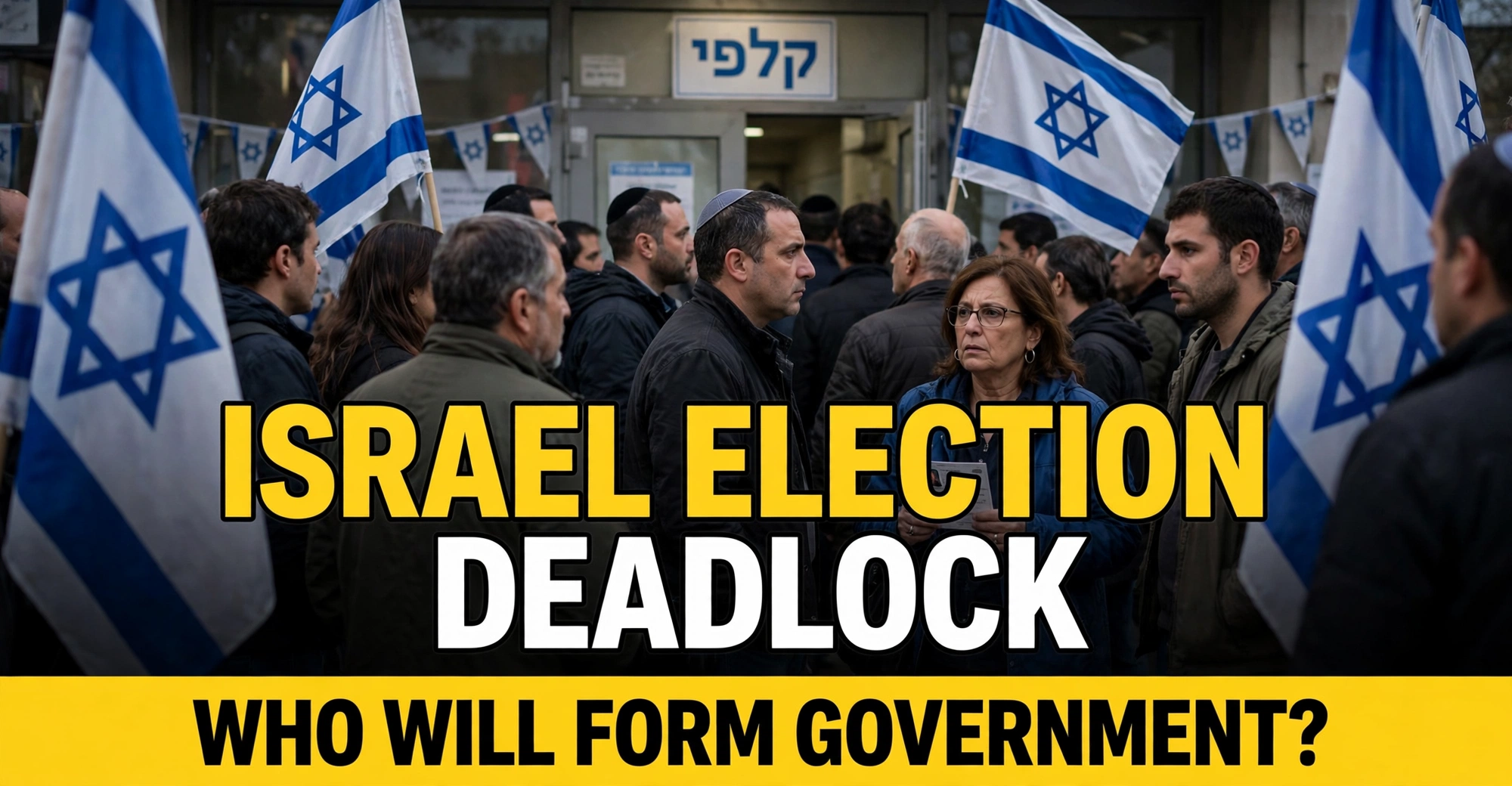
Israel election deadlock: Israel has voted, and nobody has won. Exit polls from Tuesday’s election, the country’s first since Hamas’ October 7, 2023 attacks, showed neither of the two main blocs with a clear path to forming a government, setting up days, weeks or even months of coalition wrangling.

Turnout told its own story. At least 80 percent of eligible voters cast ballots, a record high, in a vote that doubled as a verdict on longtime Prime Minister Benjamin Netanyahu. Yet when the polls closed, the numbers pointed to stalemate rather than change.
According to exit polls published by Israeli broadcasters, the bloc led by former Israel Defense Forces chief Gadi Eisenkot is projected to win 52 seats in the 120-seat Knesset. Netanyahu’s ruling coalition is projected at 50. Both fall short of the 61 seats needed to govern, which means the next government will be decided in backroom deals, not at the ballot box.
A vote about Netanyahu, not the war
The election was not fought over Gaza, the West Bank or any of the other fronts Israel says it is fighting on. It was a test of whether Israelis are ready to part ways with Netanyahu, who has served as prime minister for 19 of the past 30 years.
A large part of the electorate is demanding answers over the October 7 security failures, when 1,200 people were killed and 251 were taken hostage into Gaza. Netanyahu, long branded “Mr. Security,” has refused to authorize a state-backed investigation into what went wrong, why it happened and who is to blame.
“We’ve been given the answers to what happened,” said Ruby Chen, whose 19-year-old son Itay was killed defending civilians near Gaza. He was the youngest American hostage held in Gaza. “But the how, how did this happen? No answers.”
That frustration ran through the campaign, but it did not translate into a decisive win for the opposition. Israel’s politics have long been fragmented, with more than a dozen parties seeking Knesset seats, from Netanyahu’s right-wing Likud to ultra-nationalist Otzma Yehudit, from ultra-Orthodox parties to Ra’am, an Arab Israeli party focused on living standards for Arab citizens.
The kingmakers in the middle
If the exit polls hold, the balance of power sits with the Arab-Israeli parties, projected to win around 17 or 18 seats. That could make them kingmakers for either bloc, even though major figures from both camps have effectively ruled out teaming up with them.
The arithmetic is brutal for both leaders. Eisenkot needs nine more seats. Netanyahu needs eleven. Every smaller party now holds leverage, and every demand, from military service exemptions for ultra-Orthodox Israelis to the future of Netanyahu’s judicial reforms, becomes a bargaining chip.
Younger voters add another wrinkle. They are thought to be more hawkish and right-wing because of their formative experience of October 7, said Jonathan Rynhold, a political scientist at Israel’s Bar-Ilan University. At the same time, many have done long stretches of reserve military duty, and there is deep anger at the government for trying to pass a law giving the ultra-Orthodox a blanket exemption from serving in the army.
The Trump factor
Washington is watching closely. Every U.S. president since Israel’s founding in 1948 has been pro-Israel, but President Donald Trump has arguably been the friendliest of all, backing and joining Israel’s campaign to bomb Iran and destroy Tehran’s nuclear program. Trump and Netanyahu also appear to like working together, and they have personal chemistry.
If Netanyahu is ousted, it is far from clear how Trump would take to Eisenkot or another opposition leader, such as former prime minister Naftali Bennett or former defense minister Avigdor Liberman. “The most crucial question, by far, is who will be Israel’s prime minister during Trump’s last two years in office?” said Ophir Falk, a foreign policy adviser to Netanyahu. “Who will best cooperate and coordinate with the president to finish the job in Iran and expand peace in the region?”
What was not on the ballot
Strikingly, the war in Gaza, the plight of Palestinians in the occupied West Bank, Palestinian statehood and Israel’s international reputation hardly featured in the campaigns at all. The vote was seen through a domestic prism.
“There is notable continuity across Israel’s political mainstream regarding Iran, Lebanon, and the Palestinians,” wrote Giorgio Cafiero, CEO of Gulf State Analytics, in an analysis in early October. “This month’s election, therefore, is unlikely to fundamentally change how Tel Aviv approaches the region.”
That continuity means that whoever eventually forms a government, Israel’s regional posture is unlikely to shift sharply. The fight is over who leads, not where the country is headed on security.
Israel election deadlock: what happens next
Preliminary results are due as early as Wednesday. If neither bloc can assemble 61 seats through deal-making, Netanyahu will remain as caretaker prime minister while efforts to form a government continue. President Isaac Herzog will task the party leader he believes is most likely to succeed with forming a government.
If no candidate can put together a coalition capable of winning parliament’s confidence, new elections will be held and the whole process starts again. Israelis know this script well: the country has been through repeated rounds of inconclusive elections before.
For now, the record turnout and the deadlocked result tell a contradictory story. Israelis turned out in historic numbers to have their say, and what they said, collectively, was that they could not agree.
Sources and Resources
- USA TODAY: Israel’s election ends in apparent deadlock, exit polls show — https://www.usatoday.com/story/news/world/2026/10/27/israel-election-takeaways-benjamin-netanyahu-gadi-eisenkot/92361598007/
Frequently Asked Questions
Who won the Israel election?
No one, according to exit polls. Eisenkot’s bloc is projected at 52 seats and Netanyahu’s coalition at 50, and neither reaches the 61 seats needed to form a government.
What was voter turnout in the Israel election?
Turnout hit a record high of at least 80 percent, in Israel’s first election since the October 7, 2023 Hamas attacks.
How many seats does a party need to govern in Israel?
A bloc needs 61 of the 120 Knesset seats to form a government, which is why coalition deals with smaller parties are now decisive.
Which parties could decide the next Israeli government?
The Arab-Israeli parties, projected at 17 or 18 seats, could act as kingmakers for either bloc, though leaders on both sides have ruled out partnering with them.
What happens if no coalition can be formed?
Netanyahu stays on as caretaker prime minister, President Isaac Herzog tasks a leader with trying to form a government, and if that fails, new elections are held.
Conclusion
The Israel election deadlock leaves the country’s politics exactly where they started: divided, exhausted and waiting on negotiations. Record turnout did not produce a winner, and the weeks ahead will be decided by party leaders in closed rooms, not voters at polling stations. The one certainty is that Israel’s next chapter, whenever it begins, will be written by compromise, not by mandate.
For more World news, see World Reach Daily.
Israel election deadlock is the outcome of a record-turnout vote with no winner. The Israel election deadlock arithmetic leaves Eisenkot nine seats short and Netanyahu eleven short, and the Israel election deadlock negotiations will decide who governs. The Israel election deadlock will test whether either bloc can build a coalition of 61 seats.