
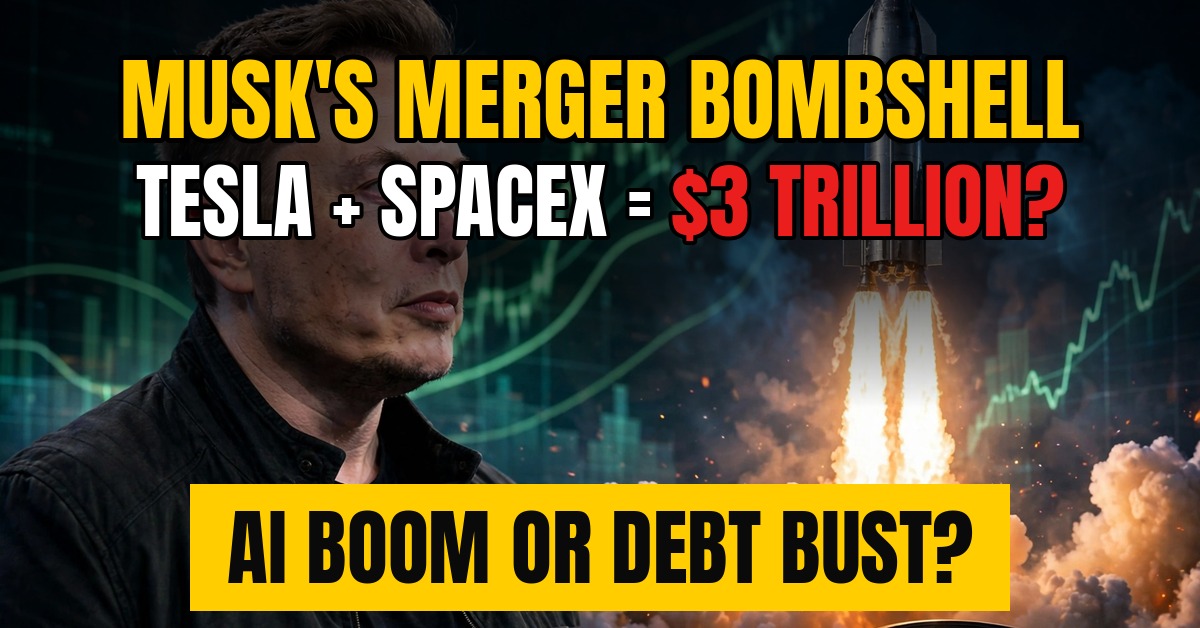
Elon Musk didn't dodge the question this time. Asked about a possible combination of his two companies on SpaceX's third-quarter earnings call Tuesday, he confirmed the SpaceX Tesla merger talks are real — both boards have formed special committees of independent directors — and called a merger “a good idea.” SpaceX shares jumped more than 8% after hours; Tesla added roughly 2%.
Then came the numbers: $14.6 billion in quarterly revenue, up 161% from a year ago, and SpaceX's first profit as a public company. Musk told investors the company could reach $500 billion to $1 trillion in annual recurring revenue by the end of 2027. The same day, Super Micro raised its revenue guidance by a staggering $4 billion, while Nvidia's Jensen Huang pitched factory-built AI data centers in Berlin. Euphoria over AI spending, colliding with fear about the debt paying for it — this market's defining split, in one 48-hour window.
The SpaceX Tesla Merger Talks Get Real
For years, a Tesla-SpaceX combination was the rumor Wall Street couldn't quit. Tuesday was the first time Musk confirmed the SpaceX Tesla merger talks have moved beyond rumor. Both boards have set up committees of independent directors, and Musk is locked out of the room: “Because I'm a conflicted party, I can't actually be in the discussions. So, it's an odd kabuki dance where two groups of people are talking and I can't be in the conversation.”
He was careful not to overpromise. The committees haven't agreed on terms, and they might never — the SpaceX Tesla merger talks started with shareholders, not with him. On the Tesla side, a deal would need a majority of all outstanding shares, not just a majority of votes cast: “quite a high hurdle.” He also threw cold water on an imminent announcement, even though Barclays floated last week that one could come before Tesla's annual meeting in December.
The logic, in Musk's telling, is overlap: SpaceX is now as much an AI compute company as a rocket company, and Tesla is building robots and chips. “I do think there's a lot of merit to combining the companies… there’s a lot to be gained from cooperating on developing superintelligence software, chip design, the Terafab obviously, robotics, mass-to-orbit with the Starlink constellation, connectivity.” Reading the SpaceX Tesla merger talks, analyst Daniel Newman of The Futurum Group called the tie-up “inevitable pretty much since the announcement of the SpaceX IPO.” Nobody is calling it done.
A $14.6 Billion Quarter Nobody Saw Coming
The SpaceX Tesla merger talks made the headlines, but the quarter itself was historic: $14.6 billion in revenue, $4.4 billion in net income, and roughly $8.8 billion in adjusted EBITDA, more than four times last year. The twist: the AI business is now bigger than the rocket business. The Super Intelligence segment — compute capacity, cloud services, Grok, and newly acquired Cursor — pulled in $7.56 billion, more than half of total revenue and up over 800% from a year ago. Starlink-led Connectivity generated $5.25 billion; the legacy Space segment trailed at $1.8 billion.
Starlink hit 13.6 million consumer subscribers, up 1.6 million in the quarter, with average monthly revenue per user up 5% to $69. President Gwynne Shotwell's number for the long game: Starlink is now contracted for roughly 12,000 aircraft, nearly a quarter of the world's planes. Backlog stands at $63 billion, about $42 billion of it expected within 12 months. What may have mattered most was the guidance: first-quarter revenue of $33 billion to $37 billion, fourth-quarter capital spending of $35 billion to $40 billion, and Musk's call for $500 billion to $1 trillion in annual recurring revenue by end of 2027.
Super Micro's $4 Billion Surprise
If SpaceX set the tone, Super Micro Computer turned it into a sector-wide rally. The AI server maker raised its fiscal first-quarter revenue guidance to $18.5 billion to $19.5 billion, up from $14.5 billion to $15.5 billion — a $4 billion jump at the midpoint, well above the roughly $15 billion analysts expected. Shares closed up more than 17% at $37.55.
What excited investors most was the margin line: gross margins lifted to 12% to 12.5% from 10.4% to 10.8%, on stronger AI platform demand and a better customer mix. For a company dogged by questions about whether it can turn explosive server orders into actual profit, that was the number that mattered. The read-through was immediate — Dell rose about 6% and Hewlett Packard Enterprise roughly 5% in extended trading, with CoreWeave and Nebius up more than 4%.
The Other Side of the Trade: CoreWeave's Debt Headache
Because the tension won't go away: while AI capex headlines mint market-cap records, the credit market is flashing yellow on the companies financing the build-out with borrowed money. CoreWeave is the case study — shares down nearly 70% from their peak to below $60, a roughly $34 billion equity value against $51 billion in debt, bonds near 80 cents on the dollar, and default swaps implying a greater-than-55% chance of default within five years.
Wall Street is split. Goldman Sachs upgraded CoreWeave to Buy while cutting its target to $106 from $139, arguing investors may be overestimating future borrowing costs. JPMorgan stayed Overweight, citing the take-or-pay contract model. The bears have Gartner's math: data centers need $8.5 trillion in cumulative revenue by 2030 for a 12% return, but AI revenue is forecast at barely $3.6 trillion. DA Davidson's Gil Luria: “If the AI cycle sputters… CoreWeave is gonna be the first to go.” CEO Mike Intrator called the selloff “irrational,” insisting the backlog more than covers the debt.
Nvidia Keeps the Capex Engine Running in Berlin
Then there was Nvidia, doing what Nvidia does: selling the shovels, then selling bigger shovels. At GTC Berlin on Wednesday, Jensen Huang unveiled DSX Pod — a factory-built reference design for complete Vera Rubin AI data centers that partners assemble, cable, and test inside modular containers, cutting deployment at a prepared site from six months to as little as 14 days. “An AI factory creates value when it starts producing tokens — not when construction is complete,” Huang said. Seventeen partners are on board, including Dell, HPE, Vertiv, Eaton, Lenovo, and Schneider Electric, with worldwide deliveries in early 2027.
While the SpaceX Tesla merger talks dominate headlines, Nvidia and the server makers are quietly building the physical base of the same bet — Huang flagged nearly $10 billion in European commitments across more than 12,000 partners. The full picture: trillion-dollar targets, record quarters, AI factories in boxes — and underneath it all, a credit market asking who pays if the music stops.
Sources and Resources
- Reuters — What Wall Street is saying about the proposed SpaceX-Tesla merger
- Motley Fool — SpaceX Q3 2026 earnings call transcript (backlog, ARR targets, compute plans)
- Wall Street Journal — Super Micro shares surge after preliminary revenue tops guidance
- Barron's — Nvidia's DSX Pod data-center quick-fix and the stocks set to benefit
- Barron's — CoreWeave's struggles and the simple problem in a complicated AI market
FAQs
So is the SpaceX-Tesla merger actually happening, or is this just Musk talking?
The SpaceX Tesla merger talks are a real process, but far from a done deal. Both companies have formed special committees of independent directors — that part is confirmed. What doesn't exist yet: terms, a price, a timeline. Musk said assuming a deal is certain would be “overstating it,” and on Tesla's side a majority of all outstanding shares must approve.
How did AI become SpaceX's biggest business so fast?
Through its Super Intelligence segment — rented AI compute, cloud services, the Grok models, and newly acquired Cursor ($608 million last quarter). It did $7.56 billion in revenue, beating Starlink's $5.25 billion and the rocket business's $1.8 billion. SpaceX is deploying Nvidia GB300 GPUs at 20,000 a month, and Musk says it's being “hounded relentlessly” for compute.
Come on — $500 billion to $1 trillion in revenue? Is that remotely plausible?
Only if everything goes right. SpaceX did $14.6 billion this quarter and guided next year's Q1 to $33-37 billion; a $500 billion run rate means roughly $42 billion a month — about ten times the planned Q1 pace. It depends on 10-plus gigawatts of new compute in 2027 at near-full utilization. Musk allowed that “as crazy as it sounds,” the top end isn't impossible — about as far as anyone should take it.
Why did Super Micro's earnings surprise move Dell and HPE too?
They're all selling into the same AI infrastructure boom. When Super Micro raised quarterly revenue guidance by $4 billion and lifted margins at the same time, investors read it as proof that AI server demand is accelerating across the board — not just for one company. Dell and HPE compete for the same hyperscaler orders, so their shares jumped 5-6% on the same signal.
What's the strongest argument the AI boom is over-leveraged?
CoreWeave: a $34 billion company carrying around $50 billion in debt, bonds near 80 cents on the dollar, credit markets pricing in real default risk. Zoom out — Alphabet, Amazon, Meta, and Oracle have issued more than $228 billion in bonds this year to fund AI build-outs. Gartner says data-center owners need $8.5 trillion in cumulative revenue by 2030 for decent returns, but forecasts barely $3.6 trillion in AI revenue. The bond market isn't convinced yet.
Conclusion
The SpaceX Tesla merger talks moved this week from rumor to formal process — committees, shareholder votes, and a very high bar still ahead. SpaceX delivered the quarter to justify the hype on paper: $14.6 billion in revenue, first profit, $63 billion in backlog, a CEO talking about trillion-dollar run rates like a forecast instead of a dare. But the CoreWeave selloff is the shadow over it all — somebody has to pay for the gigawatts, and the credit market is starting to charge more for the privilege. Whether returns outrun borrowing costs: that's the question that decides if this is a boom with a long runway, or a bubble with a very expensive landing.
For more market-moving tech stories, see our Finance desk — the spacex tesla merger talks are just one chapter in the AI capex saga, and the spacex tesla merger talks will keep shaping the market debate through the next earnings cycle.
The spacex tesla merger talks are the market’s favorite new debate topic. With SpaceX printing $14.6 billion quarters and Tesla’s own AI ambitions accelerating, the spacex tesla merger talks give investors a concrete event to model instead of pure speculation.
Coverage of the spacex tesla merger talks will only intensify as the independent committees work. Bookmark our Finance section for the latest on the spacex tesla merger talks and the AI capex cycle driving them.
Beyond the headlines, the spacex tesla merger talks raise real governance questions: overlapping boards, Musk’s dual role, and a shareholder vote. However the spacex tesla merger talks resolve, they set precedent for how mega-cap founders merge AI empires.
Stay with World Reach Daily Finance — the spacex tesla merger talks story is developing fast, and the spacex tesla merger talks will be front-page news again when the committees report back.