
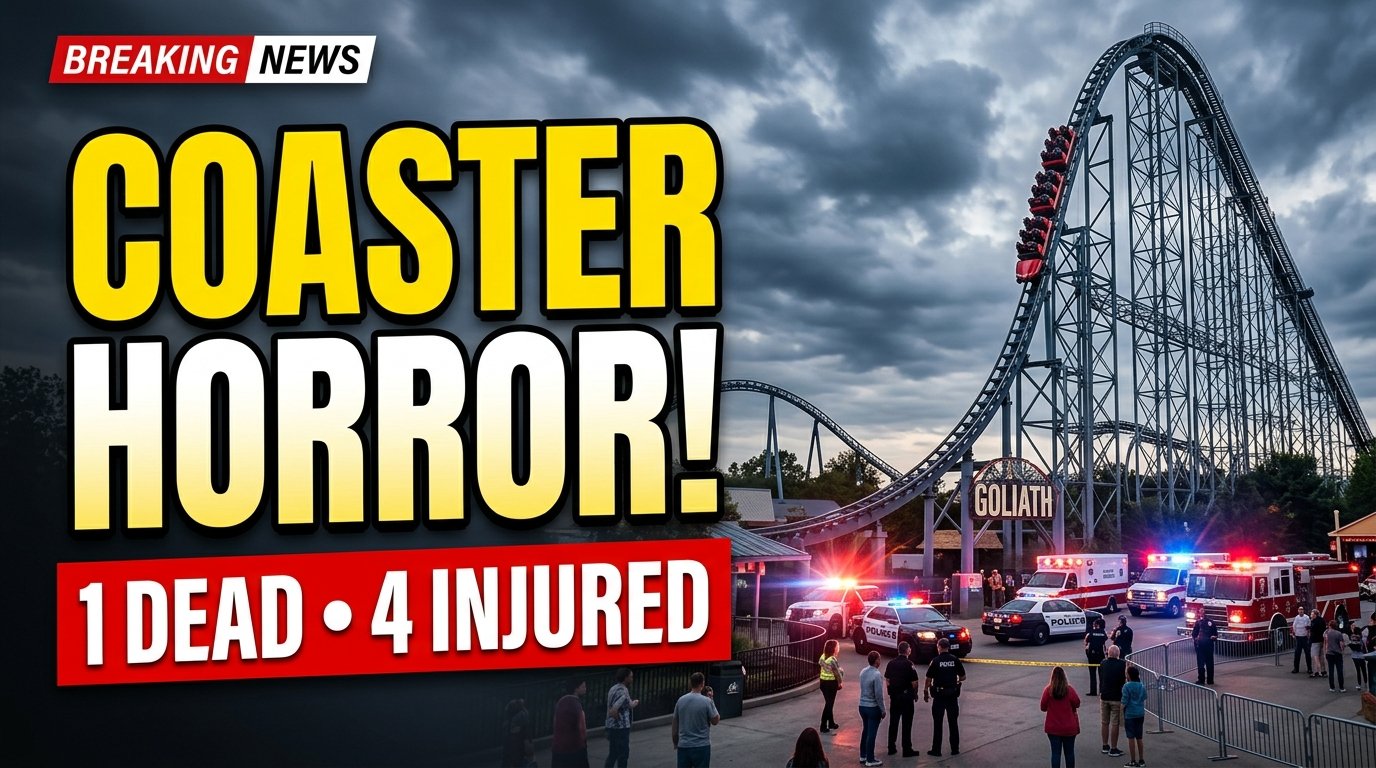
Tragedy Strikes Six Flags Over Georgia: 1 Dead, Multiple Injured in Coaster Fall
You go to an amusement park to feel alive. You strap yourself into a plastic seat, pull down a heavy metal bar, and willingly let a machine hurl you through the air at highway speeds. We do this because we trust the engineering. We trust that the danger is just a very well-executed illusion. But when that illusion breaks, the reality left behind is absolutely devastating.
That’s exactly what happened on a seemingly normal Monday afternoon. On October 12, 2026, the Goliath roller coaster at Six Flags Over Georgia became the site of a horrific accident. One person lost their life, and at least four others were left injured in a chaotic scene that has left the local community reeling and the entire amusement park industry scrambling for answers.
Also read:
El Nino Sets Pacific Temperature Record, Raising Fears for 2027 Extremes
Here is a deep dive into what we know so far about the incident, the heartbreaking accounts from those who were there, and the massive wave of ride closures happening across the continent right now.
The Afternoon Everything Went Wrong
Austell, Georgia, is normally buzzing with the sounds of screaming thrill-seekers and the roar of coaster tracks. It was just before 4:00 p.m. when things took a dark turn on the Goliath. If you’ve never ridden it, the Goliath is a monster of a hypercoaster. It’s built for sheer speed and massive, plunging drops that give you that stomach-dropping sensation of weightlessness—what coaster enthusiasts call “airtime.”
According to the Cobb County Police Department and early reports from park staff, the ride was operating as usual. But somewhere along the track, a male passenger was violently thrown from his seat.
The details are grim. As the man fell from the coaster train, he collided with the massive steel support beams holding the ride together. He eventually landed on the roof of a nearby haunted house attraction. To make a horrific situation even worse, his body reportedly struck other passengers who were still strapped into the moving train as he was ejected. Four of those riders sustained injuries.
Paramedics and park security were on the scene in minutes. Sadly, there was nothing they could do for the man who fell; he was pronounced dead. Meanwhile, park staff had to initiate highly stressful emergency protocols to rescue the remaining passengers trapped on the coaster, many of whom were in a state of sheer shock.
The Trauma Left Behind
When a public tragedy like this happens, the blast radius of trauma extends far beyond the physical injuries. For the families standing in line holding cotton candy, and for the people strapped into that train, the psychological impact is going to leave a lasting mark.
Local news caught up with Logan Conner, a park guest who had the unimaginable misfortune of being on the ride when it happened. He was sitting with his fiancée. His account is enough to make your blood run cold. Conner described seeing the safety mechanisms completely fail. “The man started levitating in the air sideways,” he told reporters. And then, he shared a detail that really grounds the human element of this nightmare: “We made direct eye contact with him.” Just seconds later, the man was gone.
Down on the ground, people waiting in the queue knew something was wrong before the ride even stopped. The screams didn’t sound right. They weren’t the usual shrieks of adrenaline; they were screams of pure panic. In one of the most unsettling twists of the day, several guests who went to check their automated, on-ride souvenir photos realized the camera had actually captured the terrifying ordeal as it unfolded.
A Massive Industry Shake-Up
When something this catastrophic happens, the industry doesn’t just wait around. Six Flags Entertainment Corporation moved fast. Out of sheer caution—and probably a good deal of shock—they indefinitely shut down nine distinct roller coasters across North America. We aren’t just talking about a local closure, either. Major, crowd-pulling rides went dark overnight.
The Goliath in Georgia is obviously closed, but its namesake in California at Magic Mountain was also shut down. In Illinois, Great America’s Raging Bull stopped running. Over in New Jersey, Great Adventure put Nitro on pause. The ripple effect even crossed corporate lines and borders. Kings Island in Ohio closed Diamondback and Orion, while Carowinds down in North Carolina halted Fury 325 and Thunder Striker. Even Canada’s Wonderland up in Ontario wasn’t spared, pulling the plug on Behemoth and The Leviathan.
Why these specific rides? They all share similar hypercoaster engineering or rely on the same type of restraint systems. Park operators aren’t taking any chances. These multi-million dollar attractions will sit completely empty until safety crews and independent mechanical auditors can tear them down and guarantee they are perfectly safe to ride.
Looking for the “Why”
So, how does this actually happen? That’s what the Cobb County Police Department’s Major Crimes Unit is trying to figure out right now. They are working hand-in-hand with specialized forensic teams to trace the exact sequence of events.
The biggest question mark hangs over the restraint system. Hypercoasters usually rely on a heavy, ratcheting lap bar and a secondary seatbelt. The police need to figure out if that metal mechanism snapped or failed mid-ride. Or, alternatively, was it human error? Did ride attendants fail to physically check and lock the restraint before sending the train out of the station? They also have to look at the rider himself. Did he have a medical emergency, or did he somehow try to bypass the safety locks?
Right now, Six Flags is cooperating fully with the cops. The internet is already full of wild theories, but local authorities are begging the public to just wait for the actual engineering reports.
A Troubling Pattern?
You can’t really look at this accident without looking at the broader context. Theme parks have been under a microscope lately.
Just a few weeks ago, Six Flags Magic Mountain quietly retired its legendary X2 coaster. Why? Because they were facing a pile of lawsuits from people claiming the ride’s aggressive, spinning movements caused them to suffer traumatic brain injuries. Add to that a recent wrongful-death settlement Six Flags paid out over a separate 2022 fatality, and a picture starts to form of an industry constantly battling the very real dangers of extreme entertainment. Universal’s Epic Universe also saw a tragedy last year when a rider died from blunt impact injuries on the Stardust Racers coaster. Even though that was ruled an accident, it rattled consumer confidence.
It brings up a bizarre quirk in American law: there is no single federal agency regulating these permanent theme park rides. Unlike airplanes or trains, coaster safety is left up to individual states. It’s a messy patchwork of local rules. A tragedy like the one on the Goliath is exactly the kind of catalyst that makes safety advocates scream for standardized, nationwide federal regulations.
Conclusion
The disaster at Six Flags Over Georgia is a sobering reminder that extreme thrills carry extreme risks. What should have been a weekend of making happy memories ended in a family losing a loved one and several strangers walking away with severe trauma. As mechanical engineers take apart the Goliath piece by piece and detectives interview traumatized teenagers, the whole industry is holding its breath. The fact that roller coasters are sitting silent across the United States and Canada speaks volumes. Finding out exactly why that safety restraint failed isn’t just about assigning blame—it’s about making absolutely sure that nobody else ever drops out of the sky on a sunny afternoon again.
Frequently Asked Questions (FAQs)
What exactly happened on the Goliath coaster in Georgia?
On October 12, 2026, a man was fatally thrown from his seat while riding the Goliath roller coaster at Six Flags Over Georgia. During the fall, he hit the ride’s structure and struck other passengers, causing one death and four injuries.
Why are so many other roller coasters closed right now?
Following the accident, park operators shut down nine similar steel hypercoasters across the US and Canada. They did this out of pure caution because these rides share similar designs and restraint mechanisms. They won’t reopen until they pass intense safety audits.
Who is in charge of the investigation?
The Major Crimes Unit of the Cobb County Police Department is leading the charge, but they are working closely with mechanical engineers and internal safety inspectors from Six Flags.
How do you fall out of a modern roller coaster?
It is incredibly rare. Investigators are looking at two main possibilities: either the lap bar and seatbelt suffered a catastrophic mechanical failure, or there was a human error where the ride attendants didn’t properly secure the passenger before the ride started.
Are theme parks federally regulated in the US?
No, they aren’t. Permanent rides at amusement parks are regulated by state and local governments, which means the safety standards can vary wildly depending on what state you are in.
Trusted News Sources & Official Links:
Associated Press (AP) News: Man falls to his death from a Six Flags roller-coaster in Georgia
9News: Six Flags closes 9 rides across 6 parks after man fell to his death from coaster
CTV News: 1 dead, several injured in incident on Six Flags ride